 DataLLM Lab
The Best Coding LLMs in 2026, Ranked and Tested
There are dozens of "best coding model" lists. Most just reprint whatever benchmark each vendor put in its launch post. This one is built differently: I ranked the field by the one independent benchmark that matters for software work — SWE-bench Verified — cross-checked it against live API prices, and then ran a handful of the models on real coding tasks myself, executing every answer. Here's who actually wins, by job, and exactly what it costs.
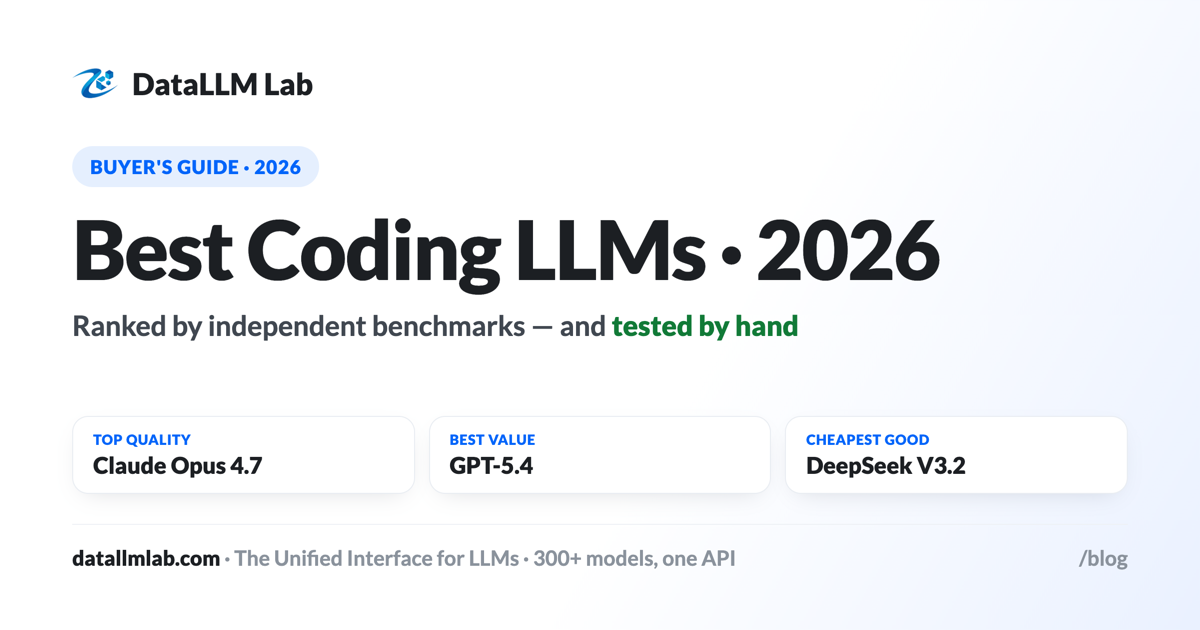
The picks at a glance
If you just want an answer, here it is. Detail and evidence follow below.
| If you want… | Use | On DataLLM Lab |
|---|---|---|
| The best quality, period | Claude Opus 4.8 | Not yet — Opus 4.7 is |
| The best coder you can call today | Claude Opus 4.7 | Yes — $5 / $25 |
| Best value all-rounder | GPT-5.4 · Gemini 3.1 Pro | Yes |
| Cheapest that's still good | DeepSeek V3.2 · Qwen3 Coder Next | Yes |
| Best open-weights (self-host) | DeepSeek V4-Pro · Kimi K2.7 Code | Not yet — K2.6 is |
| Agentic / long-horizon coding | Claude Opus 4.7 · GPT-5 Codex | Yes |
How this ranking is built
Three inputs, in order of trust:
- Independent benchmarks first. The headline ranking uses vals.ai's SWE-bench Verified leaderboard — an independent third party running the same real-world GitHub-issue test on every model. Vendor-published numbers (a model graded on its maker's own benchmark) are treated as marketing, not evidence.
- Real prices. Every price is the live rate from the DataLLM Lab pricing page, not a vendor's list price.
- My own runs. For a reality check I ran several models on three objective coding tasks and executed every answer against a test suite — no vibes, just pass/fail.
The independent leaderboard
Here is the top of vals.ai's SWE-bench Verified board (updated June 13, 2026), with availability and live gateway price added. Higher is better.
| # | Model | SWE-bench Verified | On DataLLM Lab |
|---|---|---|---|
| 1 | Claude Fable 5 | 95.0% | No — suspended |
| 2 | Claude Opus 4.8 | 88.6% | Not yet |
| 3 | GPT-5.5 | 82.6% | Not yet |
| 4 | Claude Opus 4.7 | 82.0% | Yes · $5 / $25 |
| 5 | Gemini 3.5 Flash | 78.8% | Not yet |
The takeaway for buyers: the very top of the board is bleeding-edge and rolling out across providers, but Claude Opus 4.7 — rank #4 independently, and available on the gateway right now — is the highest-scoring coder you can actually call today, essentially level with GPT-5.5. Two more worth knowing, both open-weights and not yet on the gateway: DeepSeek V4-Pro (MIT license, reported around 80.6% SWE-bench Verified on independent boards) and Qwen3.7 Max (~80.4%). And the model with the loudest launch of the month, Kimi K2.7 Code, has no independent SWE-bench score at all yet — a reminder to read the fine print.
I ran several of them myself
Leaderboards are necessary but abstract. So I gave a few models three small, objective tasks and executed the output against a hidden test suite: (1) debug a broken duration parser; (2) implement to spec a word-frequency function with a non-standard tie-break designed to defeat memorized answers; (3) refactor an O(n·k) function to O(n). I ran the cheap, high-volume coders most teams reach for first — all via one API, temperature 0.
✓ Correctness verified by running the code
| On 3 tasks (29 test cases) | DeepSeek V3.2 | Qwen3 Coder Next | Kimi K2.7 Code |
|---|---|---|---|
| Correctness | 29 / 29 | 29 / 29 | 29 / 29 |
| Total cost (measured) | $0.0004 | $0.0007 | $0.0071 |
| Average latency | 4.8 s | 2.2 s | 15.9 s |
| Hidden reasoning tokens | 0 | 0 | 1,295 |
Every model got a perfect score. That's the real headline: on routine coding tasks, correctness is now saturated even among sub-cent models. The separation was entirely in cost and speed — DeepSeek V3.2 solved all three for about four hundredths of a cent, while Kimi K2.7 Code's always-on "thinking" spent ~10× the cost and 7× the time for the same answers. (For the full breakdown of that run, see the Kimi K2.7 Code review.)
Benchmark these on your own code
Opus 4.7, GPT-5.4, Gemini 3.1 Pro, Kimi K2.6, Qwen3 Coder Next, DeepSeek V3.2 and 300+ more — one OpenAI-compatible key, live price comparison, swap models with a one-line change.
Best coding LLM for each job
Top quality Hard, agentic work
- Claude Opus 4.8 leads the independent board at 88.6%. If you can't get it yet, Opus 4.7 (82.0%, on the gateway) is the best you can call today — and the strongest planner and instruction-follower in my experience.
Best value Everyday production
- GPT-5.4 ($2.50/$15) and Gemini 3.1 Pro ($2/$12) — frontier-grade reasoning at a fraction of premium pricing. The default for most code traffic.
Cheapest good Routine tasks at scale
- DeepSeek V3.2 ($0.23/$0.34) and Qwen3 Coder Next ($0.11/$0.80) — both aced my tests for a fraction of a cent. Ideal for high-volume, well-scoped edits.
Open weights Self-host / fine-tune
- DeepSeek V4-Pro (MIT, ~80.6% SWE-bench) is the strongest open coder; Kimi K2.7 Code and Qwen3 Coder are cheaper open options. On the gateway: Kimi K2.6 and Qwen3 Coder Next.
Coding models on DataLLM Lab today
You don't have to pick one. These are the coding-capable models live on the gateway right now, with prices from the pricing page — call any of them with the same key.
| Model | Profile | Context | Price (in / out, per 1M) |
|---|---|---|---|
| Claude Opus 4.7 | Top quality · best planning (SWE-bench 82.0%) | 1M | $5 / $25 |
| GPT-5.4 | Best-value frontier | 1.1M | $2.50 / $15 |
| Gemini 3.1 Pro | Long context, low price | 1M | $2 / $12 |
| GPT-5.3-Codex | Dedicated coding/agent variant | 400K | $1.75 / $14 |
| Kimi K2.6 | Open, general + coding | 262K | $0.68 / $3.41 |
| DeepSeek V3.2 | Cheapest competent (29/29 in our test) | 131K | $0.23 / $0.34 |
| Qwen3 Coder Next | Cheap open coder (29/29 in our test) | 262K | $0.11 / $0.80 |
| Grok Code Fast 1 | Fast, low-cost coding | 256K | $0.20 / $1.50 |
Gateway prices read from DataLLM Lab on June 15, 2026. SWE-bench figure from vals.ai (independent).
How to call any of them
The gateway is OpenAI-compatible, so testing a model on your own code is a one-line change — same endpoint, same key, just swap the model id:
from openai import OpenAI

client = OpenAI(
    base_url="https://www.datallmlab.com/v1",
    api_key="$DATALLMLAB_API_KEY",
)

# Swap the model id to compare — same code, same key
for model in ["anthropic/claude-opus-4.7", "openai/gpt-5.4", "deepseek/deepseek-v3.2"]:
    r = client.chat.completions.create(
        model=model,
        messages=[{"role": "user", "content": "Fix the failing test in this module..."}],
    )
    print(model, r.choices[0].message.content)
Run your own three-task probe like the one above and let the cheapest model that passes win.
FAQ
What is the best coding LLM in 2026?
By independent SWE-bench Verified scores, the order is Claude Fable 5 (95.0%, now suspended), Claude Opus 4.8 (88.6%), GPT-5.5 (82.6%), then Claude Opus 4.7 (82.0%). The best you can call on DataLLM Lab today is Opus 4.7; for value, GPT-5.4 or Gemini 3.1 Pro; for the cheapest competent option, DeepSeek V3.2 or Qwen3 Coder Next.
What is the best open-weights coding model?
DeepSeek V4-Pro (MIT, ~80.6% SWE-bench Verified on independent boards) is the strongest open coder in 2026, with Kimi K2.7 Code and Qwen3 Coder as cheaper open options. On the gateway, the available open coders are Kimi K2.6, Qwen3 Coder Next, and DeepSeek V3.2.
What is the cheapest coding model that is actually good?
DeepSeek V3.2 ($0.23/$0.34 per 1M) and Qwen3 Coder Next ($0.11/$0.80). In our own executed tests both passed all 29 cases across three coding tasks, for a fraction of a cent each.
Do I need a frontier model to write code?
No. In our tests, cheap models solved routine debugging, implementation, and refactoring perfectly. Frontier models earn their price on hard, long-horizon, agentic work — where independent benchmarks like SWE-bench Verified still separate them clearly.
Is Claude or GPT better for coding?
On independent SWE-bench Verified, Claude Opus 4.8 (88.6%) edges GPT-5.5 (82.6%); on the gateway, Opus 4.7 (82.0%) is roughly level with GPT-5.5 and ahead of GPT-5.4. Differences are task-dependent — test both on your own code, which one API key makes easy.
Which coding models are on DataLLM Lab?
Claude Opus 4.7, GPT-5.4 and the GPT-5 Codex variants, Gemini 3.1 Pro, Kimi K2.6, Qwen3 Coder Next, DeepSeek V3.2, and Grok Code Fast — all callable through one OpenAI-compatible key. See the full pricing page.