Hands-on model comparisons, real pricing breakdowns, and cost-optimization playbooks — every number generated through the DataLLM Lab gateway, nothing copied from vendor decks.
Most best-MCP-servers lists still recommend servers that were archived in May 2025 with no security guarantees. Here is the maintained set, a four-gate selection rule, and why the token argument now points at output, not tool definitions.
Read article →
Build an MCP server in Python or TypeScript — the 2025-11-25 spec, the SDK v2 breaking changes landing 27-28 July 2026, and a v1-to-v2 migration table.
Read article →
MCP is now Linux Foundation governed and Skills are an open standard. The 2026 decision rule, the eager-vs-lazy context math, and how the two actually stack.
Read article →
Google ships an official Google Ads MCP server, and it cannot write. What Claude really does with it, the two auth systems, and why context beats quotas.
Read article →
A primary-source guide to MCP security as of July 2026: what the 2025-11-25 spec actually requires, the four verified real-world incidents, and why the reader is the audit layer.
Read article →
MCP and RAG are different layers, not rivals. A numbers-first comparison: the 200k-token skip-RAG threshold, the 55k-token tool tax, and when to combine both.
Read article →
The 2025-11-25 MCP spec inverted remote auth: Dynamic Client Registration is now MAY, Client ID Metadata Documents are the SHOULD. A dated comparison, a decision rule, and an ops checklist.
Read article →
The official MCP Registry hosts metadata only, is still in preview, and verifies publishers - not endpoints. What to check before you trust a server entry.
Read article →
Both MCP and A2A are Linux Foundation projects now. A layer-by-layer comparison, the Task naming collision, and why A2A adoption is invisible by design.
Read article →
n8n ships three distinct MCP surfaces, not two. Source-verified parameter names, the stale-docs trap, the SSE deprecation half-truth, and a falsifiable rule for when not to use n8n as your MCP server.
Read article →
Zapier MCP does not flood your context — by default it exposes 15 meta-tools. The real meter is tasks: 2 per call, exactly double a Zap action step.
Read article →
A primary-source guide to MCP authentication as of July 2026: why authorization is optional, why DCR is on the way out, the scope rule most guides quote at half length, and the two-token rule.
Read article →
MCP client, server and host are three jobs held per connection, not three kinds of app. A role-first guide that survives the 2026-07-28 spec revision, with a decision rule.
Read article →
An AI agent harness is everything around the model. See the two-sided evidence that it is the real lever, a component-to-MCP map, and a build checklist.
Read article →
We ran Kimi K3 on launch day. Here is what is independently verified, what is vendor-reported, and where its cost really lands.
Read article →
Kimi K3 is Moonshot AI frontier MoE with a 1M context. Learn the model id, the real 3 dollar/15 dollar pricing, drop-in OpenAI-compatible code, and our launch-day cost data.
Read article →
LM Studio Bionic is a local-first AI agent app for open models. What it does, how it beats and differs from Claude Code, Cursor and Ollama, plus the two open models it names and what they actually cost in our benchmark.
Read article →
xAI's Grok Voice Agent Builder is a no-code layer over Grok Voice with a single speech-to-speech path, native MCP, telephony and ~$0.06/min all-in pricing. What it is, how the MCP hook wires to an external gateway, and the honest limits.
Read article →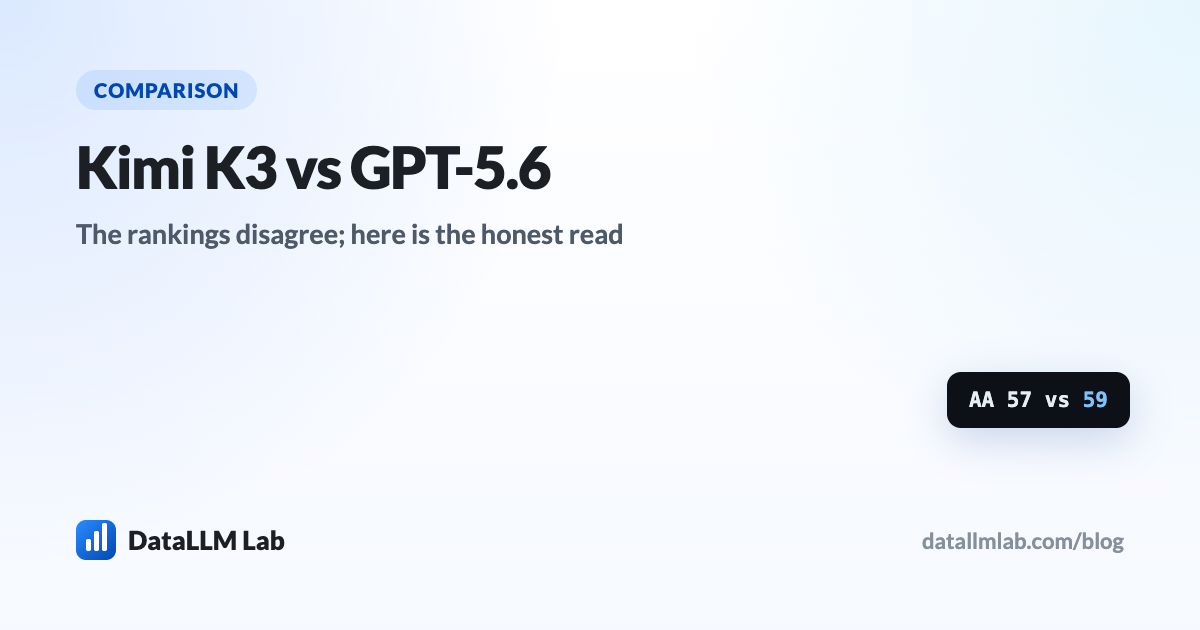
Kimi K3 vs GPT-5.6 Sol compared on independent rankings, vendor claims and a DataLLM Lab launch-day cost-per-task run. Cheaper open-ish K3 vs the higher-scoring Sol.
Read article →
An honest review of GPT-5.6 Sol, the flagship tier of OpenAI three-model family, separating vendor claims from independent benchmarks and testing its premium price against a first-party cost-per-outcome analysis.
Read article →
Grok 4.5 vs GPT-5.5 compared across three evidence layers: vendor SWE-Bench Pro, independent Artificial Analysis, and a first-party executed run. The real axis is cost per completed task, not the leaderboard.
Read article →
A verified, current guide to MCP Inspector: npx setup, the 6274/6277 ports, session-token auth, UI vs CLI mode, remote-server testing, and the failure modes it surfaces after the CVE-2025-49596 security overhaul.
Read article →
Seed Audio 1.0 is ByteDance Seed's all-in-one text-to-audio model that renders dialogue, music, ambience and SFX in one pass. API-verified specs, normalized reseller pricing, and an honest note on the missing benchmarks.
Read article →
An MCP gateway puts many MCP servers behind one endpoint with central auth, tool allow-lists and audit. Here is how it differs from an LLM gateway, and when you can skip it.
Read article →
Kimi K3 beat Claude Fable 5 on the blind Frontend Code Arena vote while Fable 5 leads the Artificial Analysis Intelligence Index. Plus our first-party launch-day cost run: K3 lands in Opus-4.8 price territory, not budget territory.
Read article →
A field-by-field map of LLM function calling: the tool-use loop, OpenAI vs Anthropic schema shapes, strict mode, parallel calls, MCP, and how to A/B tool quality on one key.
Read article →
A verified engineering guide to streaming LLM output: OpenAI-compatible chat.completions deltas in Python and JS, Anthropic Messages events, tool calls, mid-stream errors, cancellation, and the usage-token gotchas.
Read article →
A license-accurate guide to LLM observability in 2026: what to instrument, the OpenTelemetry GenAI span names, and an honest Langfuse vs Phoenix vs Opik vs Helicone vs LangSmith matrix.
Read article →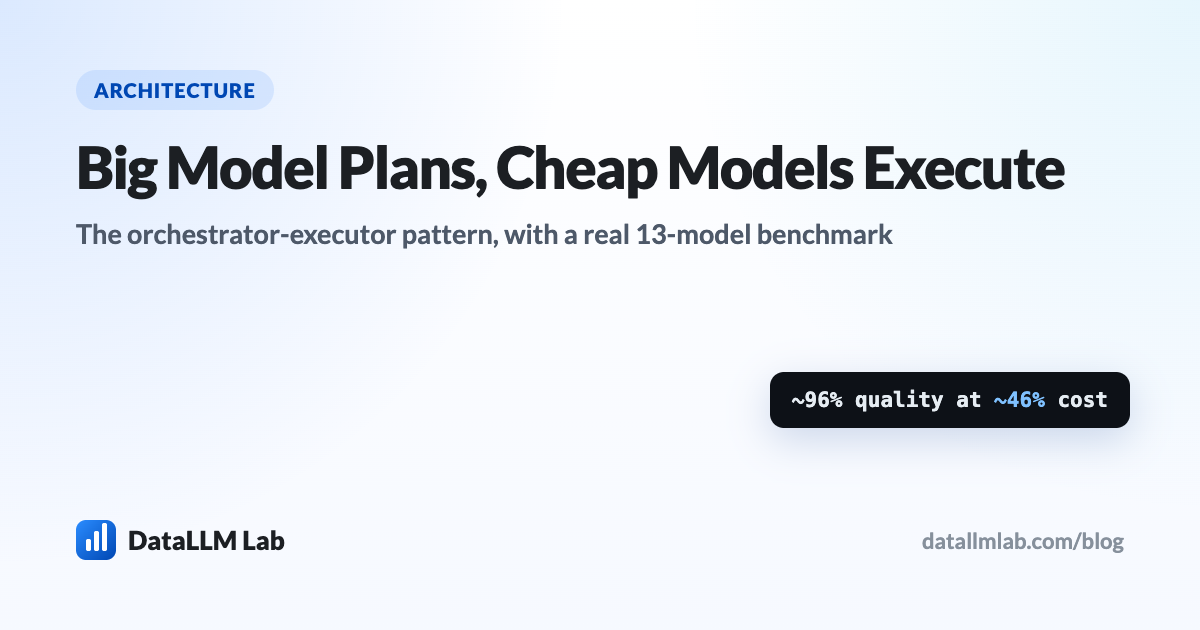
The viral pattern where a frontier model plans and cheap models do the work — separated cleanly from the advisor variant, with a first-party 13-model benchmark, a worked cross-vendor cost example, and the honest counter-evidence on when mixing loses.
Read article →
A no-hype comparison of GPT-5.6 (Sol, Terra, Luna) and Claude Opus 4.8 on price, context, and real coding and agent benchmarks, with a computed cost-per-1000-turns example.
Read article →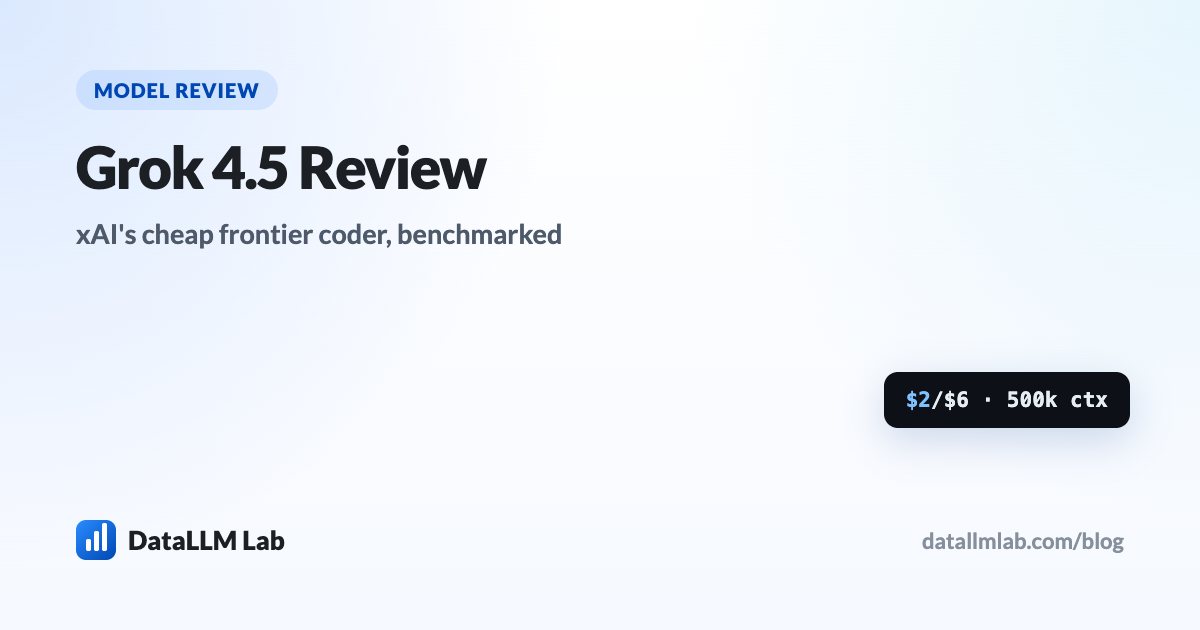
An independent, price-normalized Grok 4.5 review: Intelligence Index 54, 2 dollars in and 6 out per 1M, plus a cost-per-completed-task table against Opus 4.8, GPT-5.5 and Fable 5.
Read article →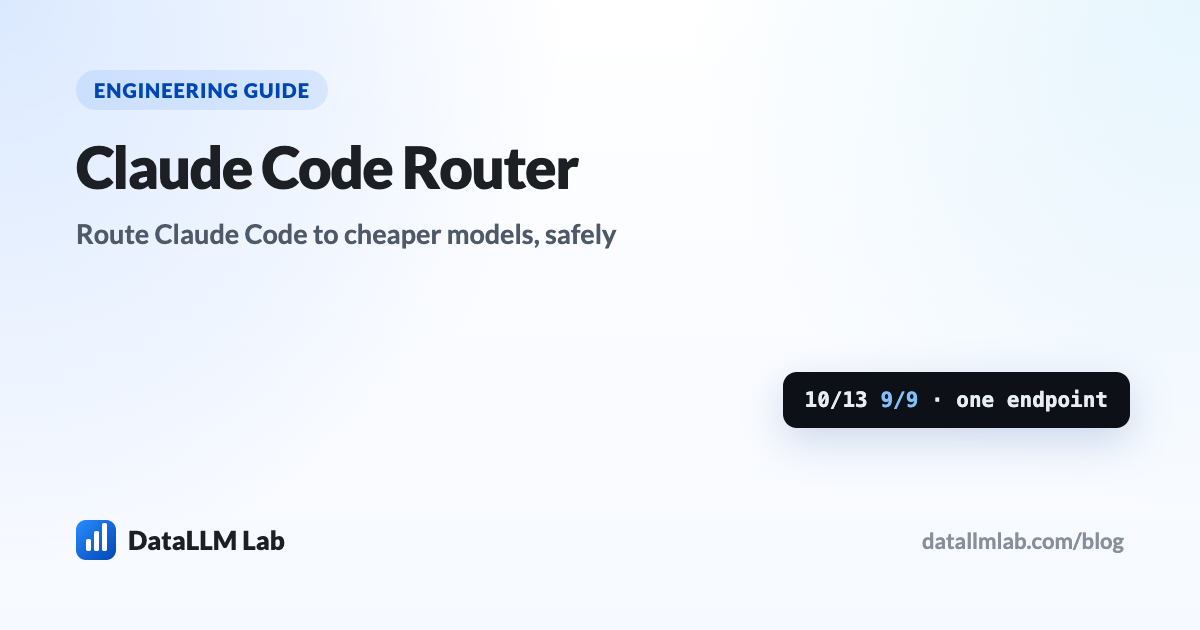
What Claude Code Router is, how the proxy and transformers route Claude Code to DeepSeek, Qwen, GLM and more, plus our benchmark proving 10 of 13 cheap models hit a perfect score.
Read article →
MCP does not replace REST or LLM APIs — it wraps them so a model can discover and call tools at runtime. Architecture, primitives, a real JSON-RPC exchange, and when to use each.
Read article →
You cannot make an LLM stop hallucinating, but you can engineer around it. The 2025 research on why it happens, a technique-vs-failure-mode table, and model choice as routing.
Read article →
A practical, lever-by-lever guide to cutting LLM latency, anchored by a first-party benchmark where the fastest model finished in 2.9s versus 19s for heavy reasoners on identical tasks.
Read article →
Context engineering is the discipline of curating what goes into an LLM context window. Learn the practices, a token-budget model, and how to ship it across 300+ models.
Read article →
Chroma tested 18 models across 194,480 calls and every one degraded as input grew — well before the window filled. The real failure modes, why NIAH lies, and the fixes.
Read article →
Spec-driven development makes the spec the source of truth that the agent implements to. How SDD differs from vibe coding and TDD, the tools, and when to skip it.
Read article →
Vibe coding vs agentic coding, untangled. Why the trap debate is really about autonomy without review, plus first-party benchmark data showing why the harness beats the model.
Read article →
A practical guide to Claude Code hooks: the lifecycle events, the five handler types, real settings.json recipes, and how hooks differ from skills now that slash commands have merged into skills.
Read article →
How prompt caching works across Anthropic, OpenAI and Gemini, the real pricing shapes, a break-even rule, and the anti-patterns that silently kill your cache hit rate.
Read article →
OpenClaw is a self-hosted, open-source personal AI assistant that lives in your chat apps. Here is how it works, why model-agnostic routing matters, and the honest security trade-offs.
Read article →
An honest review of Ornith 1.0, DeepReinforce open-source agentic coding model. Self-scaffolding RL, four sizes, vendor benchmarks, and where it fits on cost.
Read article →
A skeptical review of Sakana Fugu, the multi-agent orchestration model. Vendor-reported benchmarks, real cost and latency, and a first-party rule for when orchestration overhead is worth paying.
Read article →
Cursor, Copilot, Windsurf, Replit and Claude Code all moved to usage or credit metering. Here is why it happened, what users complain about, and how to regain cost control with transparent per-token routing.
Read article →
METR found experienced devs 19% slower with AI on mature repos, yet they felt 20% faster. Here is when AI coding speeds you up vs slows you down, with the data.
Read article →
Watermelon is Meta Superintelligence Labs internal codename for the next model after Muse Spark. It is still in training with zero published benchmarks. Here is what is verified, what is not, and how to read the GPT-5.5 parity claim.
Read article →
Z.ai is the international brand of Zhipu AI, the Tsinghua-spun-out Chinese lab behind the open-weights GLM model family. Here is what Z.ai is, where GLM-5.2 fits, what it costs, and how it scored in our own executed coding benchmark - 9/9 at
Kimi K2 Thinking is Moonshot AI 1T-parameter open-weights reasoning model. We cover its specs, vendor benchmarks, and a first-party executed-cost datapoint for the newer K2.7-Code.
Read article →
A Claude Code Skill is a folder with a SKILL.md that Claude loads on demand. How Skills differ from MCP and slash commands, how to build and install one, and where to find good ones.
Read article →
What AGENTS.md is — an emerging open convention that tells AI coding agents how to work in your repo. What goes in it, which tools read it, and how it differs from README and CLAUDE.md.
Read article →
The 2026 local-LLM stack decoded — Ollama, llama.cpp, LM Studio and vLLM compared, what hardware and VRAM you need, picking a quantization, and when the API is honestly cheaper.
Read article →
MiMo-Code is Xiaomi's terminal-native coding agent (a fork of OpenCode), not a model — what it does, its license, the underlying open-weight MiMo models, and how it compares.
Read article →
Token bills on coding agents are exploding — the highest-impact fixes ranked: prompt caching, context editing, memory files, cheaper models for routine steps, and gateway routing, with a worked before/after cost example.
Read article →
An emerging practice — instead of prompting a coding agent turn-by-turn, you design the plan-act-verify loop it runs, with review gates and hard stops. The core idea, the patterns, and the failure modes.
Read article →
Add any OpenAI-compatible model provider to Dify — the model-provider settings, base URL plus API key, the OpenAI-API-compatible plugin, and how outputs are consumed. Setup and troubleshooting tables.
Read article →
Add DeepSeek to Cursor via the custom OpenAI-compatible model settings — base URL, key and model id — plus the agent-mode caveat and a one-key gateway alternative.
Read article →
How to configure a chat model in LangChain — set the API key env var, use init_chat_model or ChatOpenAI with a custom base_url, and point one key at a gateway for every model.
Read article →
Pull and run Qwen3-Coder with Ollama — the 30B and 480B tags, quantization sizes, VRAM you actually need, and an honest call on when the hosted API is cheaper and faster.
Read article →
What Aider is, how to install it, and how to point Aider chat at any model with --model, API keys, and an OpenAI-compatible base URL — plus a config table and a /commands cheat sheet.
Read article →
GPT-5.6 is OpenAI's new three-model family — Sol, Terra and Luna. Confirmed release timeline (preview June 26, GA July 9 2026), official per-model pricing, context windows and how to access it.
Read article →
GPT-5.6 (Sol, Terra, Luna) launched July 9 2026. OpenAI says Terra matches GPT-5.5 at 2x lower cost. The real capability and price deltas, plus an honest upgrade call.
Read article →
An honest Grok 4.3 review — we ran xAI's 1M-context model through our executed coding benchmark (8/9). Real cost, vendor vs independent benchmarks, strengths and weaknesses.
Read article →
GLM 5.2 review: we ran Z.ai's 753B open-weights model through our executed 9-task coding benchmark. It scored 9/9 at about
A review of Nvidia Nemotron 3 Ultra — the 550B-total / 55B-active open-weight LatentMoE model. License, size, self-host reality, vendor benchmarks, and who it is for.
Read article →
An honest Mistral Medium 3.5 review — we ran it through our executed coding benchmark (9/9, fastest we tested). Official
A world model is a learned, interactive simulation an agent can act inside and predict — how it differs from an LLM and a text-to-video model, the key systems (Genie, Cosmos, Marble), and why it matters for robotics and agents.
Read article →
What Nano Banana costs and how it works — Google Gemini image models Nano Banana Pro (gemini-3-pro-image), Nano Banana 2 (gemini-3.1-flash-image) and Lite, their per-image token pricing, features, and how to call them.
Read article →
The leading text-to-image models compared on quality, price unit, editing, API access and license — Nano Banana, GPT Image, Imagen 4, FLUX and Midjourney, with a decision framework. Prices as of July 2026.
Read article →
The leading text-to-video models in 2026 compared on max clip length, resolution, native audio, access and per-second price — Google Veo 3.1, OpenAI Sora 2, ByteDance Seedance 2.0 and Kuaishou Kling 3.0, with figures quoted from primary sources.
Read article →
Sora 2 pricing, decoded — what ChatGPT Plus and Pro include, the OpenAI API price per second of video, the 720p/1080p tiers, and the honest cost-per-clip math.
Read article →
What a JSON prompt for Veo 3 and Sora 2 actually is, why the structured pattern is a community convention (not an official schema), a field-by-field schema table, and two copy-paste JSON examples.
Read article →
Why Claude shows rate exceeded and the API returns 429 rate_limit_error — the causes, the retry-after fix, tier RPM/ITPM/OTPM limits, the prompt-cache lever, and failover.
Read article →
The real gpt-oss-120b memory requirements — a VRAM-by-setup table, consumer-GPU offload options, and self-host vs API cost math. It is MoE (5.1B active), so it runs faster than a dense 120B.
Read article →
Claude overloaded error, Anthropic 529, the model is overloaded on Gemini, and chat completion api provider returned error — a cross-provider decoder of capacity 529/503 vs your 429 quota, fixed with retry, backoff, and failover.
Read article →
On 2026 adaptive-thinking Claude models the temperature, top_p and top_k sampling parameters are removed and return a 400 error. Here is why you cannot turn temperature up, which older models still accept it, and what to use instead.
Read article →
Grok is xAI's family of LLMs (from Elon Musk and X). Groq is an inference-hardware company that runs open models fast on LPU chips. Here is the side-by-side, and which one you actually meant.
Read article →
Step-by-step to create a Grok API key from the xAI console, the OpenAI-compatible base_url, current Grok model ids and pricing, plus a one-key gateway alternative with failover.
Read article →
What the sequential-thinking MCP server is, how to add it with claude mcp add, and a decision table for when explicit step-by-step MCP reasoning beats Claude built-in extended thinking.
Read article →
Claude is Anthropic's model; Cline is an open-source coding agent that runs a model. The real question is which model to run in Cline — and how to plug Claude in cheaply.
Read article →
The Claude context window and max output tokens per model — Opus 4.8, Sonnet 5, Fable 5 and Haiku 4.5. The context-vs-max_tokens distinction, the 1M window, and how to use it.
Read article →
The honest answer — claude.ai has a real free plan with message limits, the API has no ongoing free tier (only trial credits), and Haiku 4.5 plus caching is the cheapest paid route.
Read article →
How to get guaranteed-valid JSON from Claude — the structured outputs feature (output_config.format and messages.parse), strict tool schemas, and why reply-in-JSON prompting is unreliable.
Read article →
Compare Claude 4.5 to ChatGPT-5 as they exist now — Claude Opus 4.8 and Sonnet 5 vs OpenAI GPT-5.5 and GPT-5.4 — on coding, reasoning, price, context, and a use-case decision framework.
Read article →
Two different Grok limits — the X/Grok consumer app weekly usage pool (free vs SuperGrok) and the xAI API rate limits (RPS/TPM by spend tier) — plus how to get more.
Read article →
GPT-4o is the fast multimodal model; o1 is the deliberate reasoning model. The clear 2026 comparison — specs, prices, when to use each — plus the honest update that GPT-5.x now supersedes both.
Read article →
What Z.ai's GLM Coding Plan is, how its Lite/Pro/Max tiers work with Claude Code and Cline, how it compares to paying per token, and how to run GLM via a gateway.
Read article →
Gemma is Googles family of open-weight, self-hostable models; Gemini is Googles closed API flagship. Different tools for different jobs — sizes, license, cost, and which one you actually need.
Read article →
DeepSeek R1 vs gpt-oss on license, size, self-host footprint, and reasoning approach — 671B MoE under MIT vs a 117B Apache-2.0 MXFP4 model that fits one 80GB GPU.
Read article →
A practical reference for text-embedding-3-small — its 1536 default dimension, the Matryoshka dimensions parameter, $0.02 per 1M tokens, 8192 max input, MTEB score, and how it compares to text-embedding-3-large and gemini-embedding-001.
Read article →
A buyer roundup of embedding models — OpenAI text-embedding-3-small and 3-large, Google gemini-embedding-001, and top open models (Qwen3, BGE-M3, E5) compared by dimensions, price, max input, and MTEB.
Read article →
Get a Gemini API key in Google AI Studio in under a minute — the exact create-key steps, what the free tier covers, when to move to paid, the OpenAI-compatible endpoint, and a one-key gateway alternative.
Read article →
Add a payment method and buy prepaid credits on the OpenAI billing page, set auto-recharge, learn the $5 minimum and 1-year expiry — plus the one-balance alternative.
Read article →
Gemini 2.5 Pro vs Claude 4 Opus, mapped to the current Gemini 3.1 Pro and Claude Opus 4.8 and Sonnet 5 — coding, reasoning, context and price compared side by side, with a use-case decision guide.
Read article →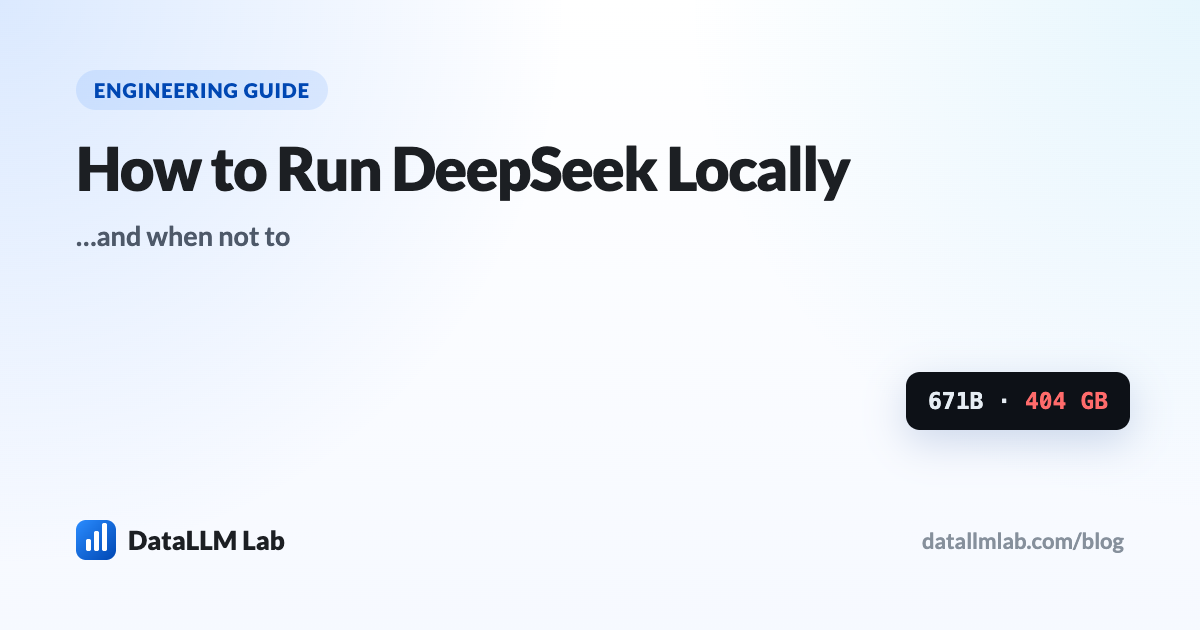
An honest guide to running DeepSeek locally — which distills fit your GPU, real VRAM and RAM needs for the full 671B model, the quantization trade-off, and when the API is far cheaper.
Read article →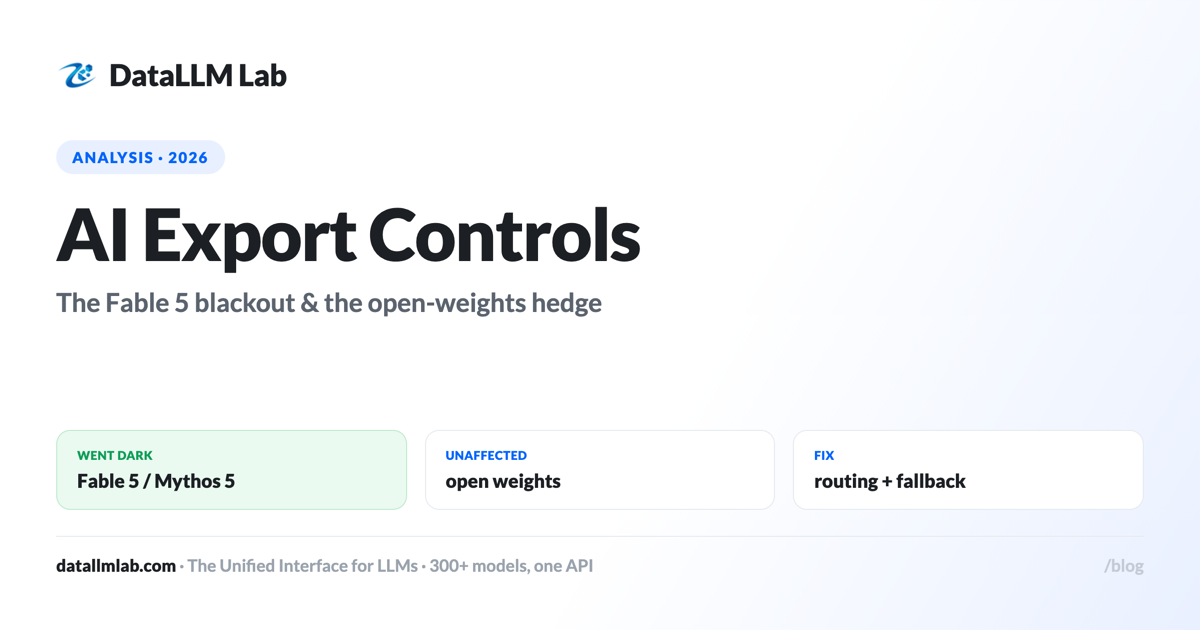
When Claude Fable 5 vanished worldwide for 18 days under a US export-control order, open-weights models kept running. Here's how AI export controls work, what they can and can't touch, and how to hedge availability risk.
Read article →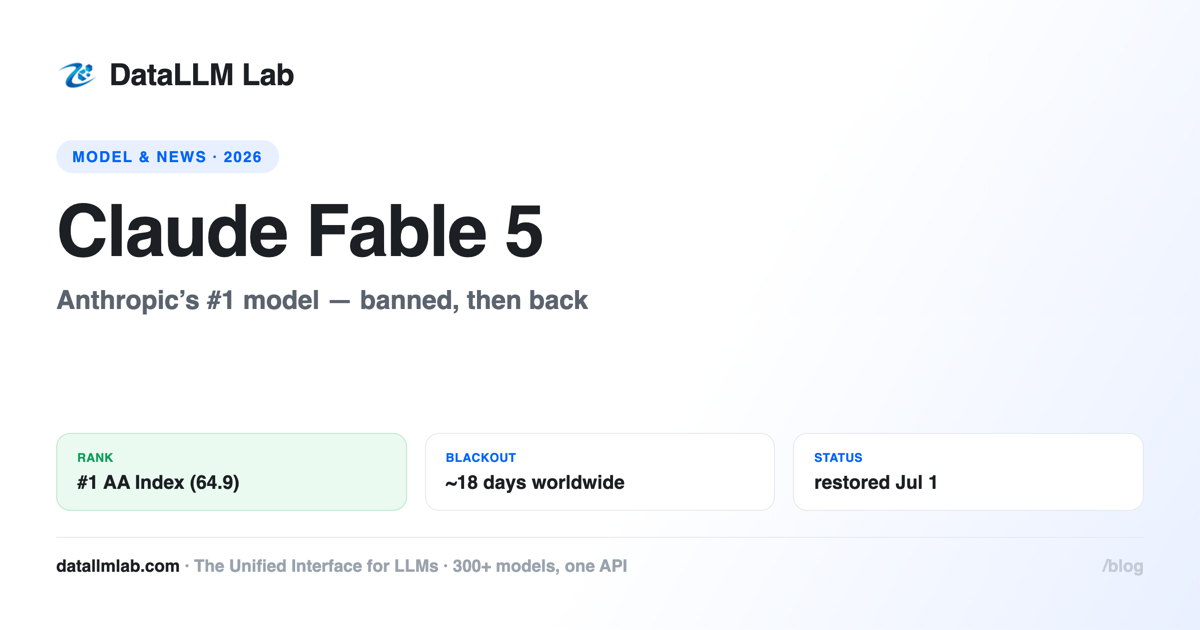
Claude Fable 5 is Anthropic's top frontier model - #1 on the Artificial Analysis Index at 64.9. It was suspended worldwide for ~18 days under a US export-control order, then restored on July 1, 2026. The full story, status, and what it means.
Read article →
DataLLM Lab is a unified LLM gateway and an evidence-based blog about language-model cost and capability. Who we are, who writes it, and the editorial standards behind every number we publish.
Read article →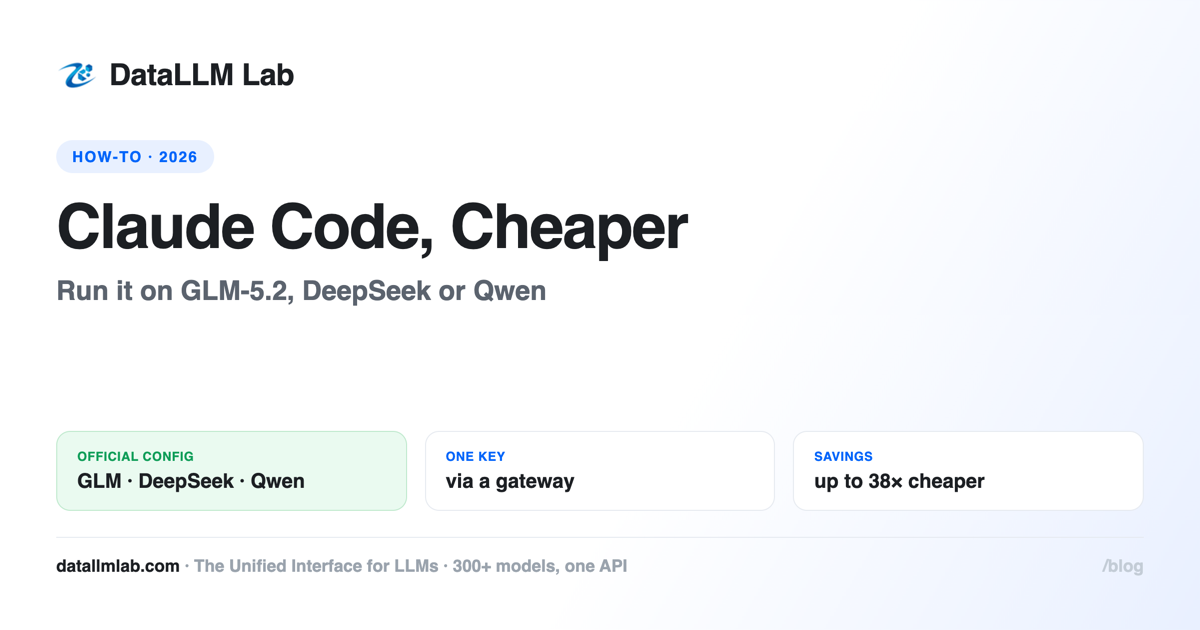
Run Anthropic's Claude Code on cheaper models. Verified, copy-paste config for GLM-5.2 (Z.ai), DeepSeek and Qwen via their official Anthropic endpoints, or any model through one gateway - plus the real cost savings, tested.
Read article →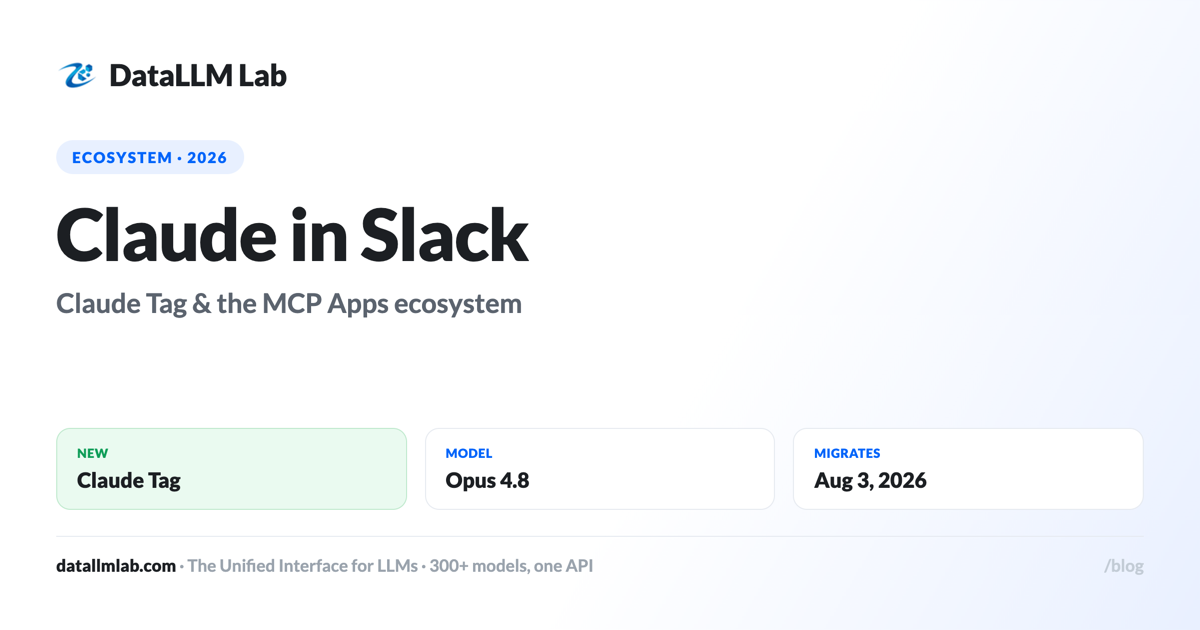
Claude in Slack is becoming Claude Tag - Anthropic's persistent, multiplayer @Claude teammate (launched June 2026, runs on Opus 4.8). What it does, spend controls, the MCP Apps ecosystem, the Aug 3 migration, and how to build your own.
Read article →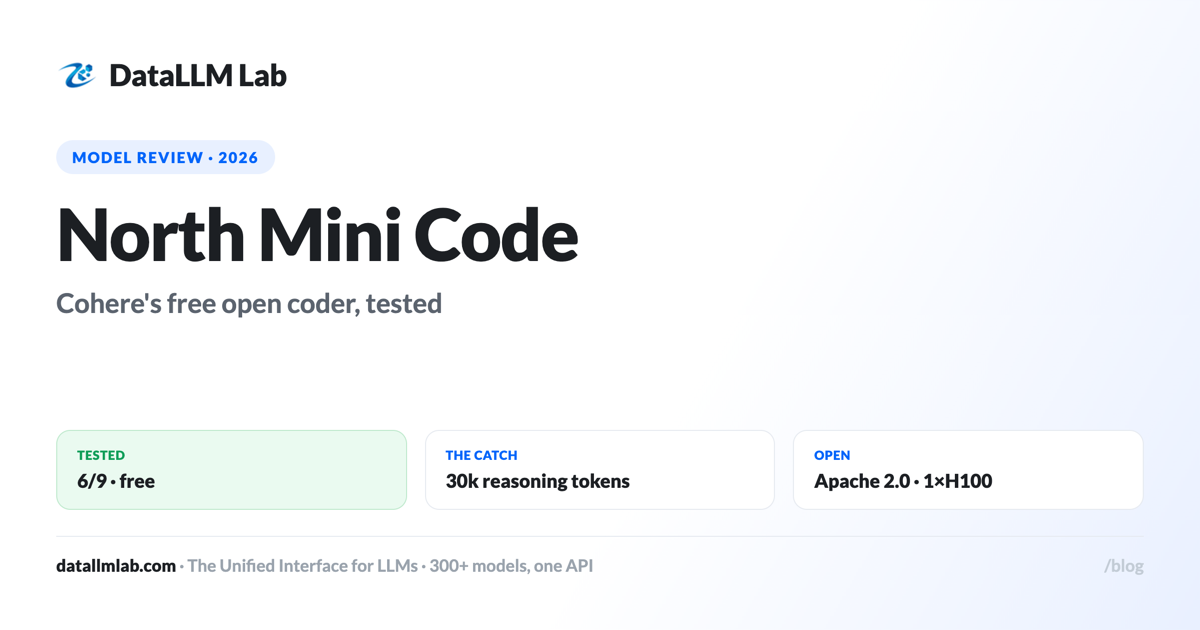
Cohere North Mini Code review: a free, Apache-2.0 coding model with only 3B active params. We ran it on real coding tasks - capable and free to self-host, but it over-thinks hard: 30,000+ reasoning tokens and very slow.
Read article →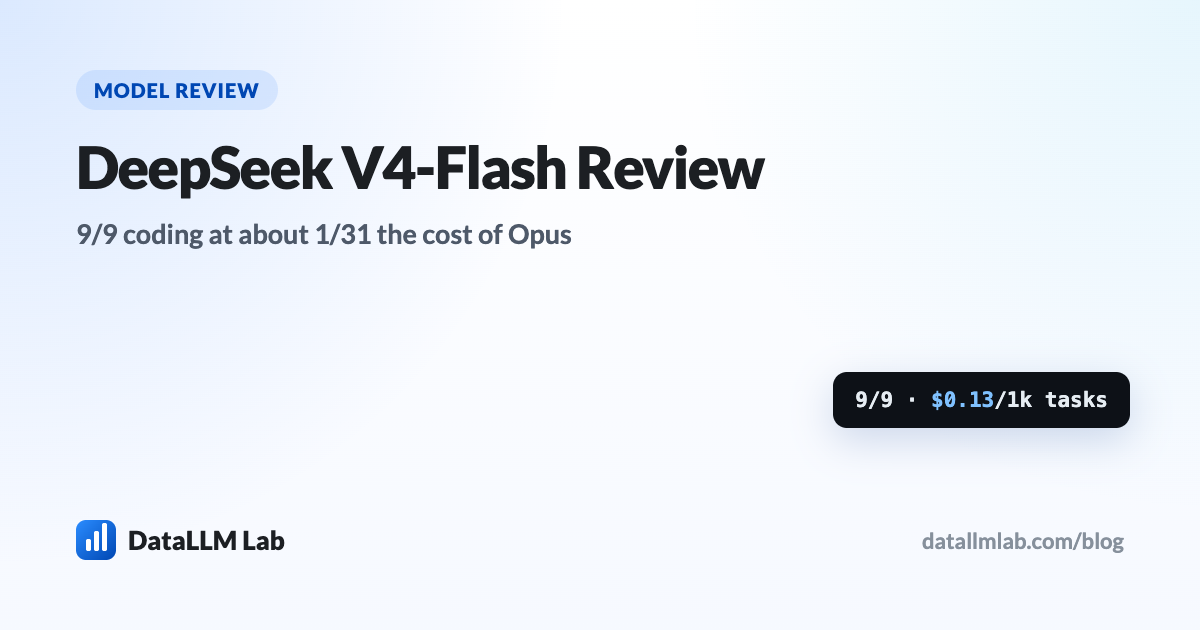
DeepSeek V4-Flash review: in our executed coding test it matched Claude Opus 4.8's perfect score at about 1/31st the cost - and beat its bigger sibling V4-Pro. Specs, real pricing, benchmarks, and who should use it.
Read article →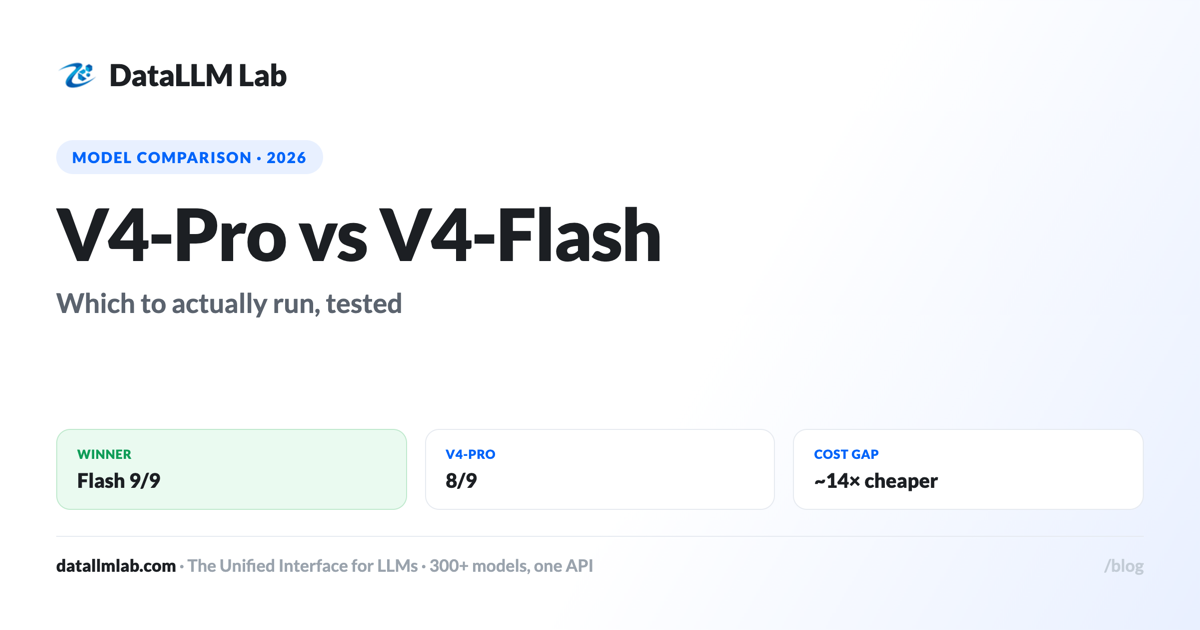
DeepSeek V4-Pro vs V4-Flash: we ran both on the same coding tasks. Flash scored higher (9/9 vs 8/9) at about 1/6th the cost. When the big model is worth it, when it is not, with real numbers.
Read article →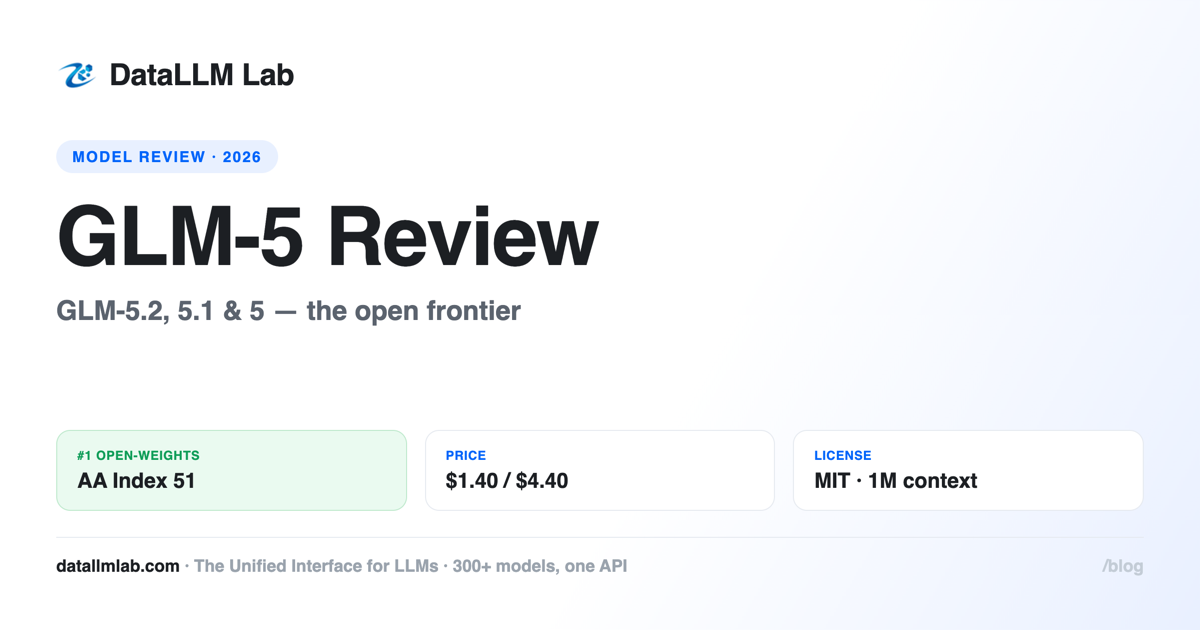
GLM-5 review: Zhipu/Z.ai's GLM-5.2 is the #1 open-weights model on the independent Artificial Analysis Index, MIT-licensed, 1M context, at
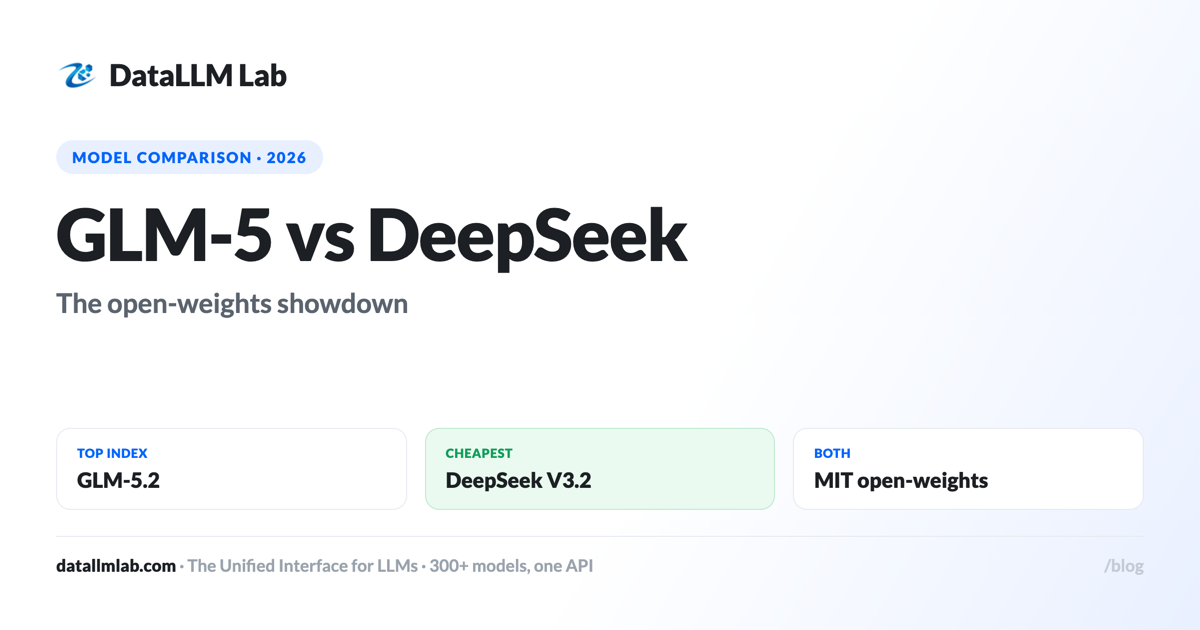
GLM-5.2 vs DeepSeek: both open-weights and MIT-licensed. GLM-5.2 leads the open Artificial Analysis Index; DeepSeek is cheaper per token. Benchmarks, modeled costs, and which to pick.
Read article →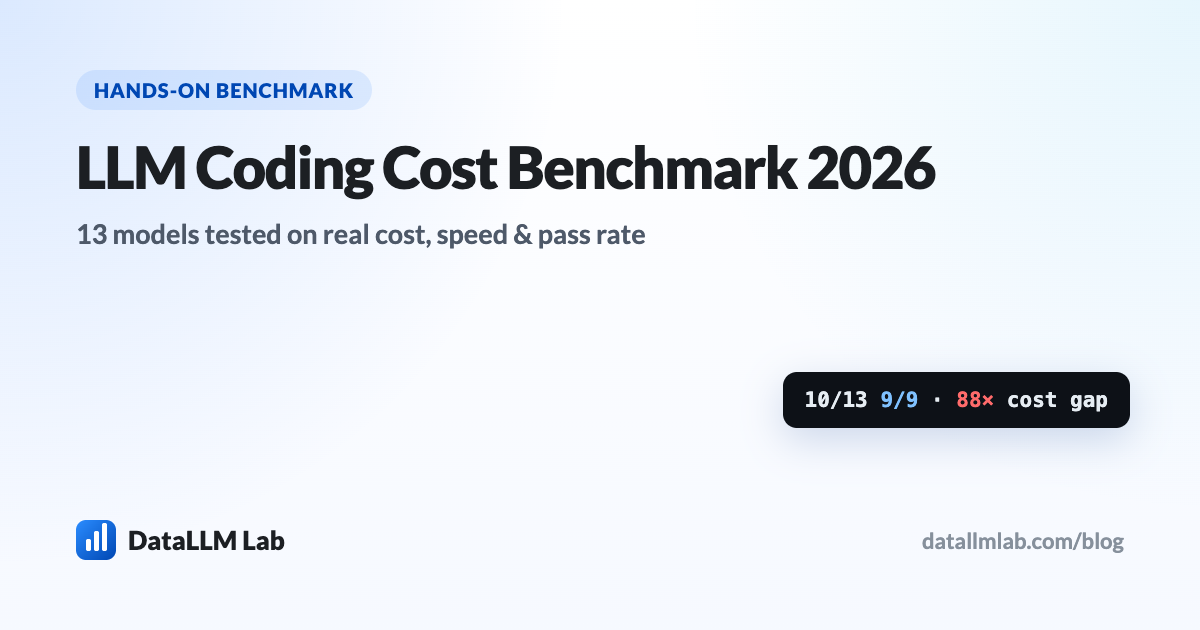
We ran 13 models on the same nine executed coding tasks and measured real cost, speed and pass rate. 10 of 13 aced it, so the gap that matters is cost: 88x between the cheapest and priciest for the same score.
Read article →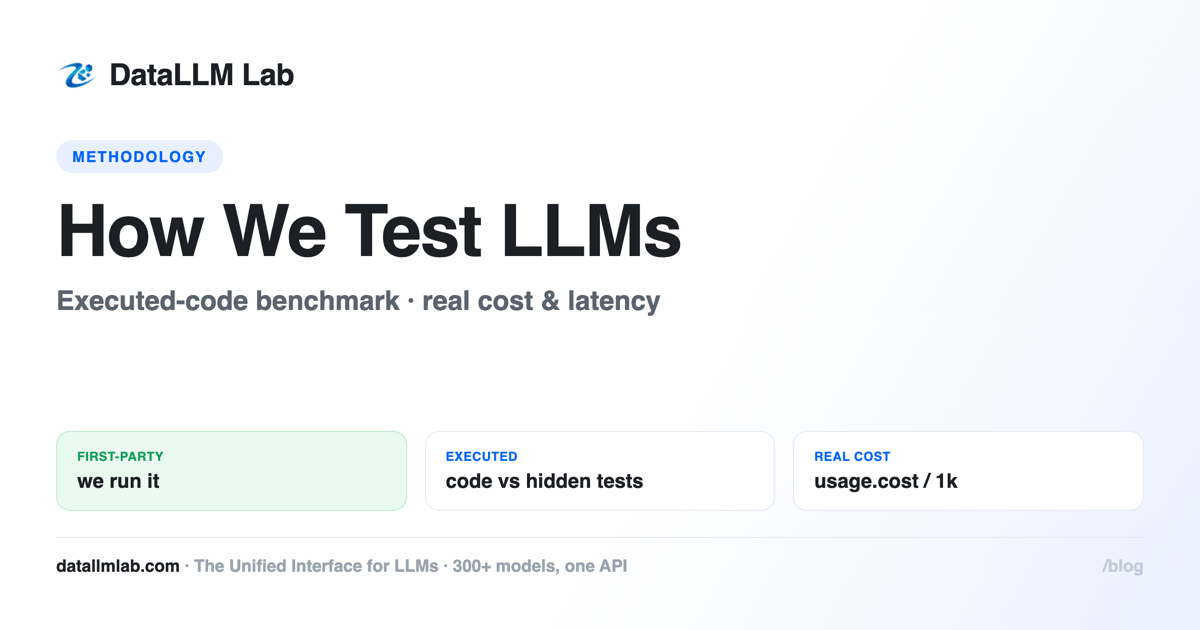
How DataLLM Lab tests language models: a reproducible, executed-code coding benchmark with real billed cost, latency and pass rates - plus the principles we follow (independent numbers, vendor claims labeled, no fabrication).
Read article →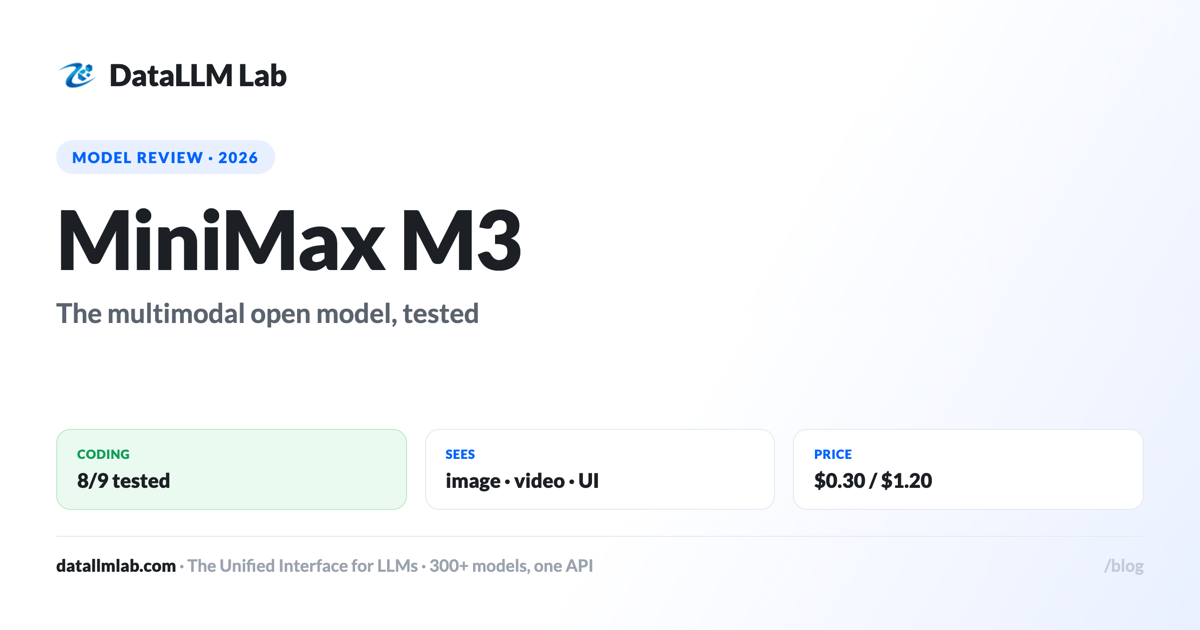
MiniMax M3 review: a cheap open model with native image/video input and computer-use. In our executed coding test it scored 9/9 at about $0.90 per 1,000 tasks - but it is a heavy reasoner. Specs, pricing, and where it fits.
Read article →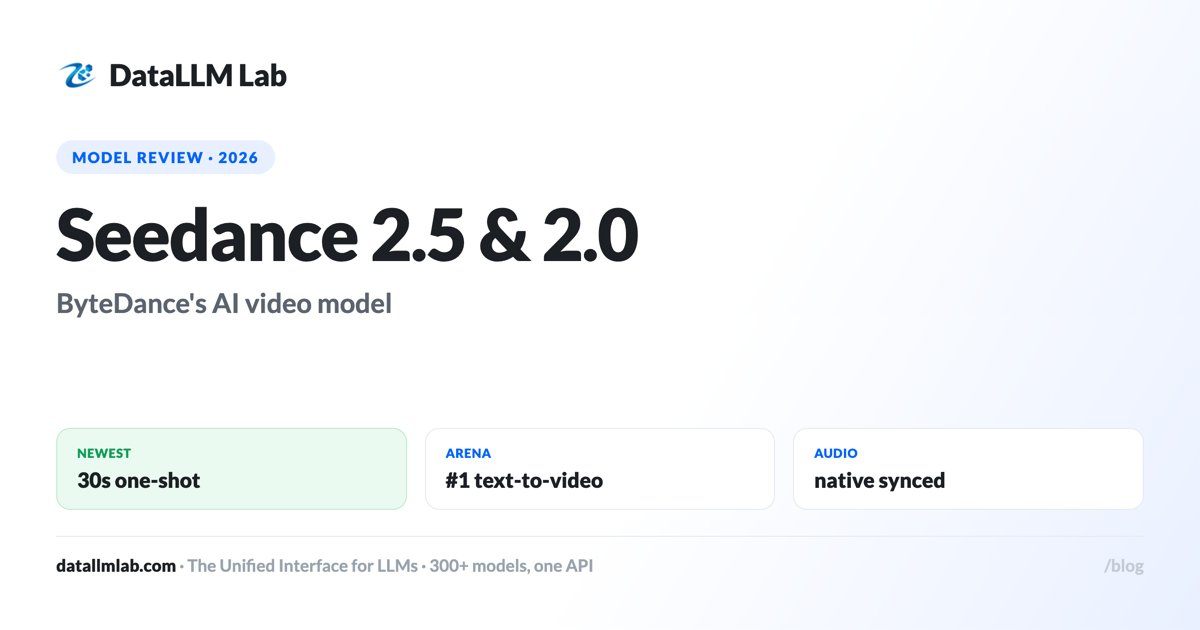
Seedance review: ByteDance's Seedance 2.5 (announced June 2026) does 30-second one-shot video; Seedance 2.0 is #1 on the Artificial Analysis video arena. Versions, specs, real per-second pricing, and access.
Read article →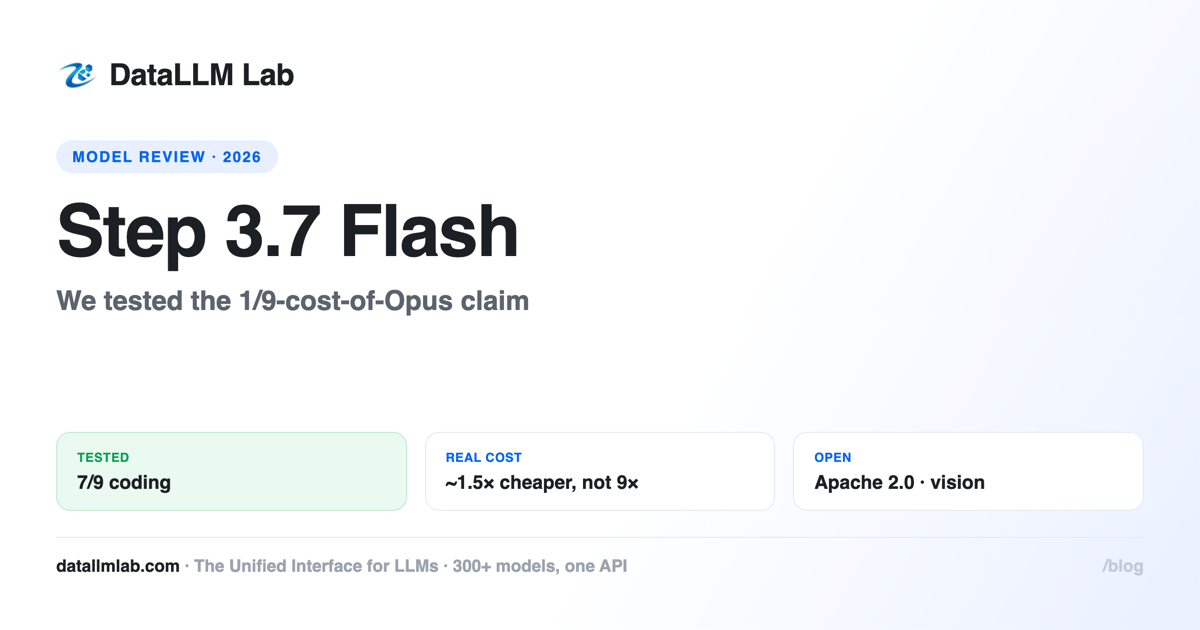
Step 3.7 Flash review: StepFun's open Apache-2.0 198B MoE claims 97% of Claude Opus coding at 1/9 the cost. We ran it on real coding tasks - the per-token price is low, but verbosity makes the per-task story very different.
Read article →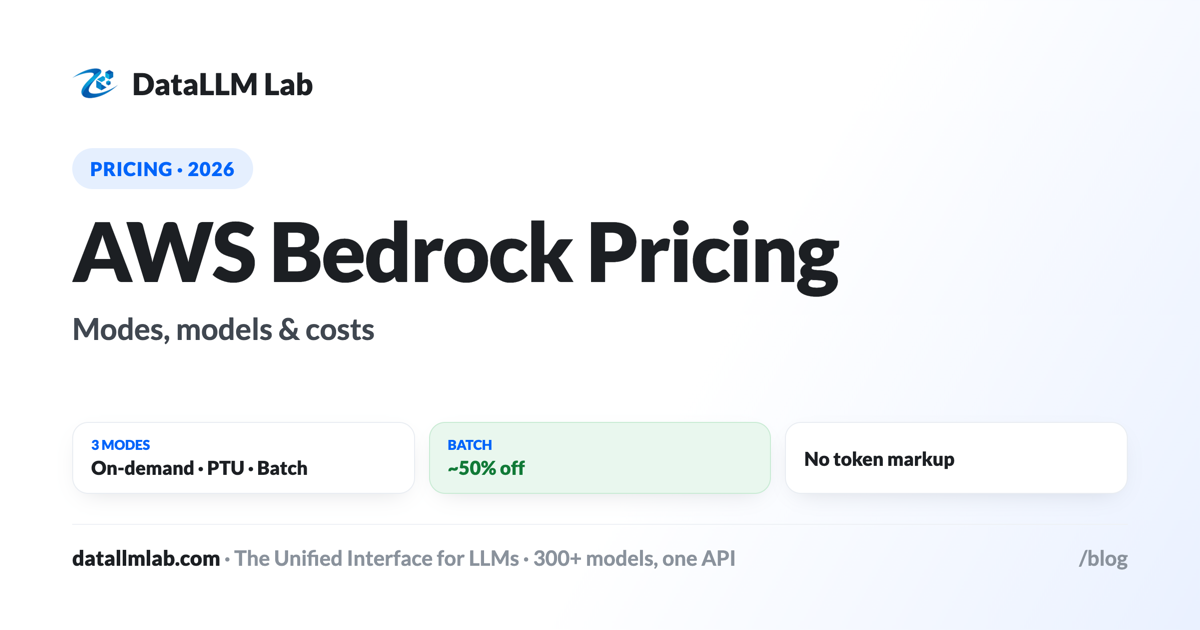
AWS Bedrock pricing explained: on-demand vs provisioned throughput vs batch, modeled monthly costs, the provisioned break-even math, the batch discount, cost traps, and when a gateway is cheaper.
Read article →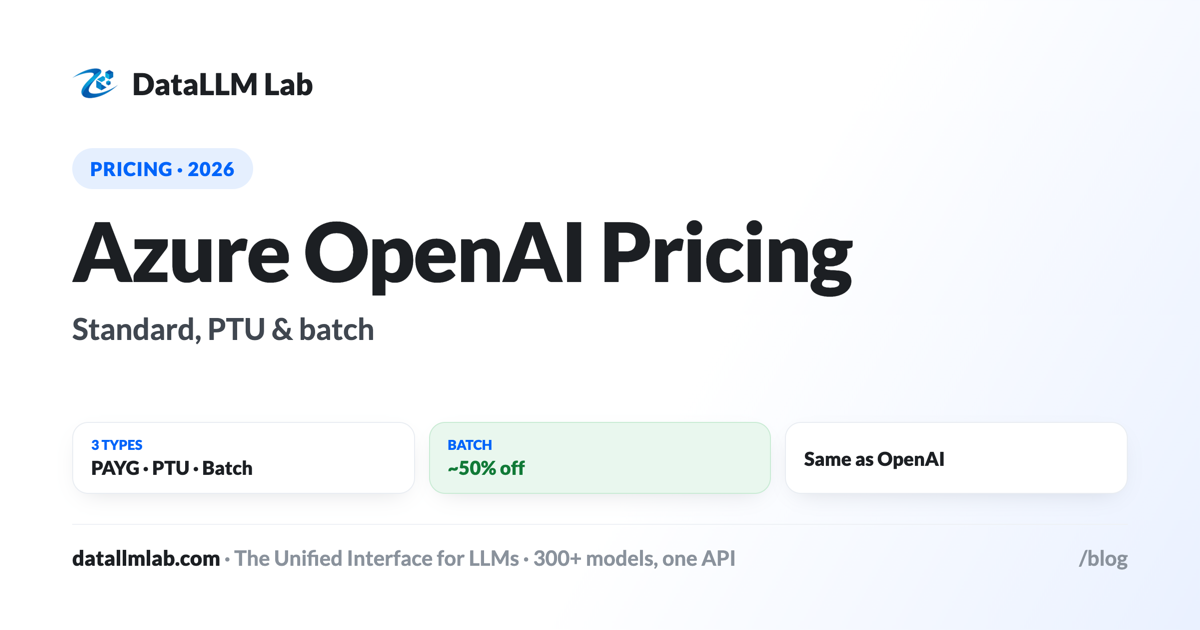
Azure OpenAI pricing explained: standard vs PTU vs batch, modeled monthly GPT-5 costs, the PTU break-even math, the batch discount, the enterprise features you pay for, and when a gateway is cheaper.
Read article →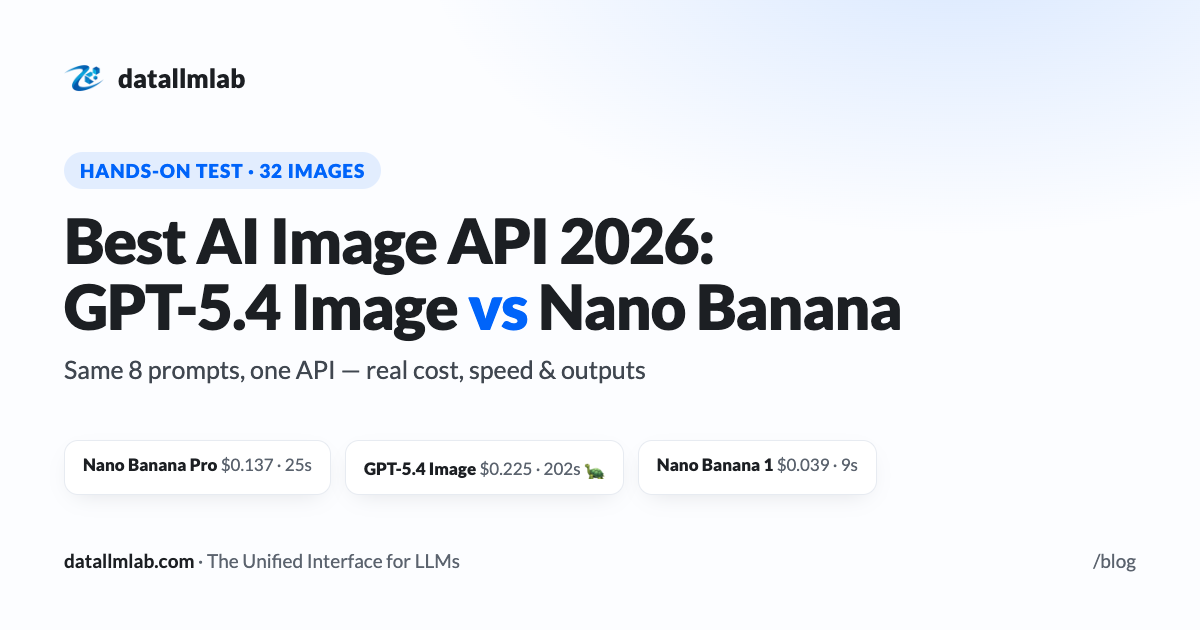
We generated 32 images through one API comparing GPT-5.4 Image 2 vs Google’s Nano Banana 1/2/Pro — real cost, speed and quality, with every unedited output shown.
Read article →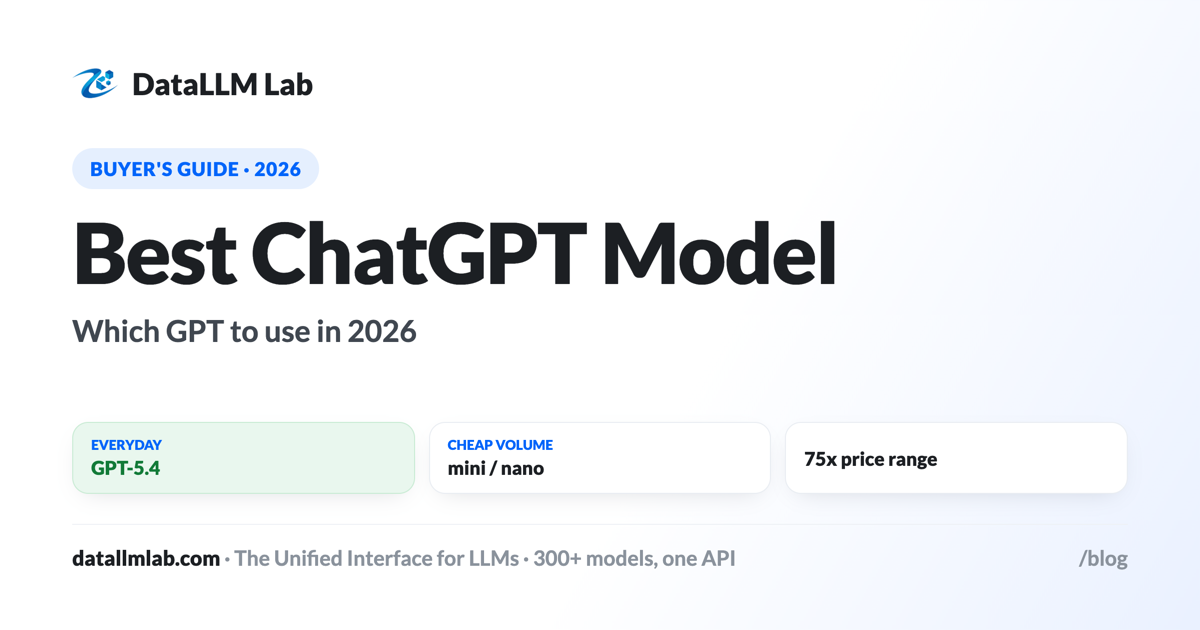
The best ChatGPT model in 2026 depends on the task: GPT-5.5 for agents, GPT-5.4 for everyday, mini/nano for cheap volume, Codex for coding. With modeled monthly costs and a routing example.
Read article →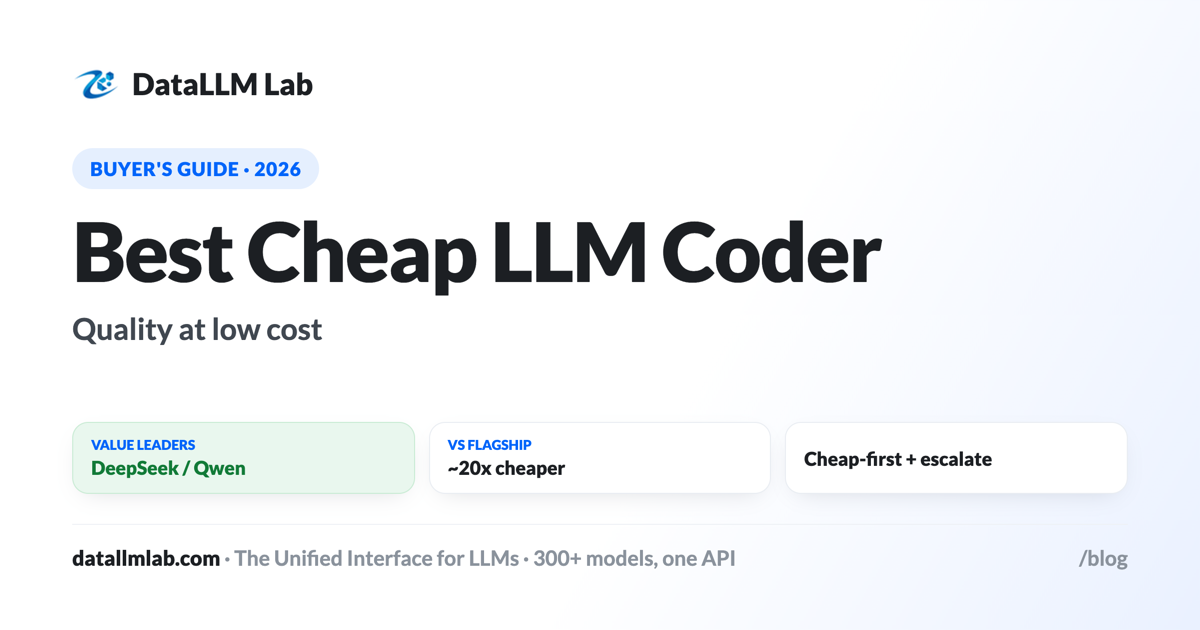
The best cheap LLM for coding in 2026: DeepSeek and Qwen Coder lead on value, Grok Code Fast and GPT-5 mini are close. Modeled costs, where each fits, and how to route cheap-first.
Read article →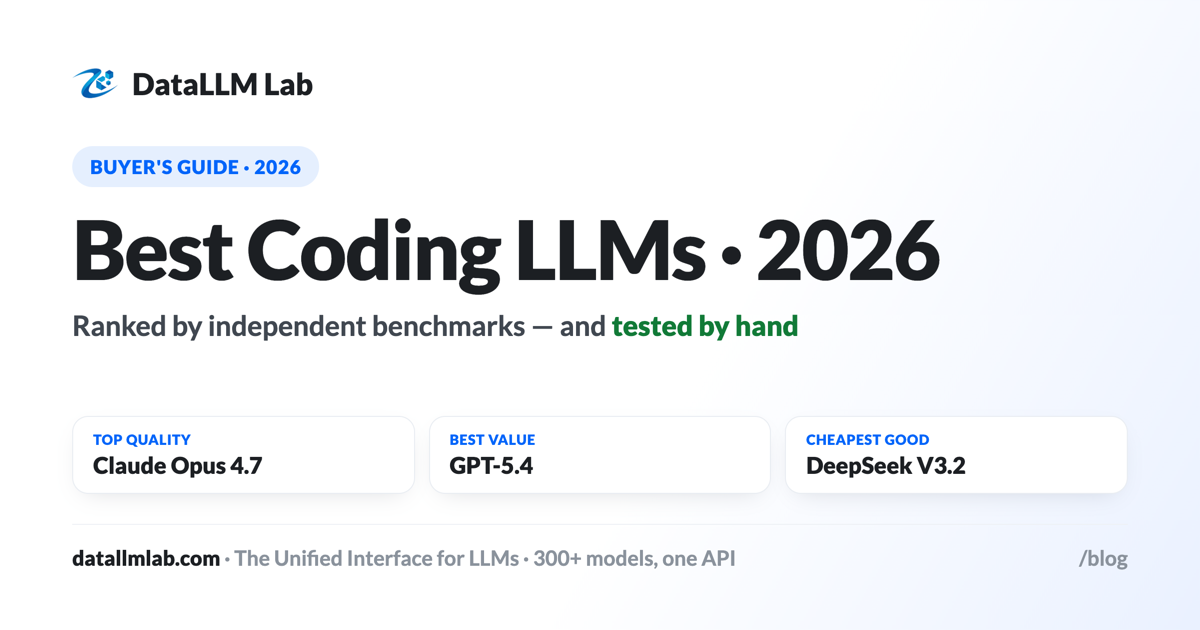
The best coding LLMs in 2026, ranked by independent SWE-bench scores, real price, and our own executed tests — with clear picks by use case.
Read article →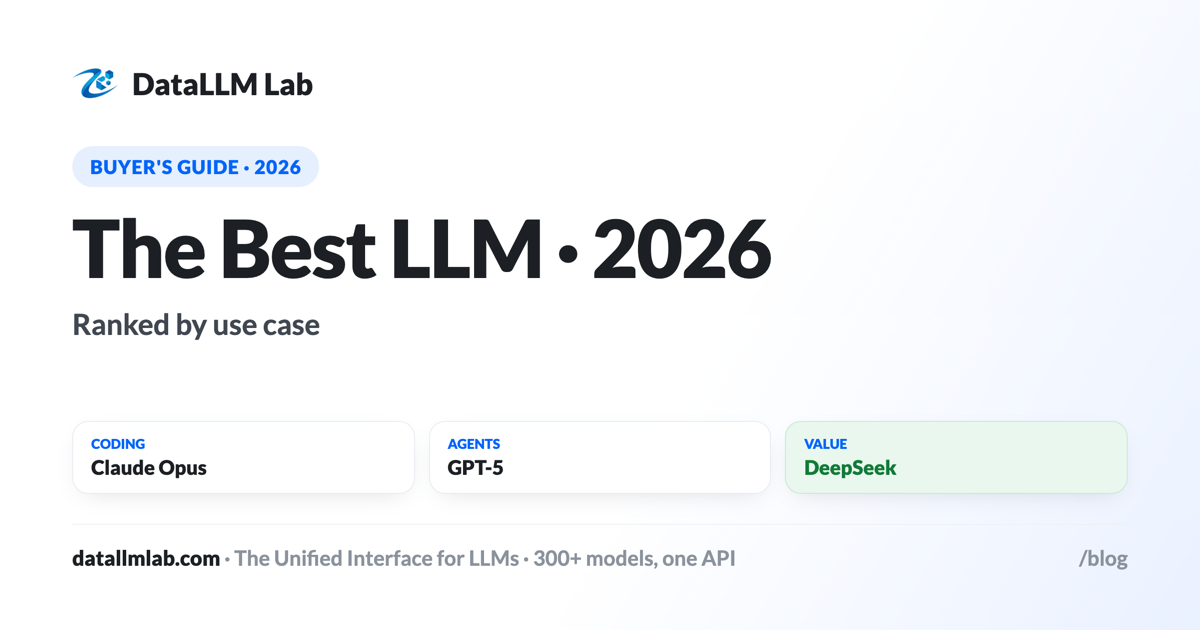
The best LLM in 2026 depends on the job. We rank the top models by independent benchmarks and pick a winner for coding, agents, reasoning, multimodal, and cost.
Read article →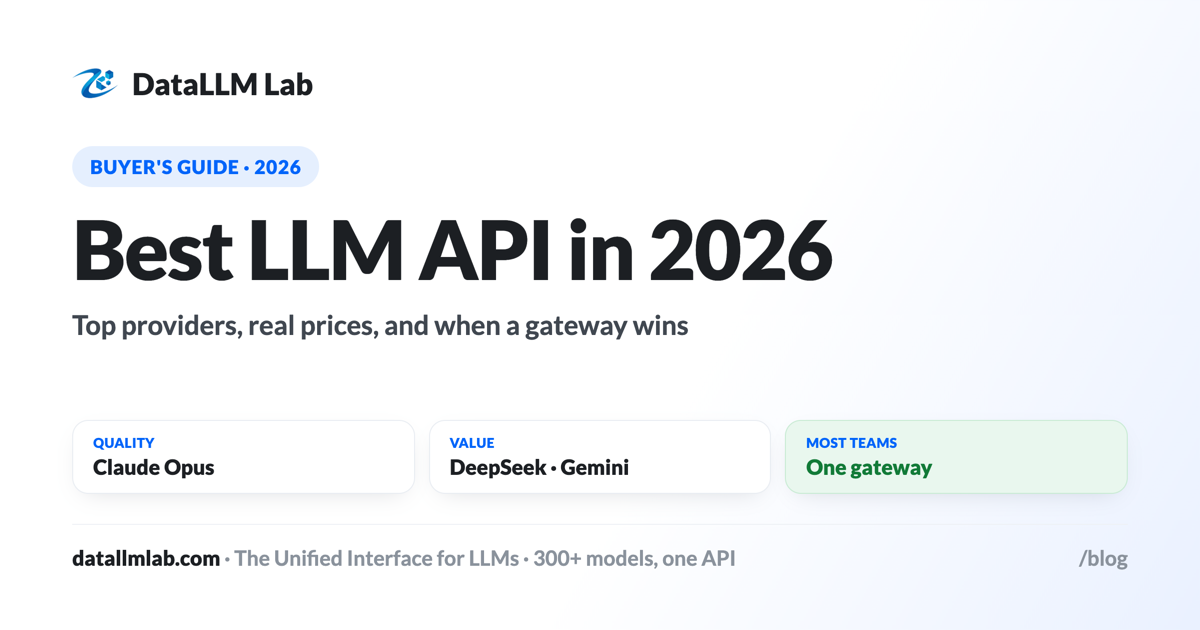
The best LLM API in 2026 depends on your workload. We rank OpenAI, Claude, Gemini, DeepSeek and more on verified price and quality — plus a cost-routing model and when a gateway wins.
Read article →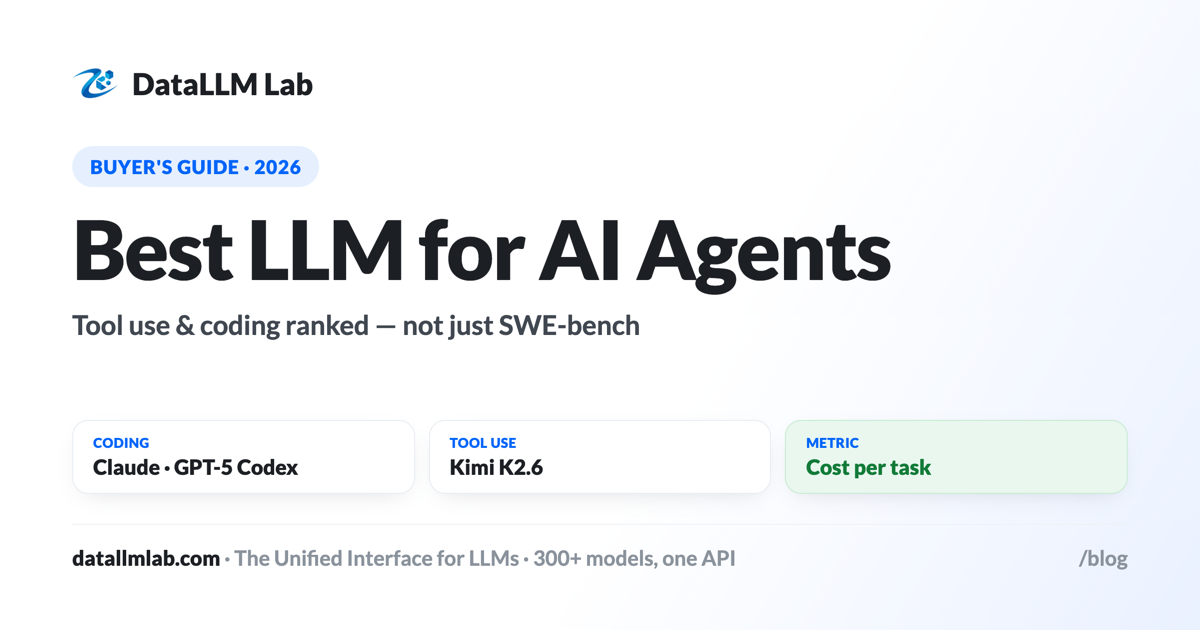
We rank the best LLMs for AI agents in 2026 on tool use, agentic coding, and long-horizon tasks — with verified benchmarks, real cost-per-task, and a code snippet to call each.
Read article →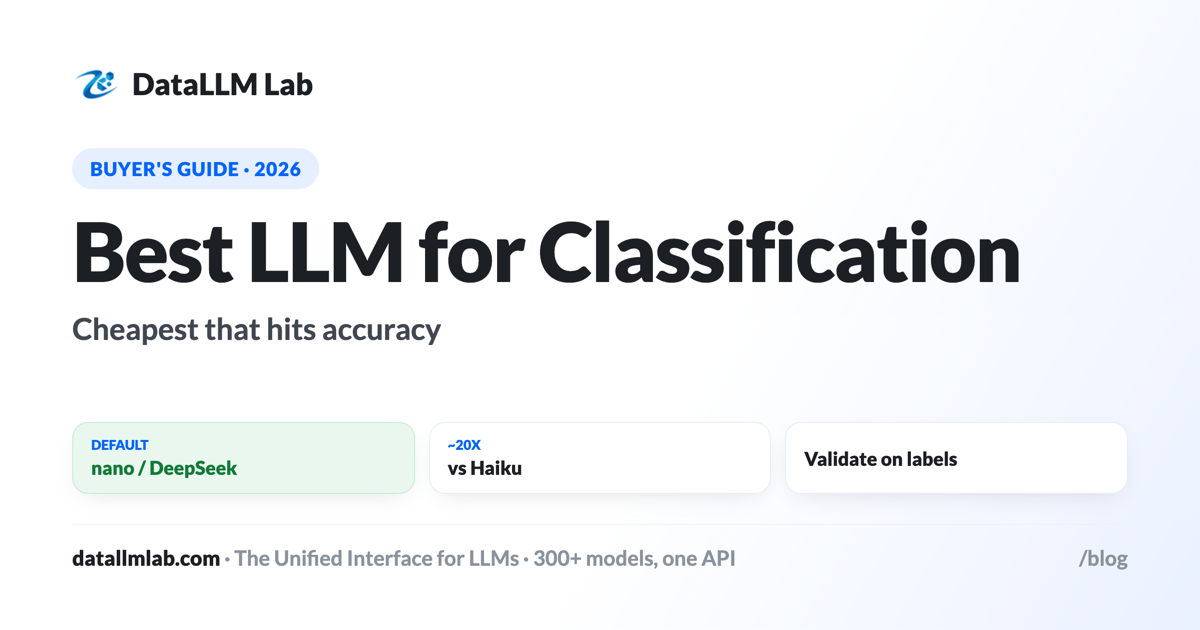
The best LLM for classification is the cheapest one that hits your accuracy bar — usually GPT-5 nano or DeepSeek. What matters, modeled costs, a worked example, and when to step up.
Read article →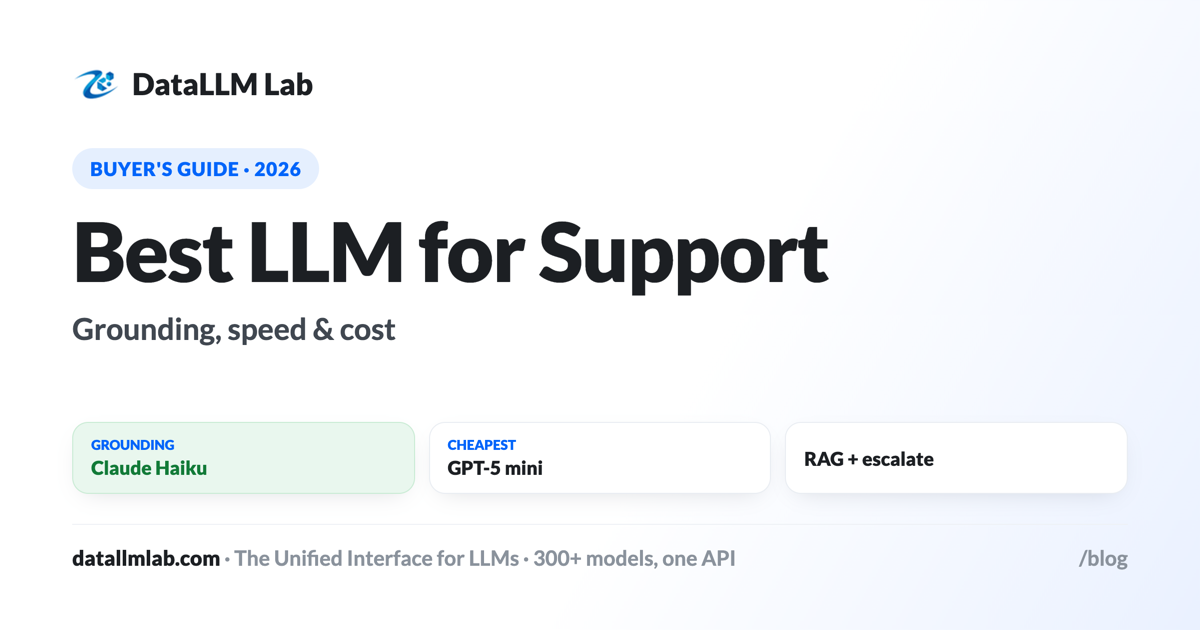
The best LLM for customer support optimizes for grounding in your help docs, tone, latency, and cost — Claude Haiku for fidelity, GPT-5 mini for cost, routed with escalation. With modeled costs.
Read article →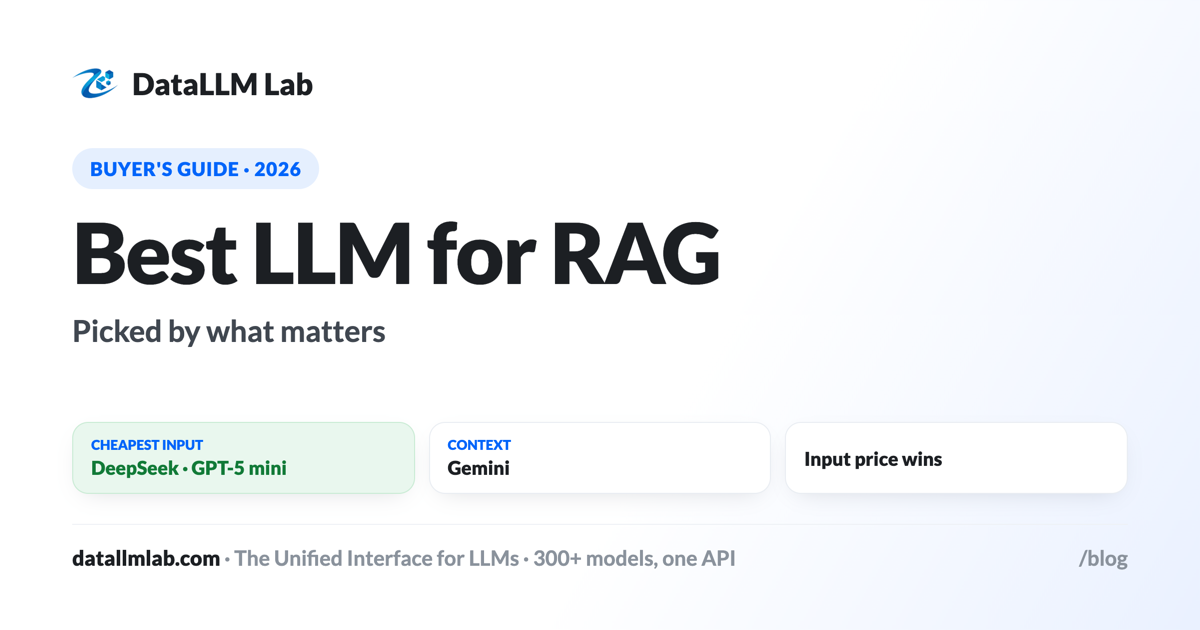
The best LLM for RAG in 2026 optimizes for cheap input tokens, grounding, and context window — not raw IQ. Top picks by need, the input-price reality, modeled RAG costs, and a worked example.
Read article →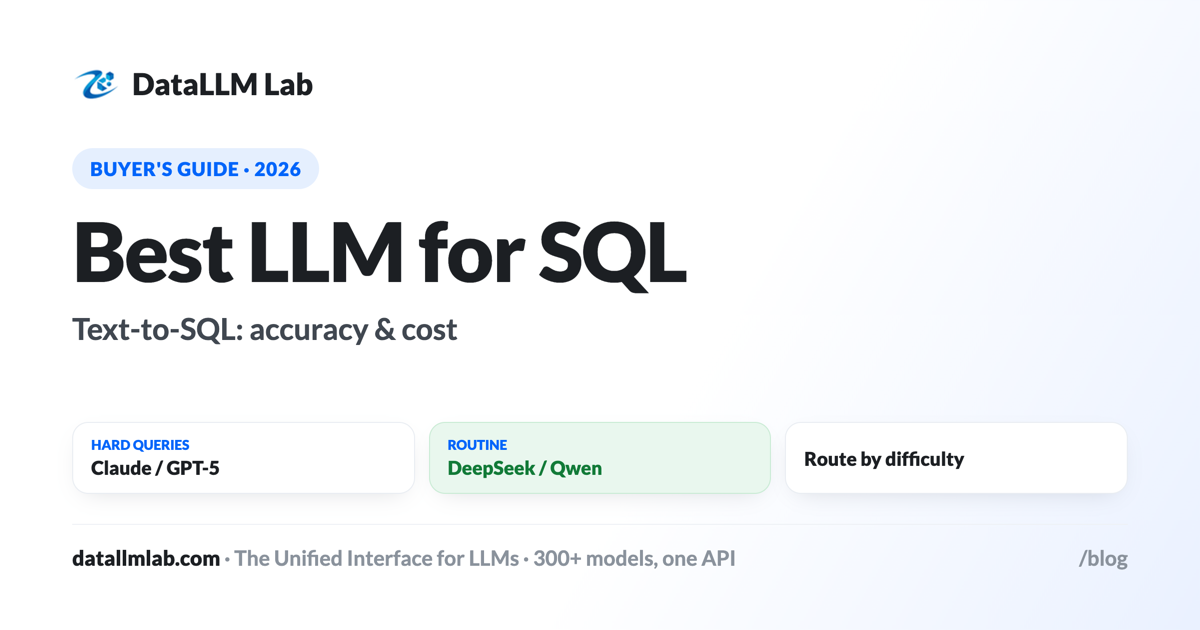
The best LLM for text-to-SQL needs schema reasoning and query accuracy — Claude and GPT-5 lead, DeepSeek and Qwen Coder are cheap and capable. What matters, modeled costs, and how to make it accurate.
Read article →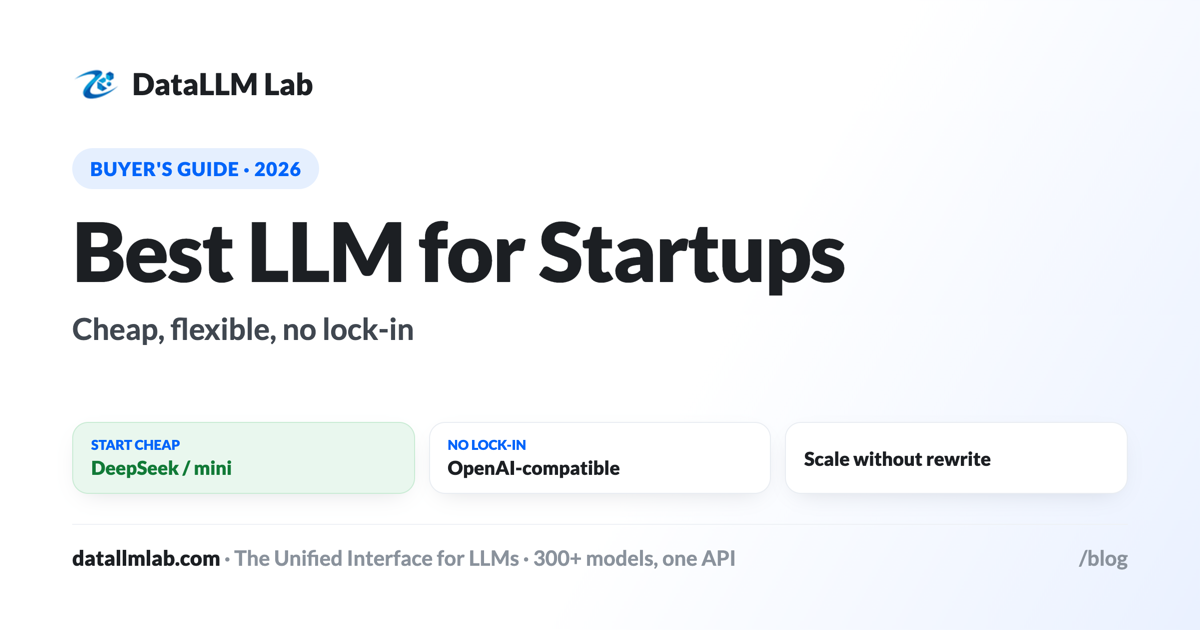
The best LLM strategy for startups: start cheap to protect runway, stay flexible to switch models, avoid lock-in with one OpenAI-compatible API, and route to scale. With modeled costs.
Read article →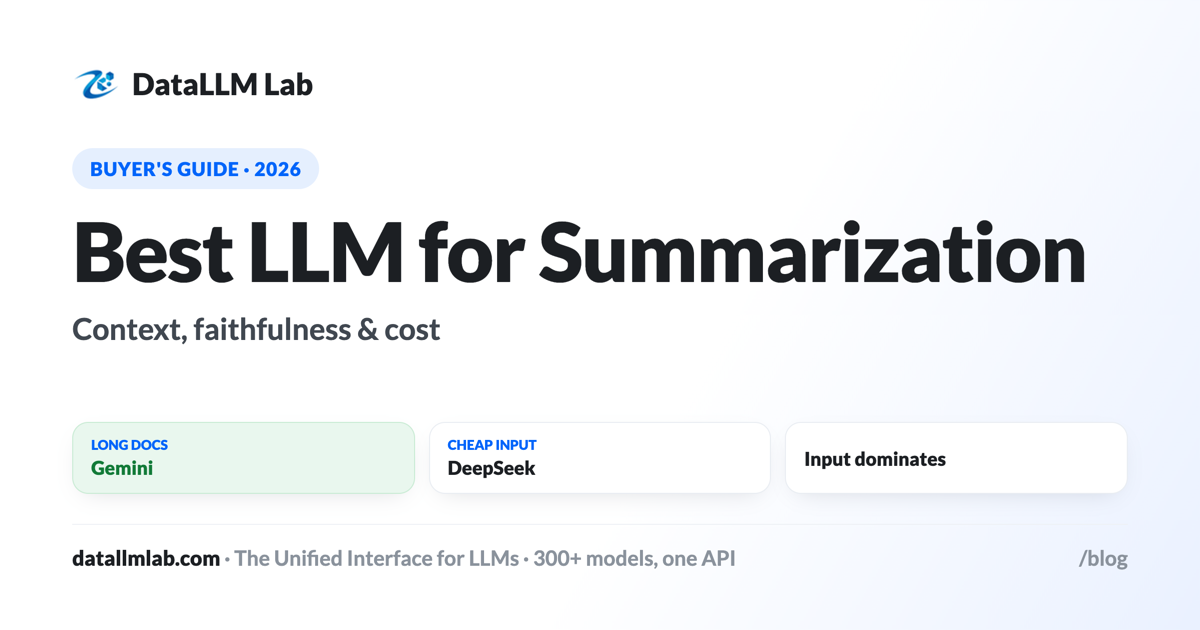
The best LLM for summarization optimizes for long context, faithfulness (no hallucination), and cheap input — Gemini for context, DeepSeek/mini for cost, Claude for fidelity. With modeled costs.
Read article →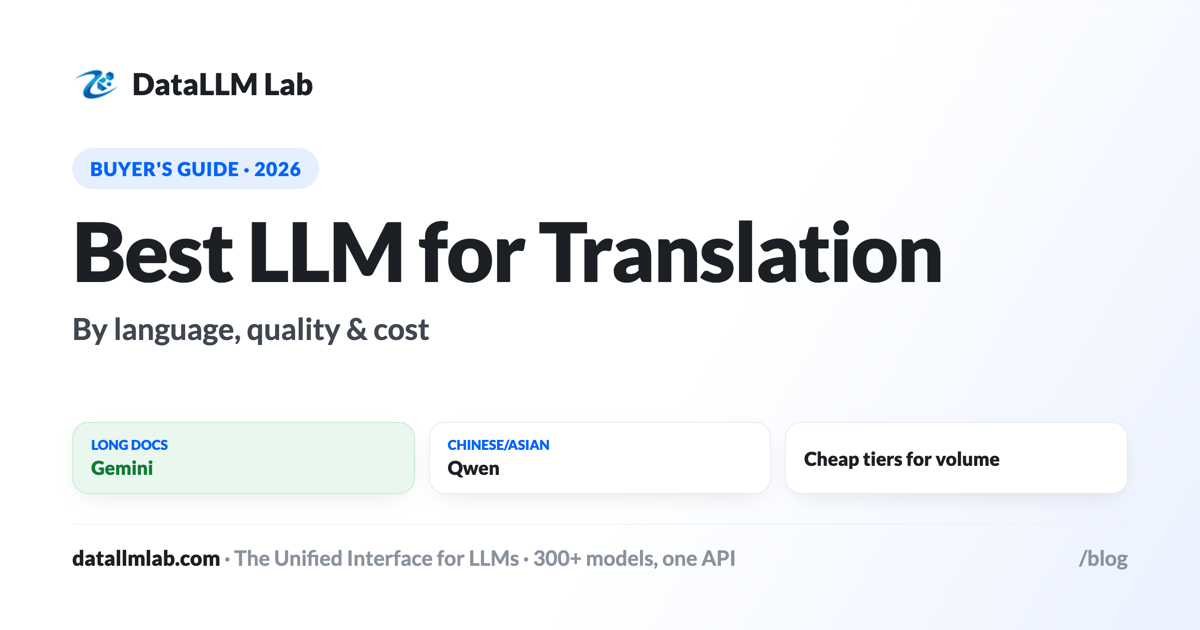
The best LLM for translation in 2026: Gemini for breadth and long documents, Claude/GPT-5 for quality, cheap tiers for volume, Qwen for Asian languages. Modeled costs and picks.
Read article →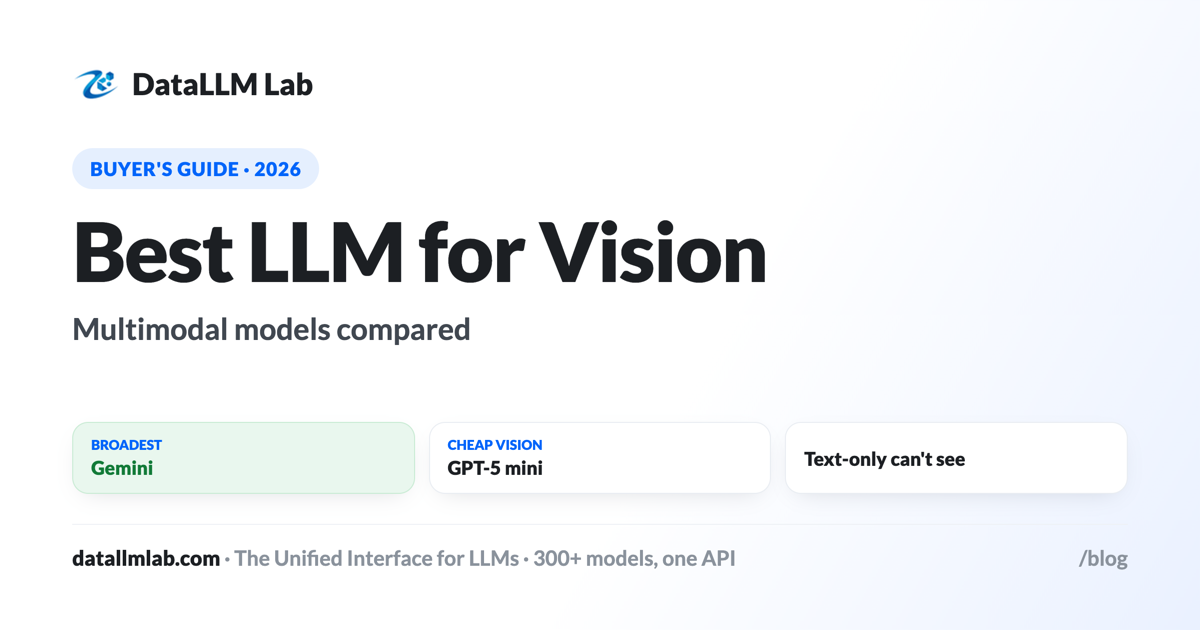
The best LLM for vision in 2026: Gemini leads multimodal (image, document, chart, video), with GPT-5 and Claude strong on vision too. What matters, modeled costs, and which to pick.
Read article →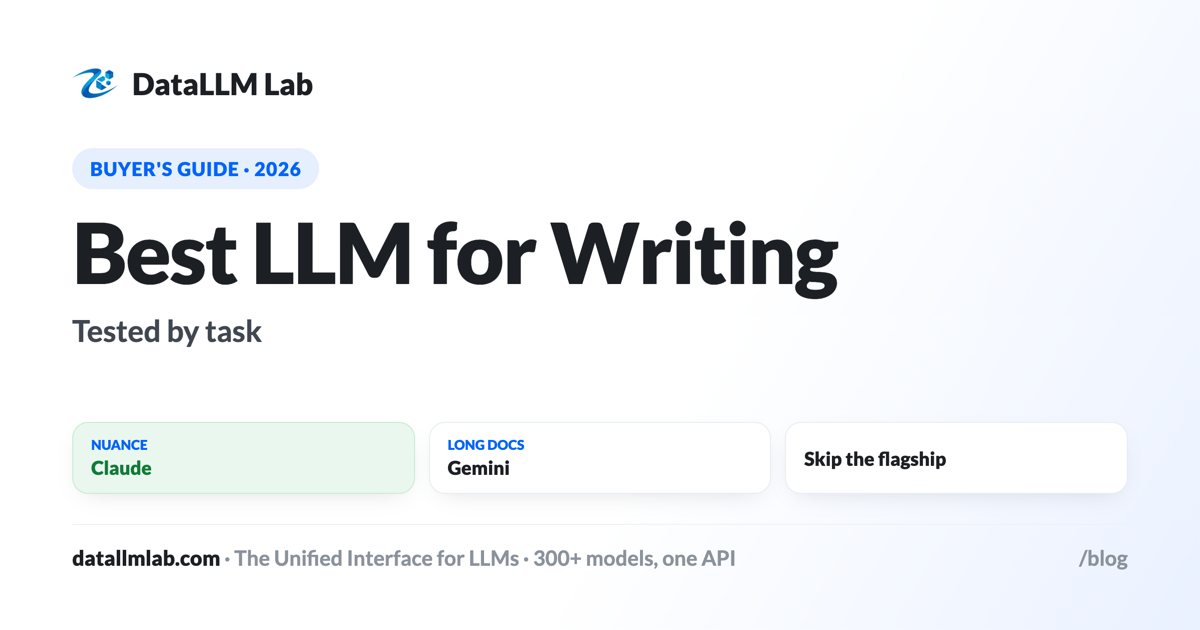
The best LLM for writing in 2026 depends on the task: Claude for nuanced long-form, GPT-5 for versatility, Gemini for long-context. With modeled costs and why writing rarely needs a flagship.
Read article →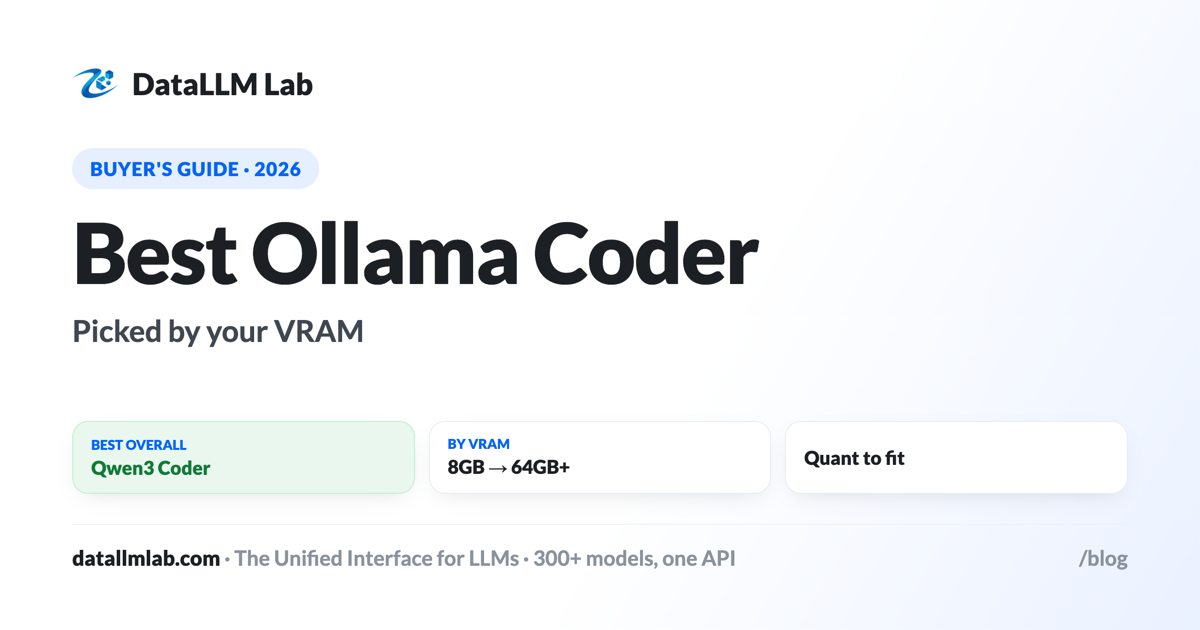
The best Ollama models for coding in 2026: Qwen3 Coder, DeepSeek-Coder, Codestral and more — picked by GPU/VRAM, with the quantization math and when a hosted API beats local.
Read article →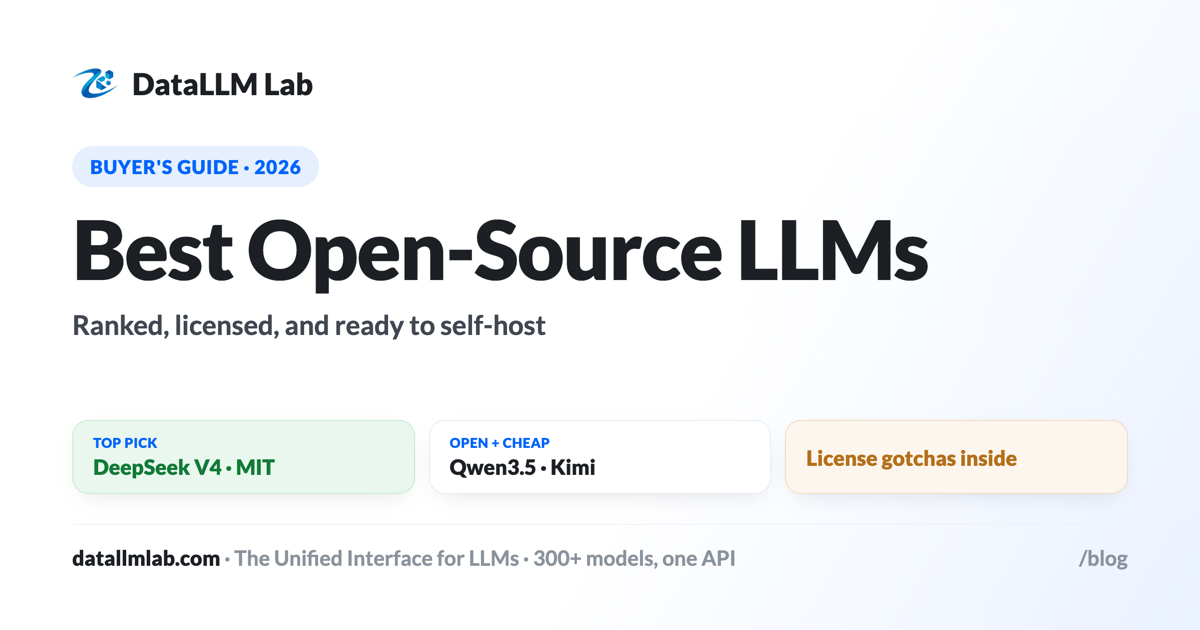
The best open-weights LLMs in 2026, ranked by independent benchmarks: DeepSeek V4, Kimi K2.6, GLM-5, Qwen3.5 — with params, the license gotchas, and how to run them.
Read article →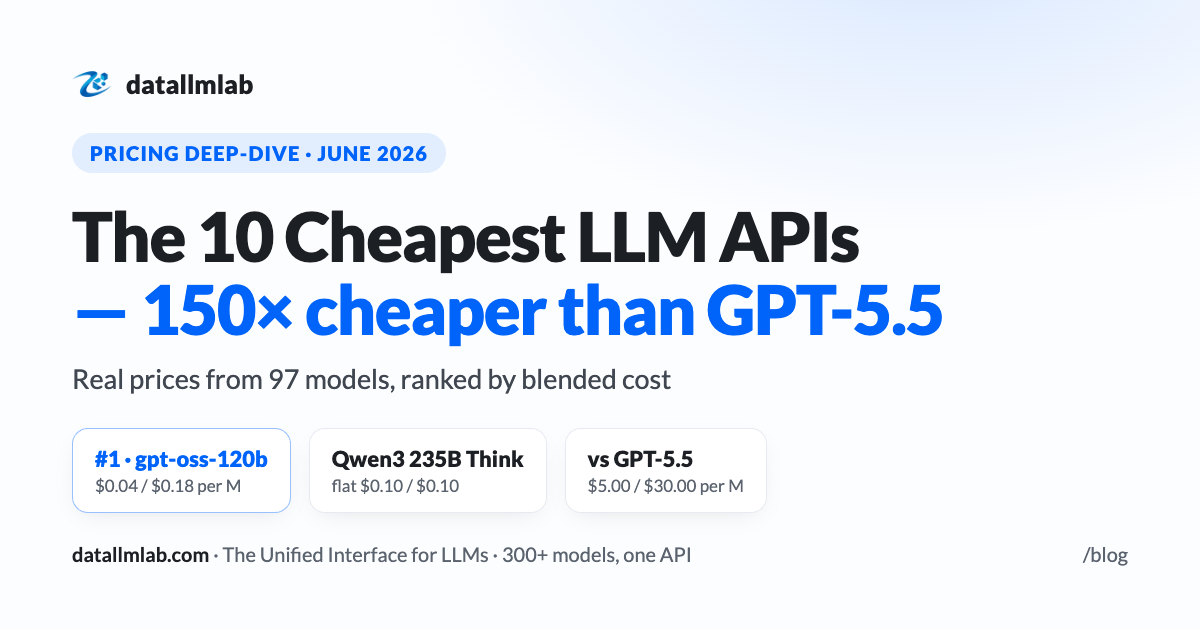
Live per-token prices for all 97 models on our gateway (June 2026): the cheapest LLM API is $0.075 per million blended tokens — 150× cheaper than GPT-5.5. Full ranked table inside.
Read article →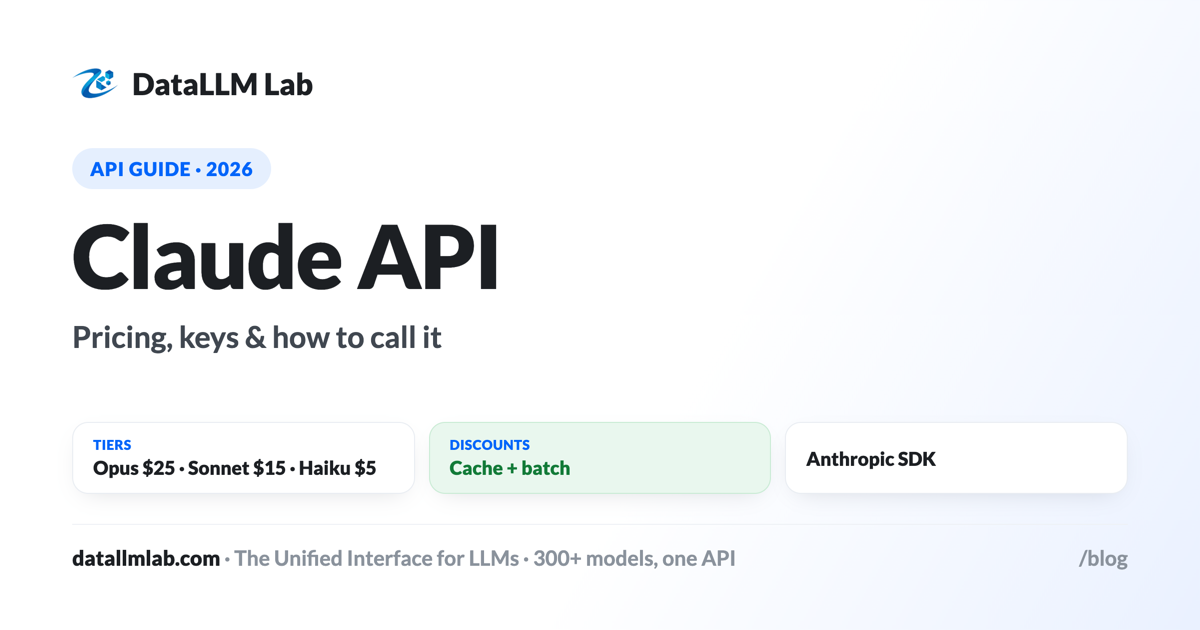
Claude API pricing for every model (Opus, Sonnet, Haiku), how to get an Anthropic key, prompt caching and batch discounts, and how to call it — direct or via a gateway.
Read article →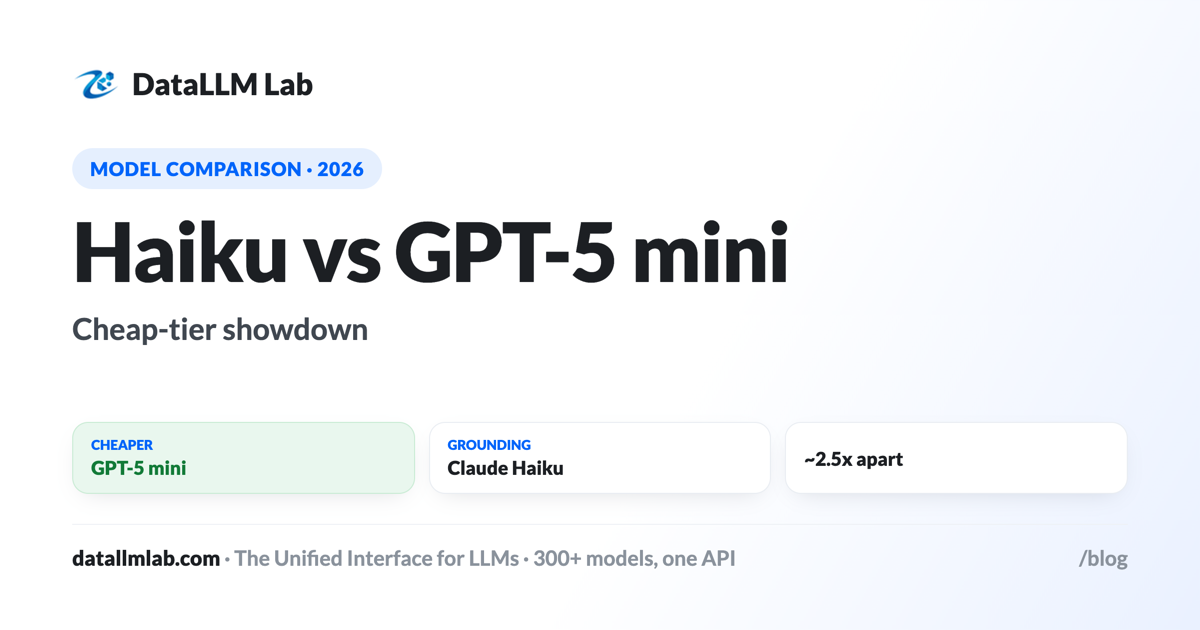
Claude Haiku vs GPT-5 mini compared: GPT-5 mini is cheaper, Claude Haiku leads on grounding and instruction-following. Prices, modeled costs, and which cheap tier to pick.
Read article →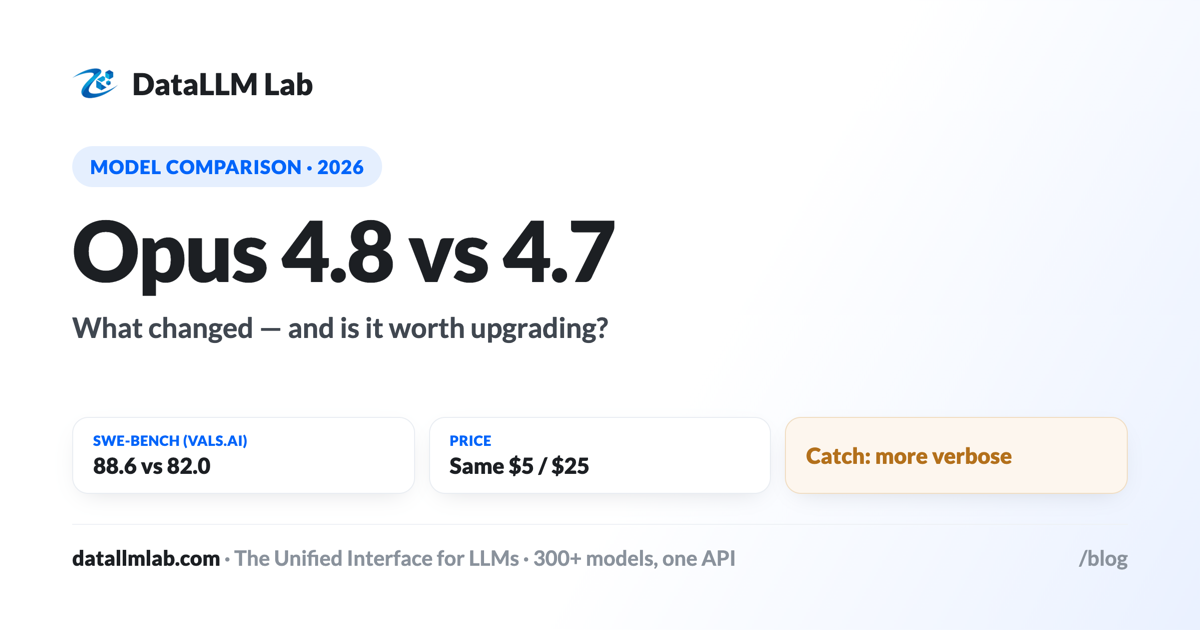
Claude Opus 4.8 vs 4.7 compared: independent benchmark gains (SWE-bench 88.6% vs 82%), unchanged $5/
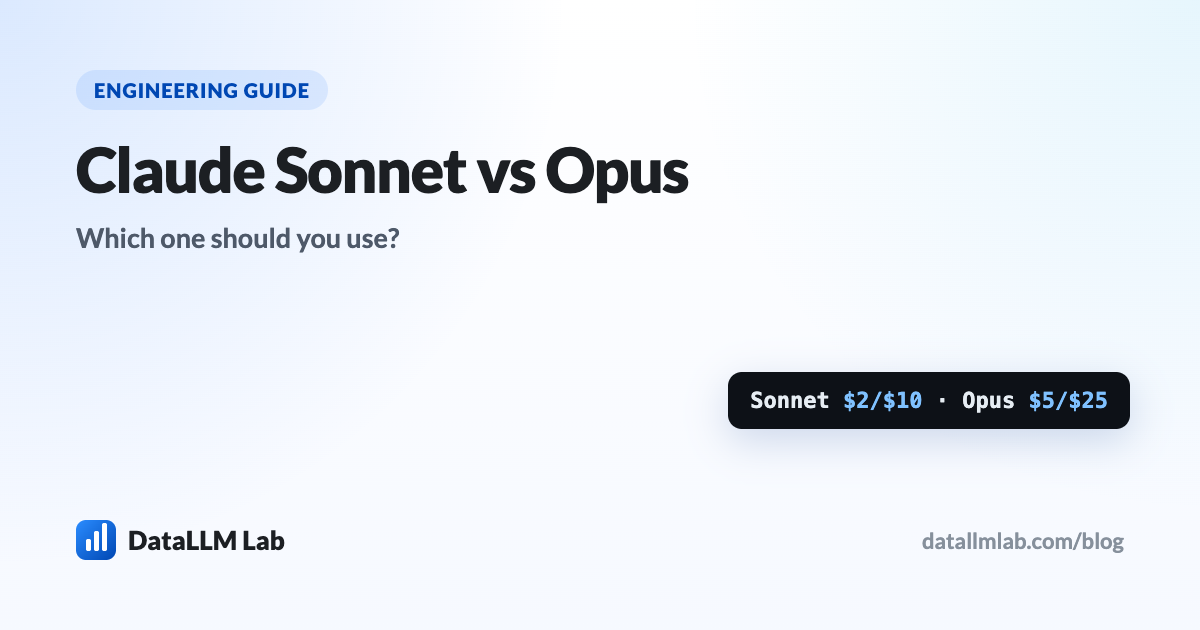
Opus 4.8 (most capable, $5/
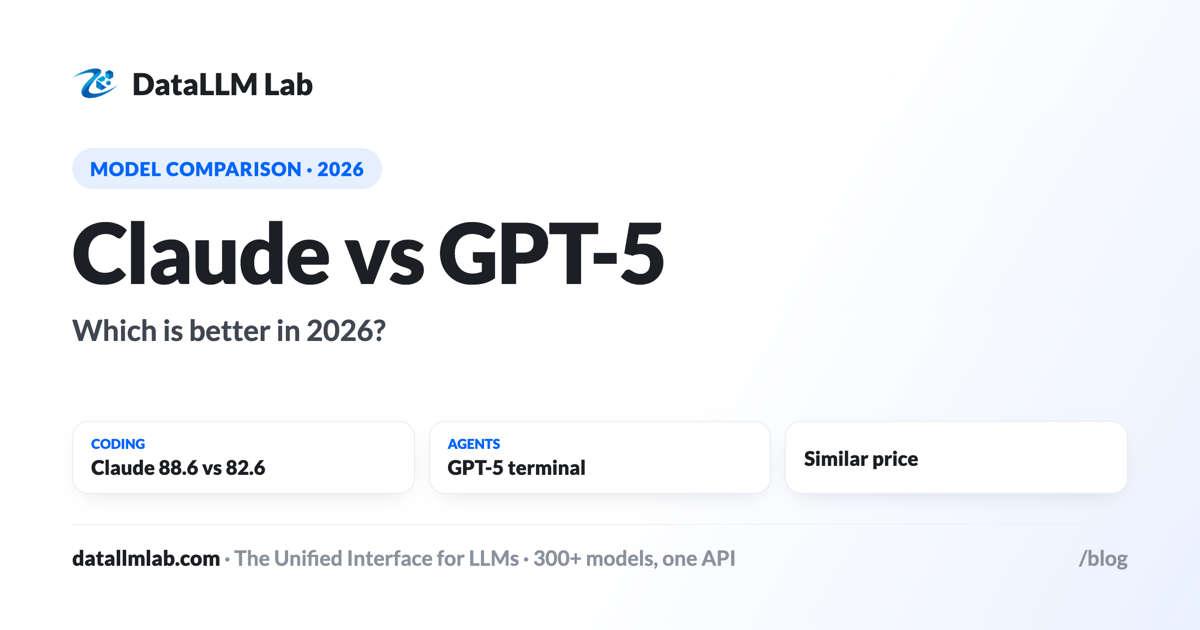
Claude vs GPT-5 compared: independent benchmarks (Claude leads coding, GPT-5 leads agents), modeled monthly costs across real workloads, and worked scenarios for which to pick by job.
Read article →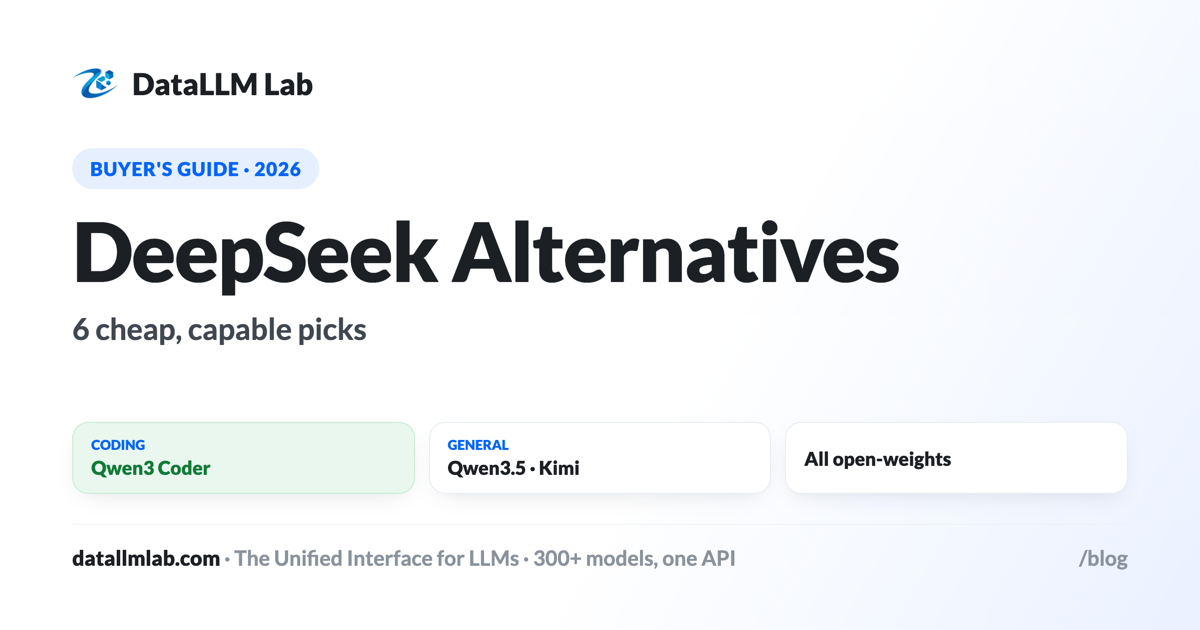
The best DeepSeek alternatives in 2026: Qwen, Kimi, Llama, Mistral and GLM compared on price, license, and use case — with a modeled cost table and one-line migration notes.
Read article →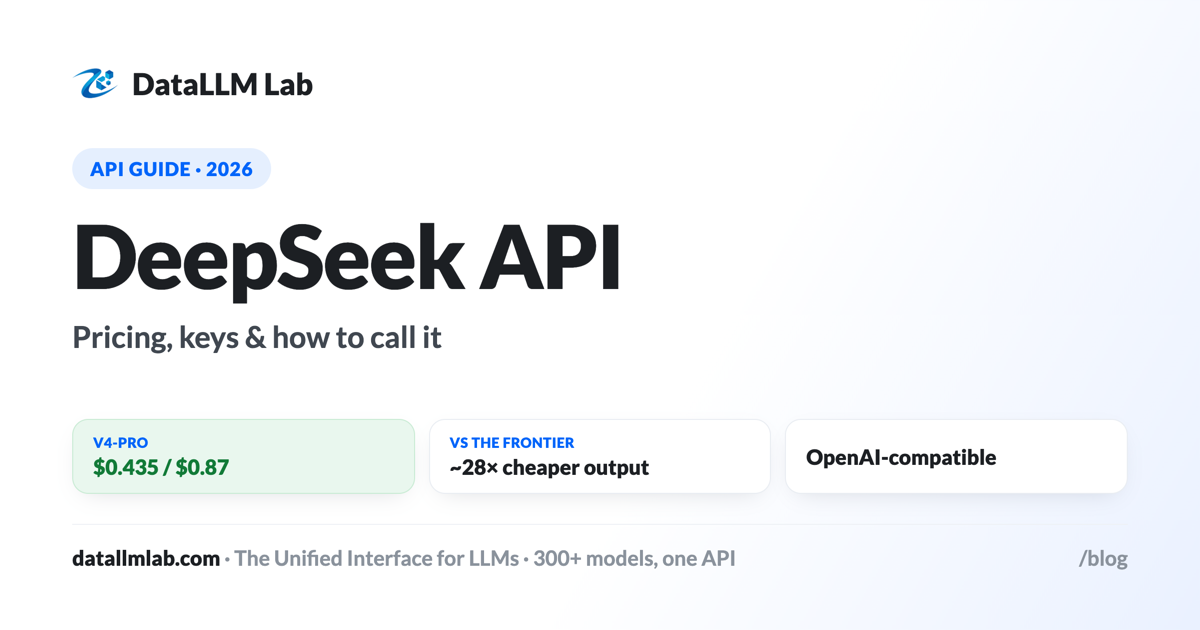
DeepSeek API pricing, how to get a key, rate limits, and how to call it (OpenAI-compatible). V4-Pro at $0.435/$0.87 — the cheapest frontier-class API in 2026.
Read article →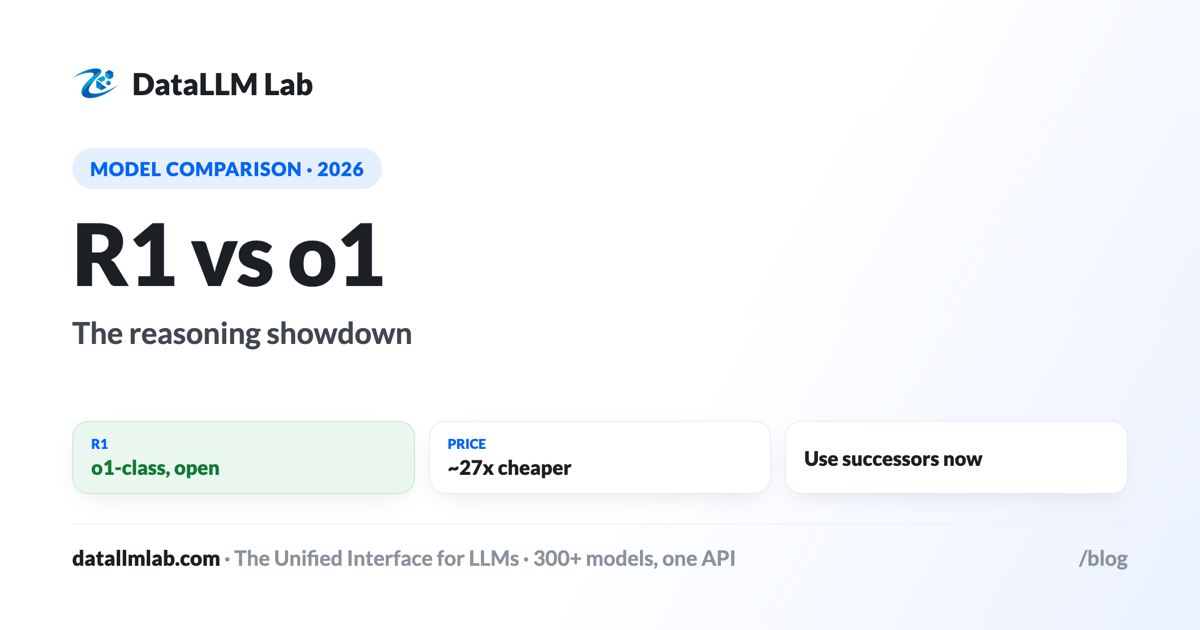
DeepSeek R1 vs OpenAI o1: the open reasoning model that matched o1 at ~1/27th the price. Benchmarks, the modeled cost gap, why it reset the market, and what to deploy instead in 2026.
Read article →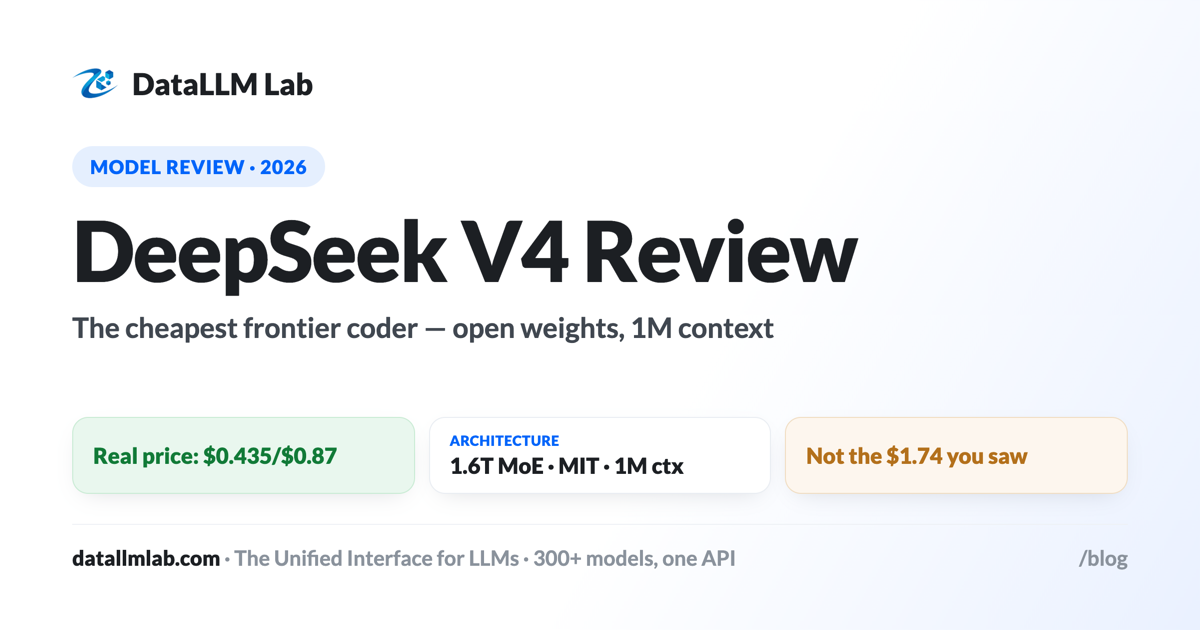
An honest DeepSeek V4 review: real benchmarks, the official API price ($0.435/$0.87 — not the inflated host rates), Pro vs Flash, and when to actually use it.
Read article →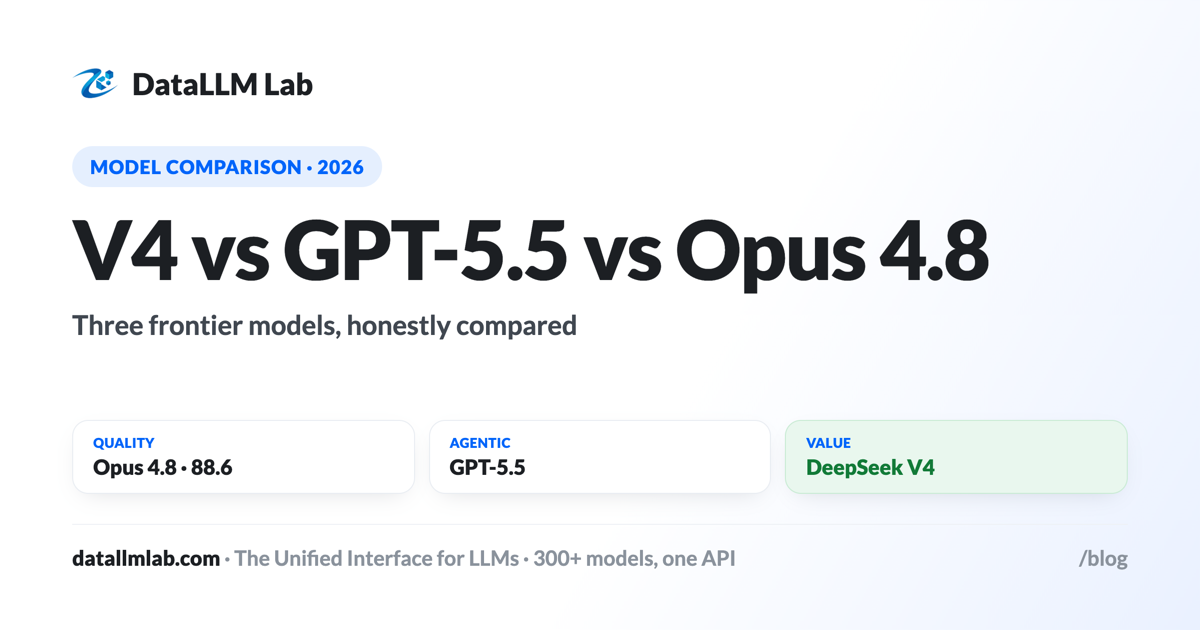
DeepSeek V4 vs GPT-5.5 vs Claude Opus 4.8 — independent SWE-bench scores, reconciled real pricing, 1M context, and which frontier model you can actually use today.
Read article →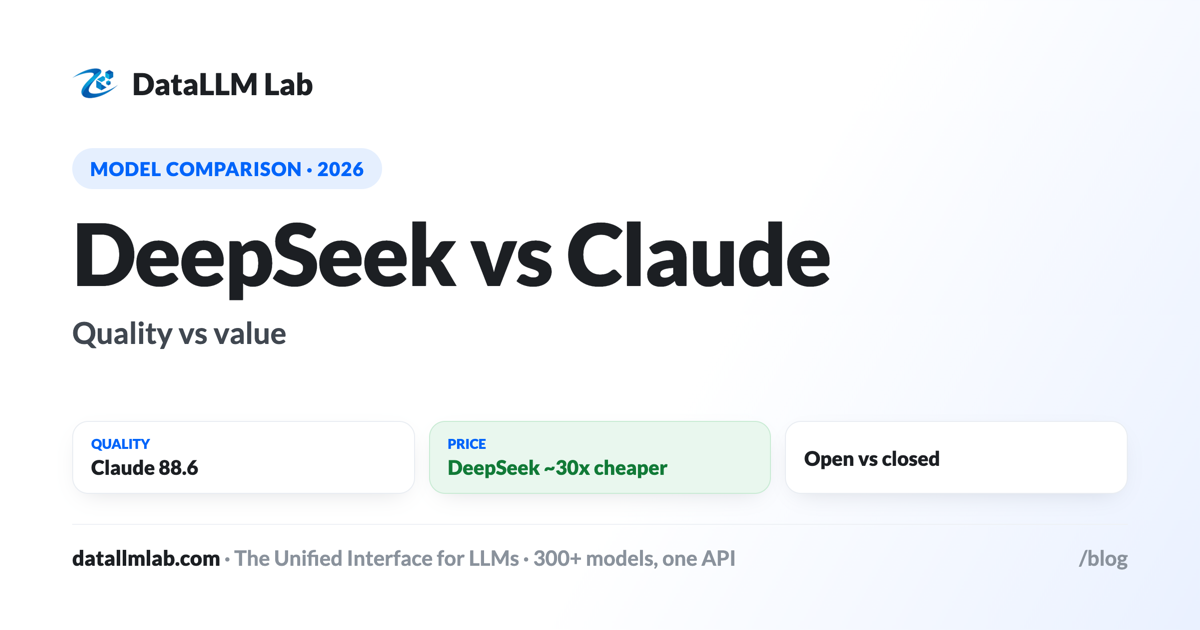
DeepSeek vs Claude compared: Claude leads quality, DeepSeek is open-weights and roughly 30x cheaper. Benchmarks, modeled monthly costs, and worked scenarios for which to pick.
Read article →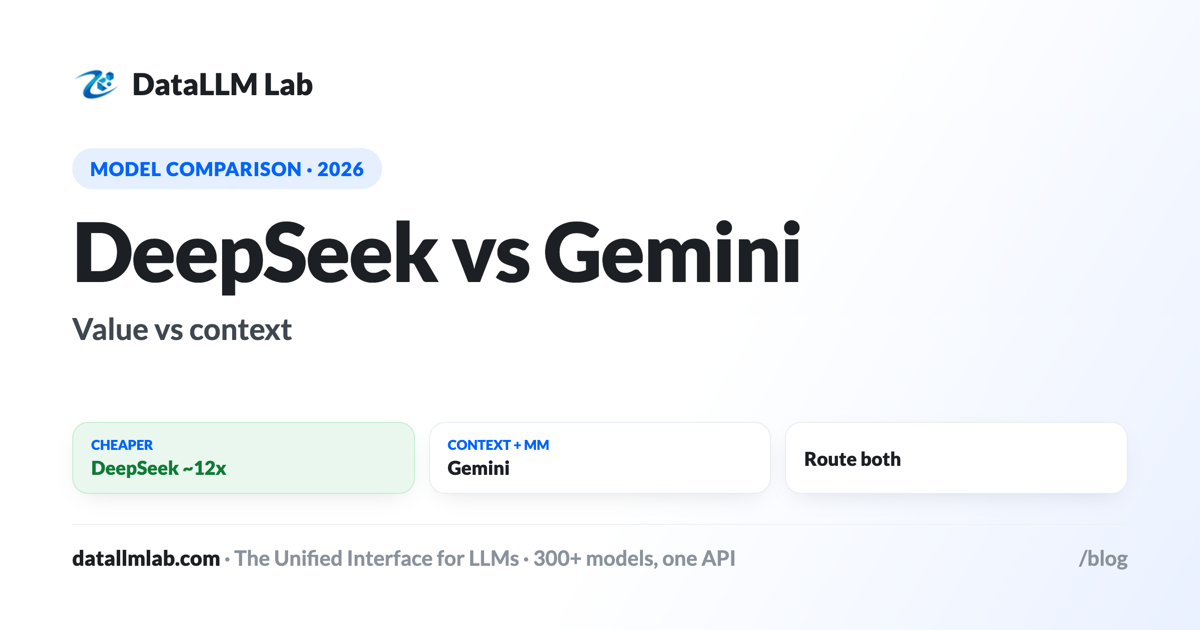
DeepSeek vs Gemini compared: DeepSeek is open-weights and far cheaper, Gemini brings the largest context and native multimodal. Modeled costs and which to pick by job.
Read article →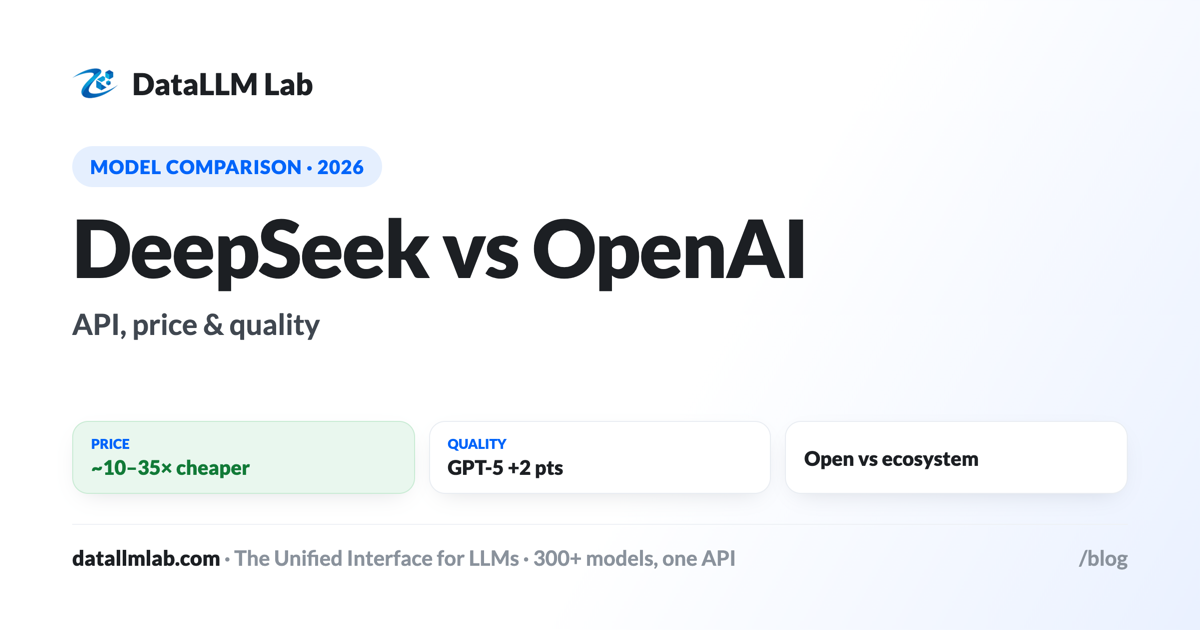
DeepSeek vs OpenAI compared: independent benchmarks, the order-of-magnitude price gap, open weights vs ecosystem, and which API to pick for coding, agents, and scale.
Read article →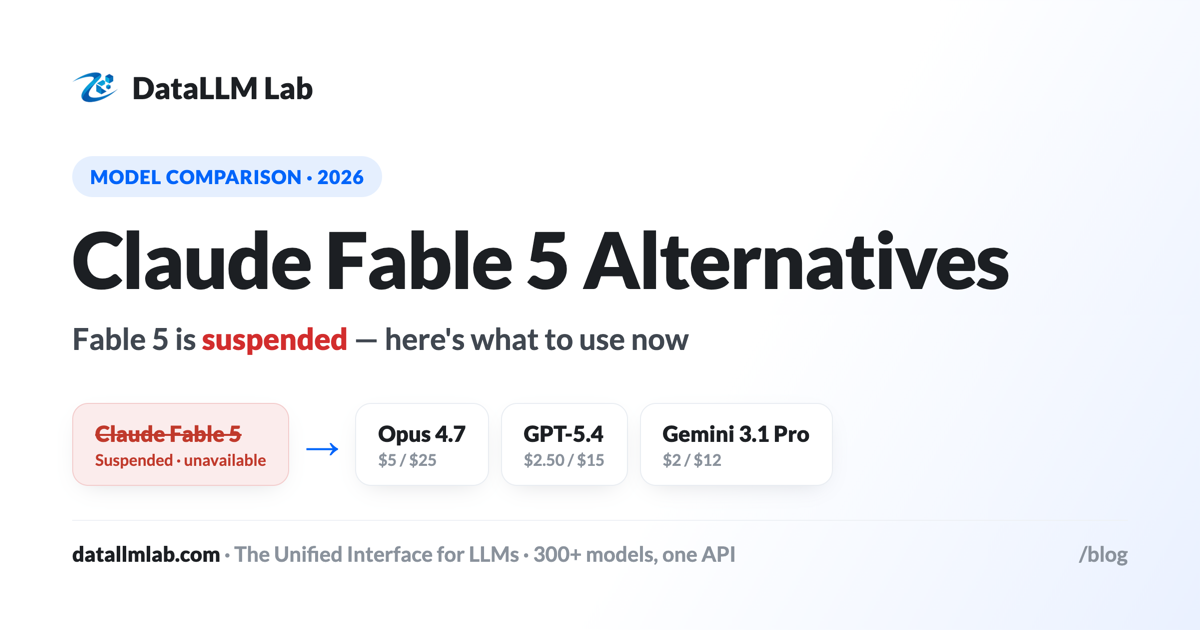
Claude Fable 5 was suspended June 12, 2026 by a U.S. export-control directive — unavailable to everyone. Here are the frontier alternatives you can call right now.
Read article →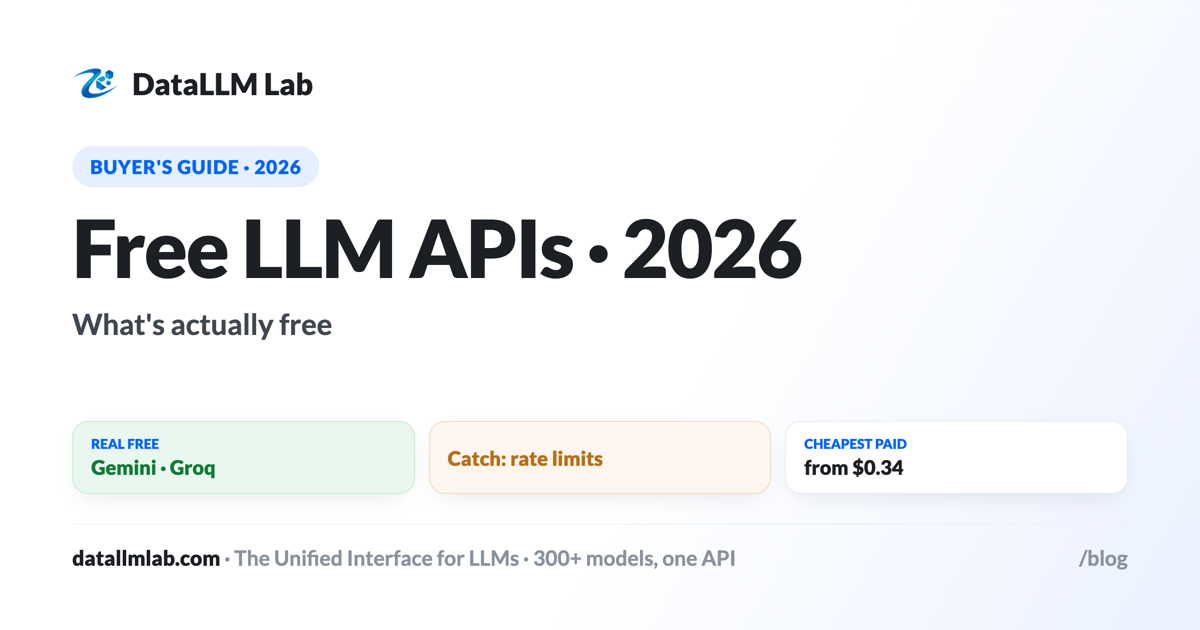
The real free LLM APIs in 2026 — which providers have genuine free tiers, the rate limits and catches, free vs trial vs self-host, and the cheapest paid options when you scale.
Read article →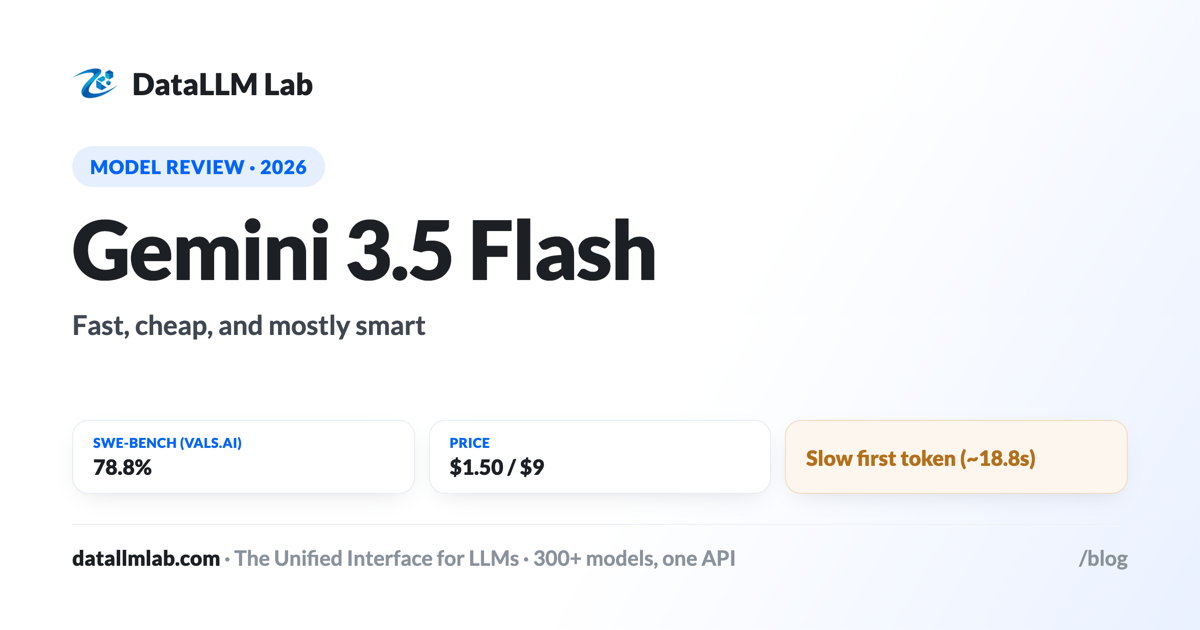
A Gemini 3.5 Flash review: real benchmarks (SWE-bench Verified 78.8%),
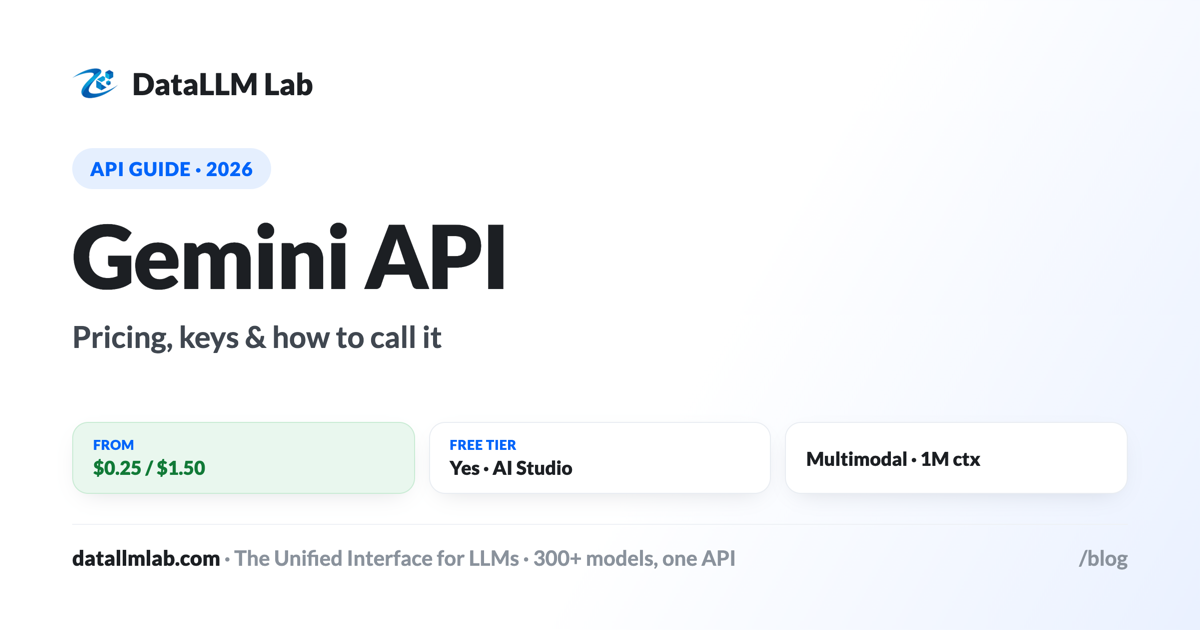
Gemini API pricing for every tier (Pro, Flash, Flash-Lite), the free tier and its limits, how to get a Google AI Studio key, and how to call it — direct or via a gateway.
Read article →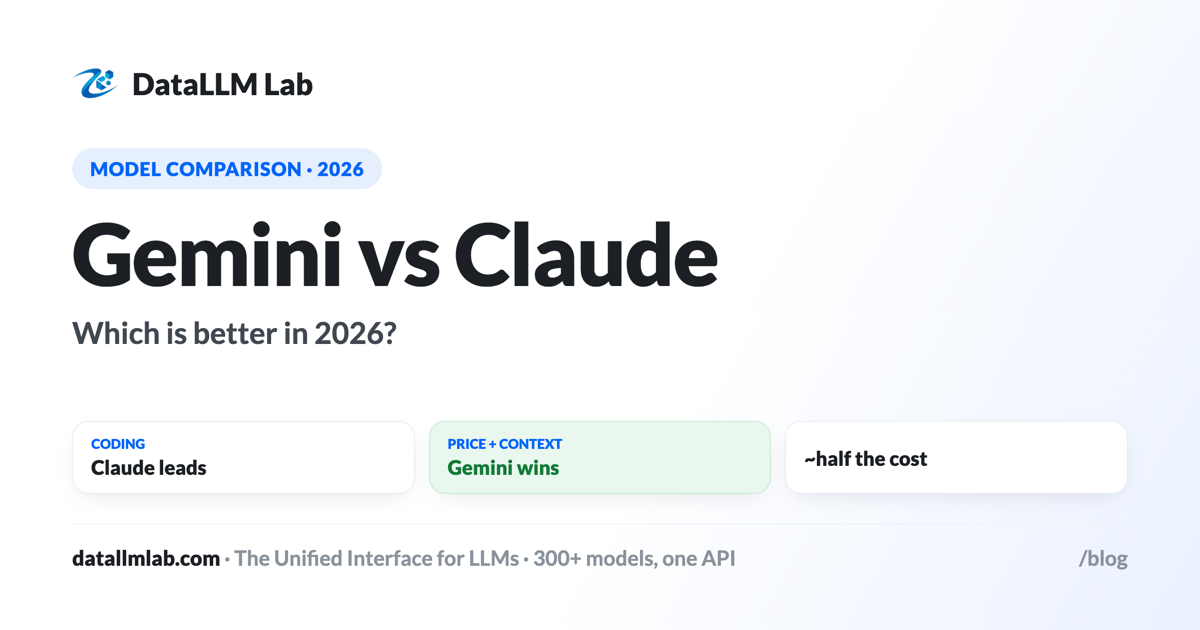
Gemini vs Claude compared: Claude leads coding, Gemini wins on price, context window and multimodal. Benchmarks, modeled monthly costs, and worked scenarios for which to pick.
Read article →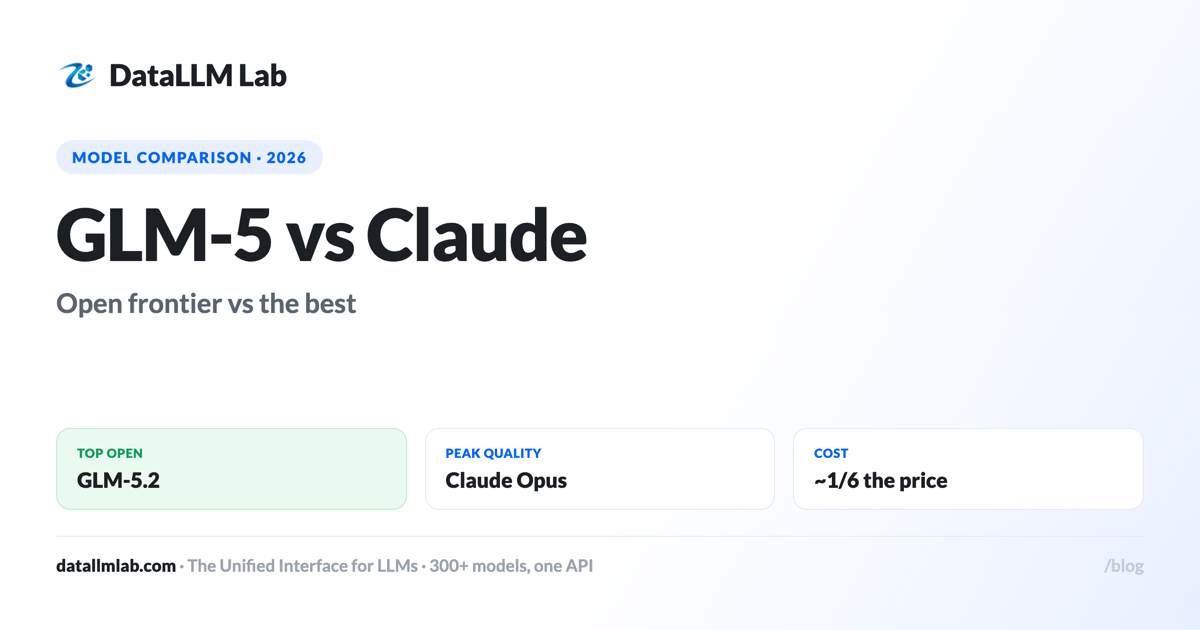
GLM-5.2 vs Claude: Claude leads overall quality, GLM-5.2 is the #1 open-weights model at ~1/6 the price and MIT-licensed. Benchmarks, modeled costs, and which to pick.
Read article →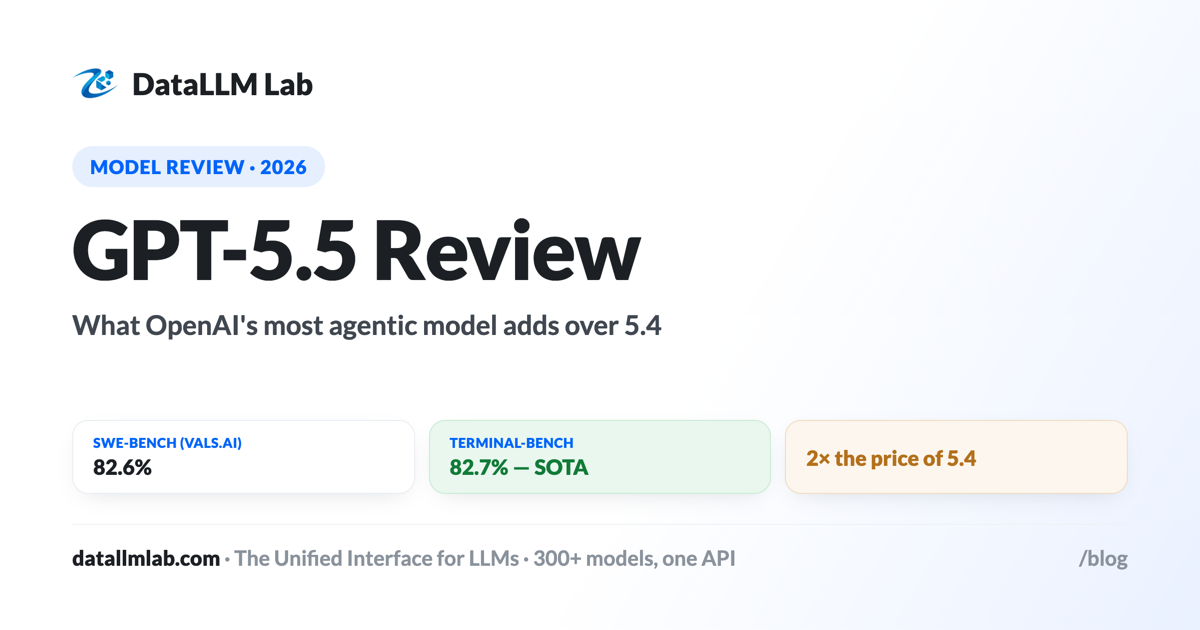
A GPT-5.5 review grounded in independent benchmarks (82.6% SWE-bench Verified), the real $5/$30 pricing, what it adds over GPT-5.4, and what you can call today.
Read article →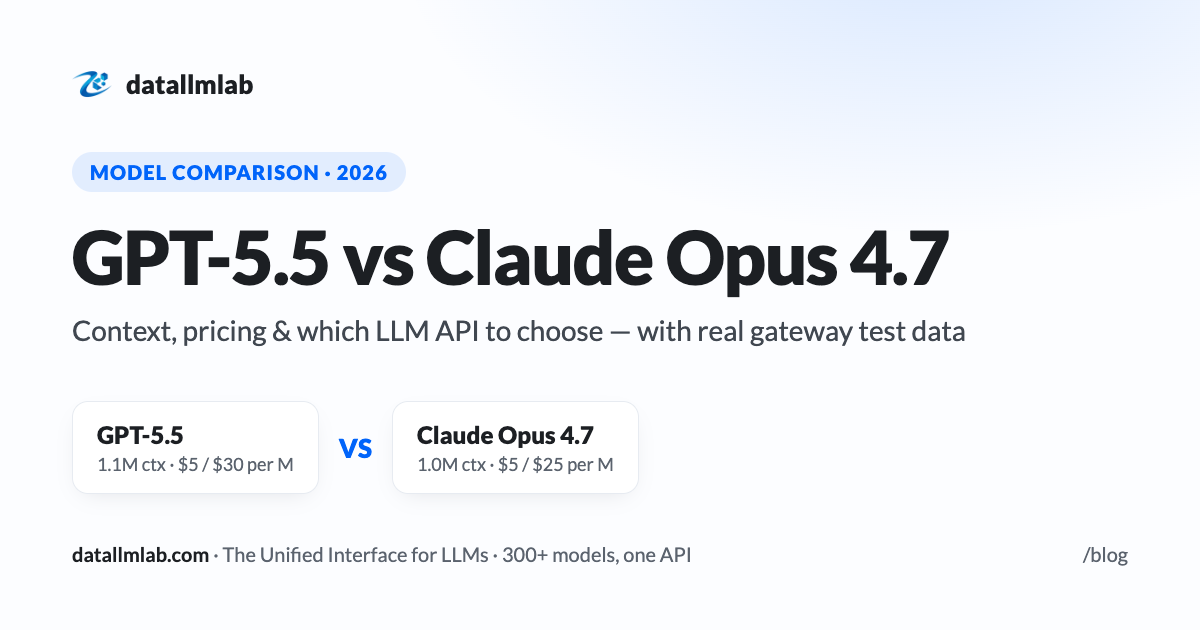
A practical 2026 comparison of GPT-5.5 vs Claude Opus 4.7 — context window, pricing and a clear pick for coding, writing and agents, with our own gateway test data.
Read article →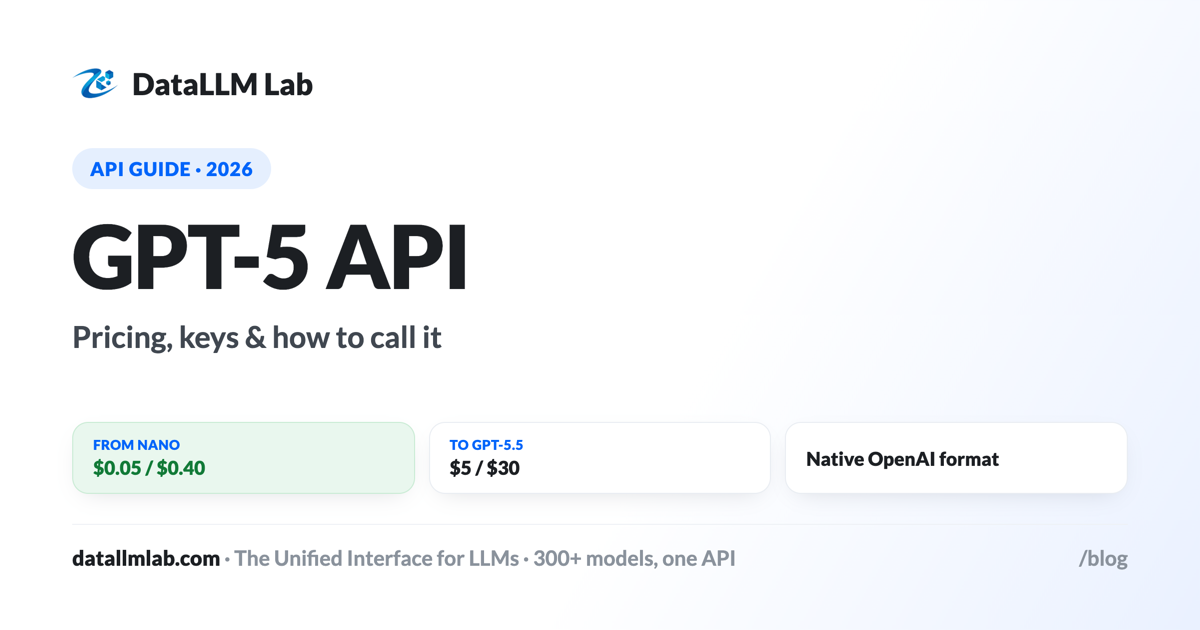
GPT-5 API pricing for the whole family (5.5, 5.4, mini, nano, Codex), how to get an OpenAI key, and how to call it — directly or through a gateway with 300+ models.
Read article →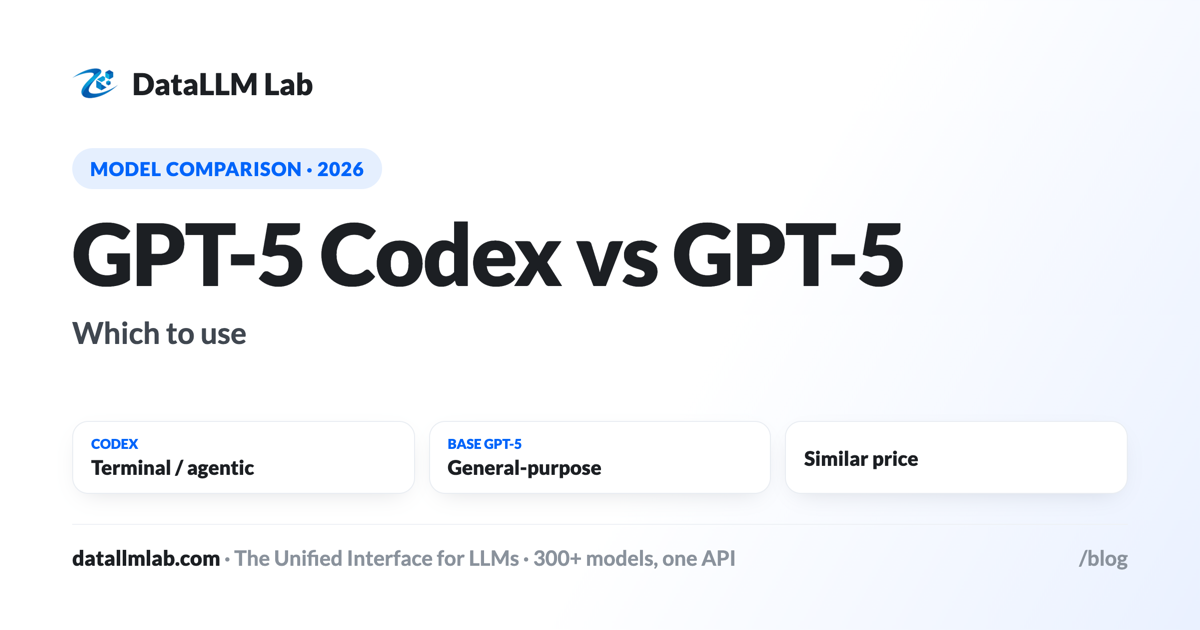
GPT-5 Codex vs GPT-5: Codex is tuned for terminal and agentic coding, base GPT-5 is the general model. Differences, modeled costs, worked scenarios, and how to call each.
Read article →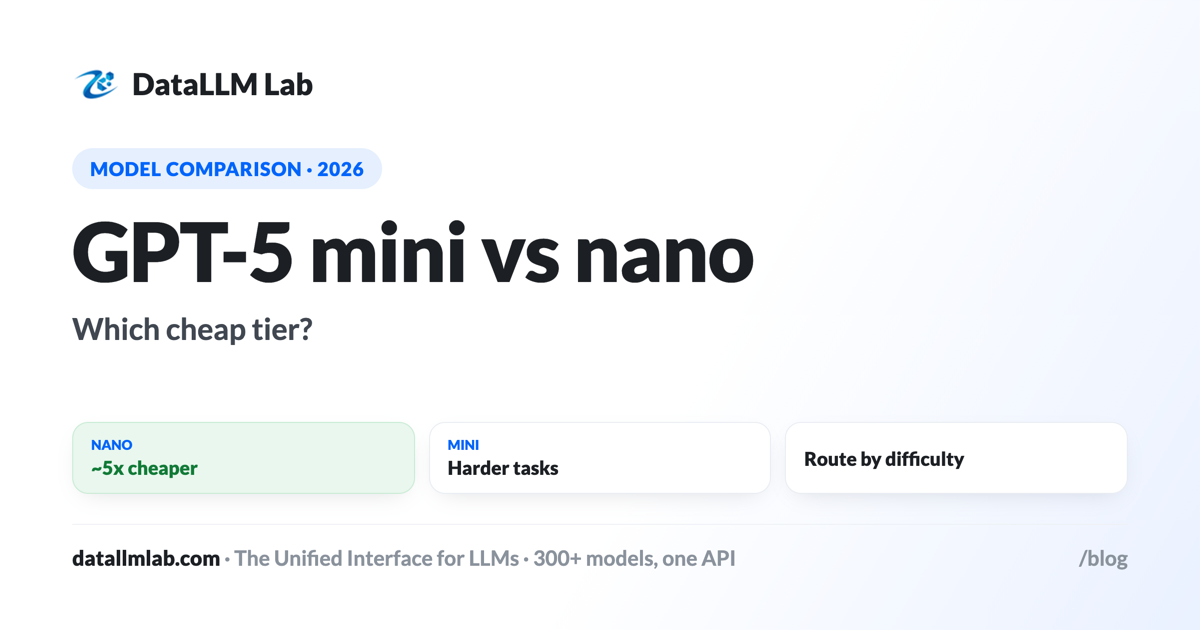
GPT-5 mini vs GPT-5 nano compared: nano is ~5x cheaper for the simplest tasks, mini handles harder ones. Prices, modeled costs, where each wins, and how to call them.
Read article →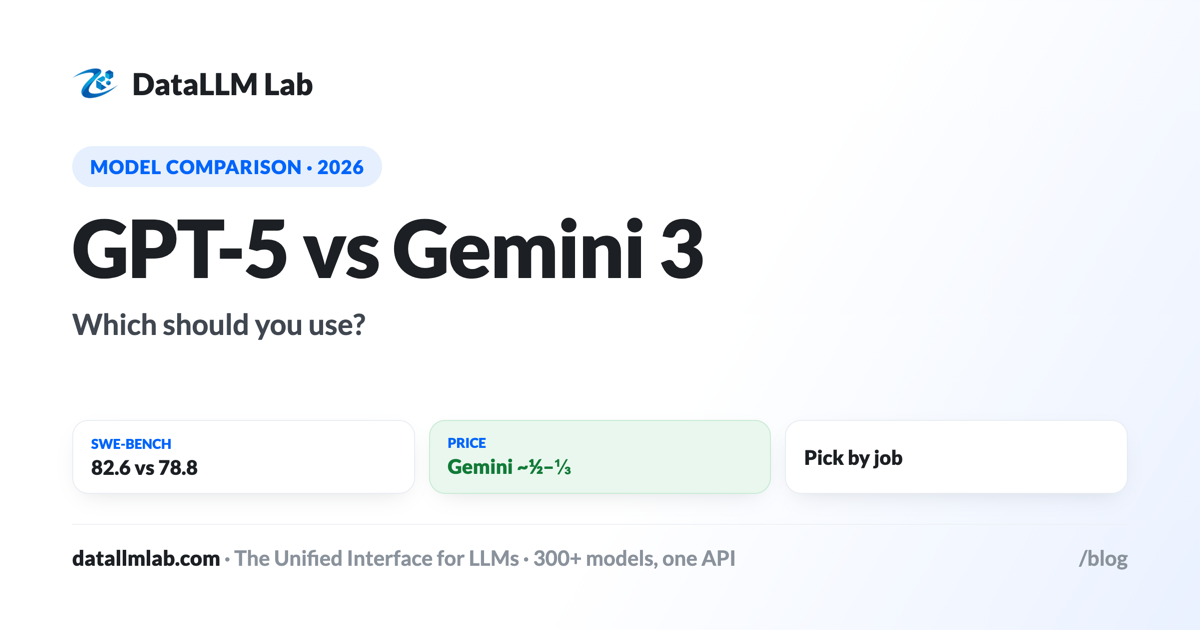
GPT-5 vs Gemini 3 compared: independent benchmarks, the big price gap (Gemini is far cheaper), where each wins, and which to pick for coding, agents, and multimodal.
Read article →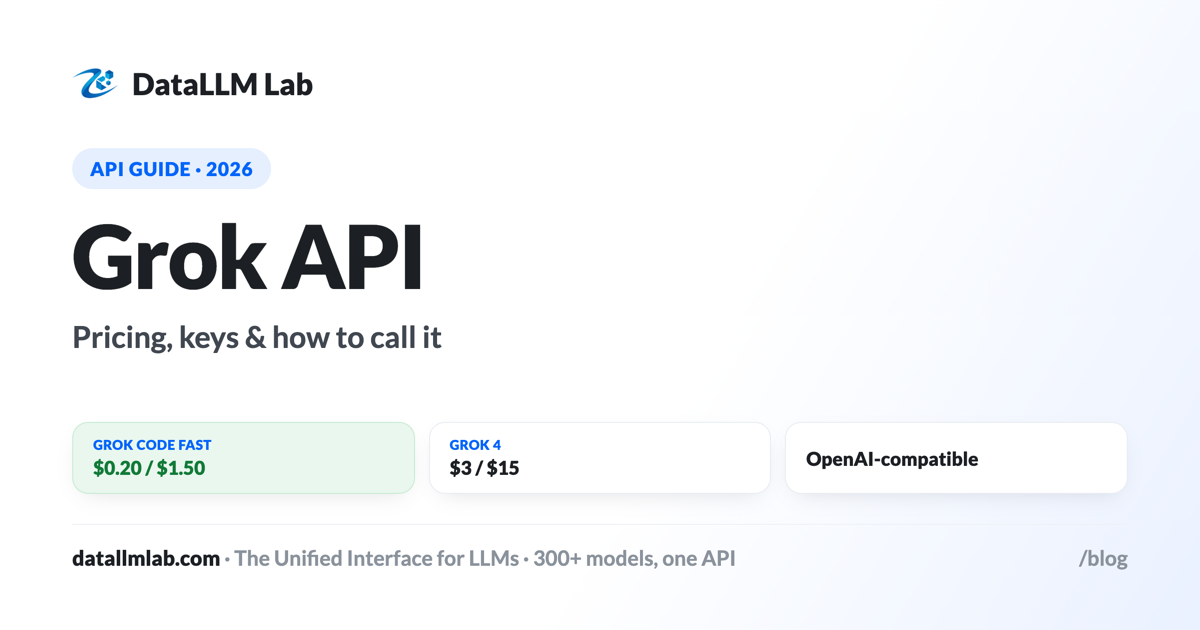
Grok API pricing for every model (Grok 4, Grok Code Fast, Grok 3), how to get an xAI key, and how to call it (OpenAI-compatible) — directly or through a gateway.
Read article →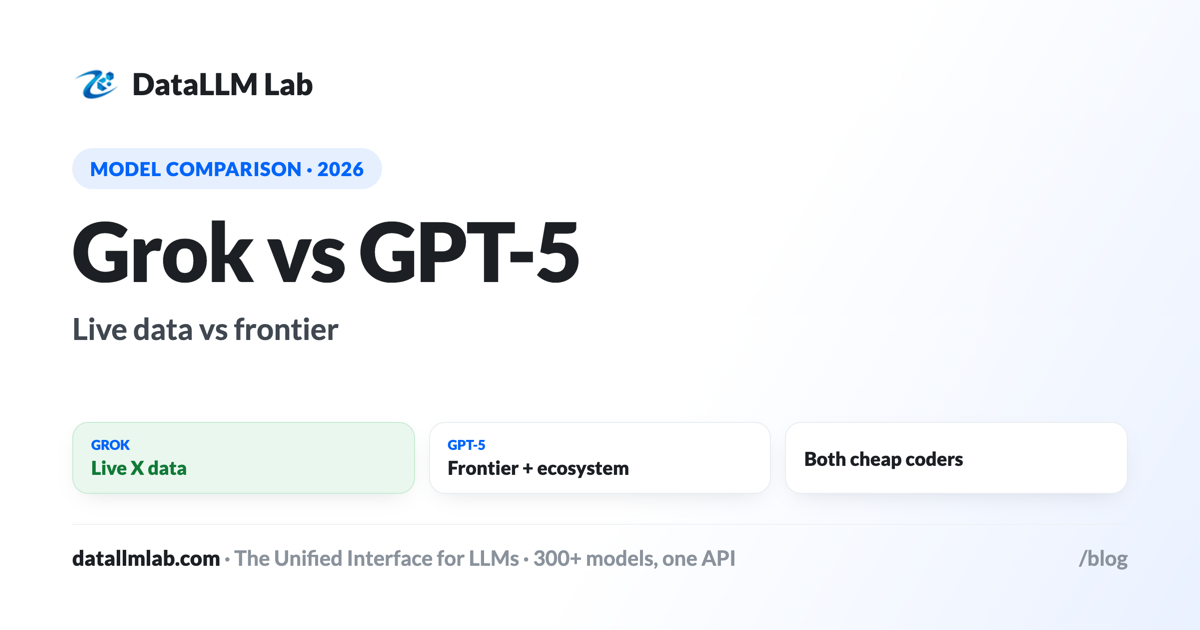
Grok vs GPT-5 compared: Grok's live X data and cheap Code Fast tier vs GPT-5's frontier quality and ecosystem. Spec table, modeled costs, and worked scenarios for which to pick.
Read article →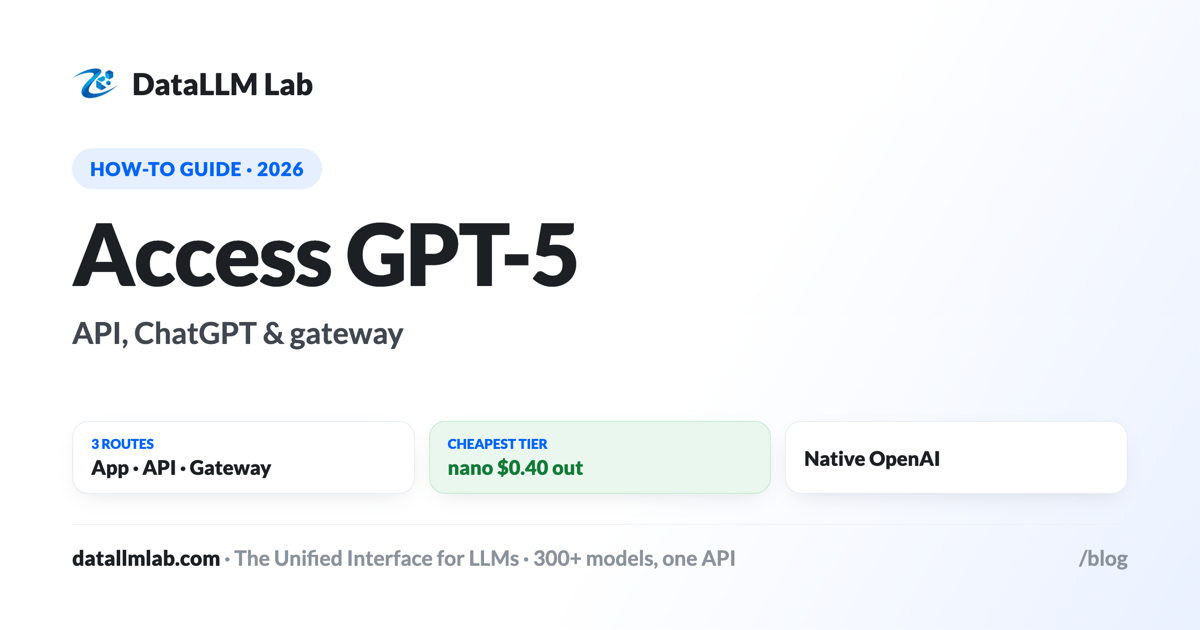
How to access GPT-5 in 2026: ChatGPT, the OpenAI API, or a gateway. Getting API access, what each tier costs on real workloads, a worked code example, rate-limit tiers, and how to cut the bill.
Read article →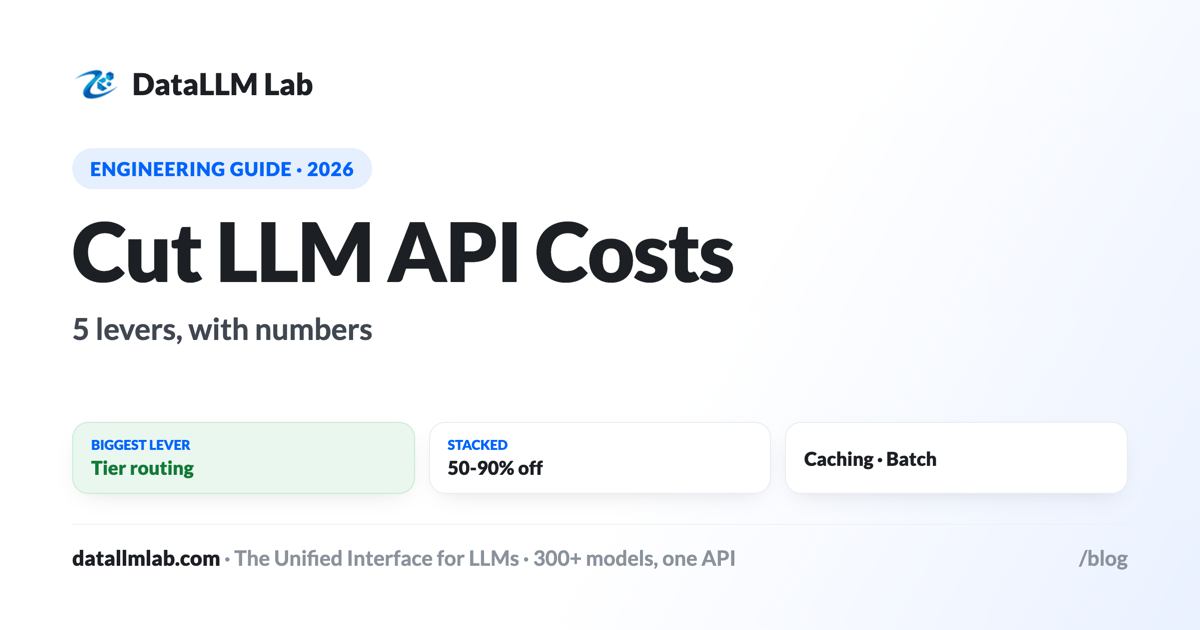
How to cut LLM API costs in 2026: right-tier routing, prompt caching, batch, tighter prompts, and cheaper models — each lever quantified with modeled monthly costs, plus a stacked example.
Read article →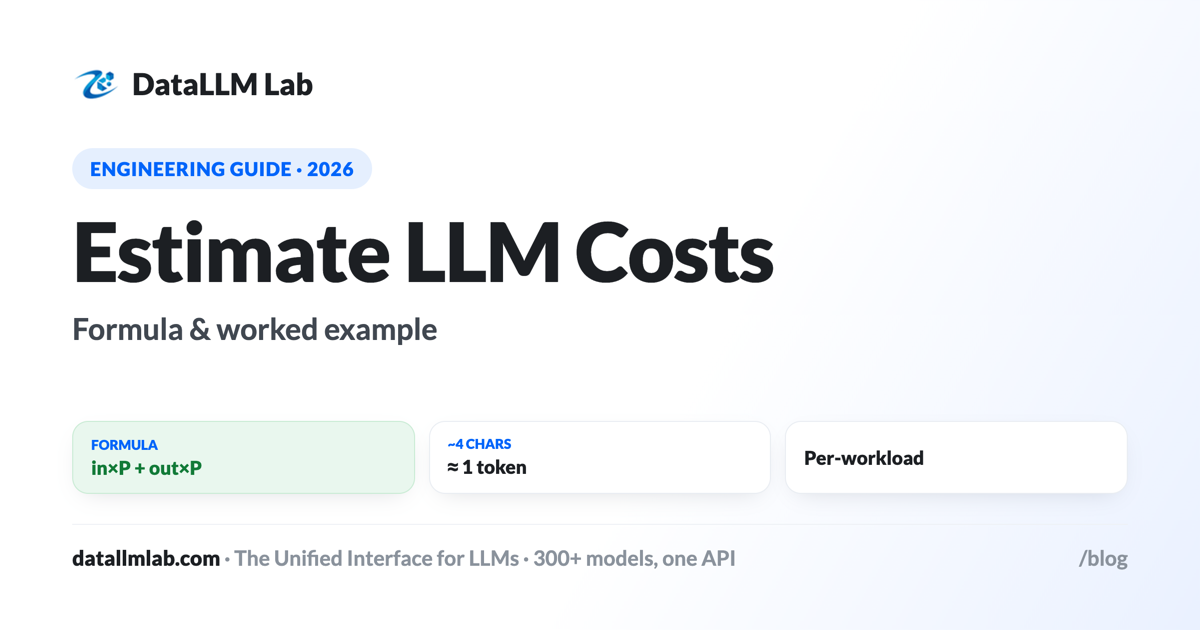
How to estimate LLM API costs before you build: the cost formula, how token counting works, a worked monthly estimate, a modeled cost table, and the assumptions that make or break it.
Read article →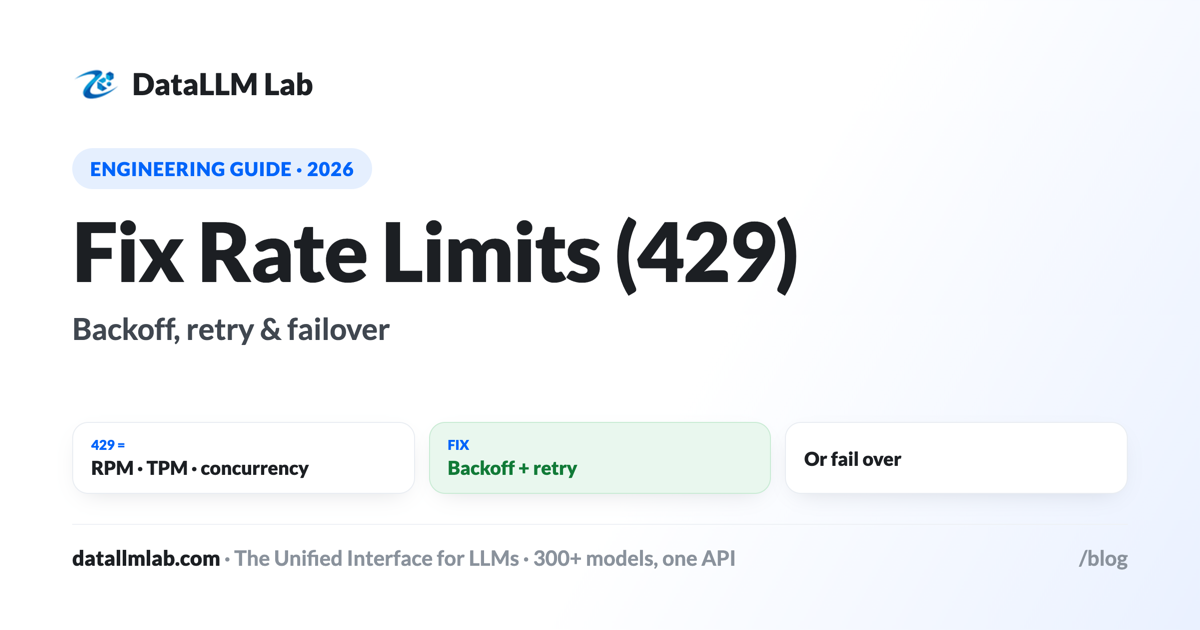
Hitting 429 rate-limit errors? How LLM rate limits work (RPM/TPM, usage tiers), why you hit them, backoff and retry code, requesting increases, and failover across providers.
Read article →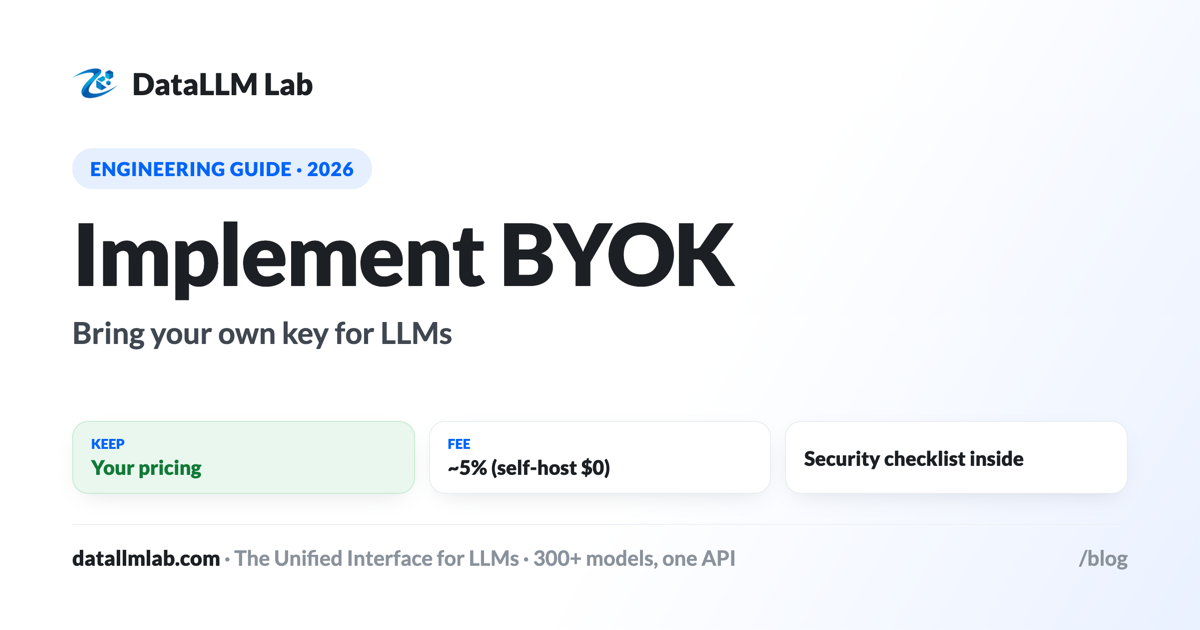
How to implement BYOK (bring your own key) for LLMs: how it works, BYOK vs credits vs direct, the fee model with a worked calculation, per-provider setup, key-scoping, and security best practices.
Read article →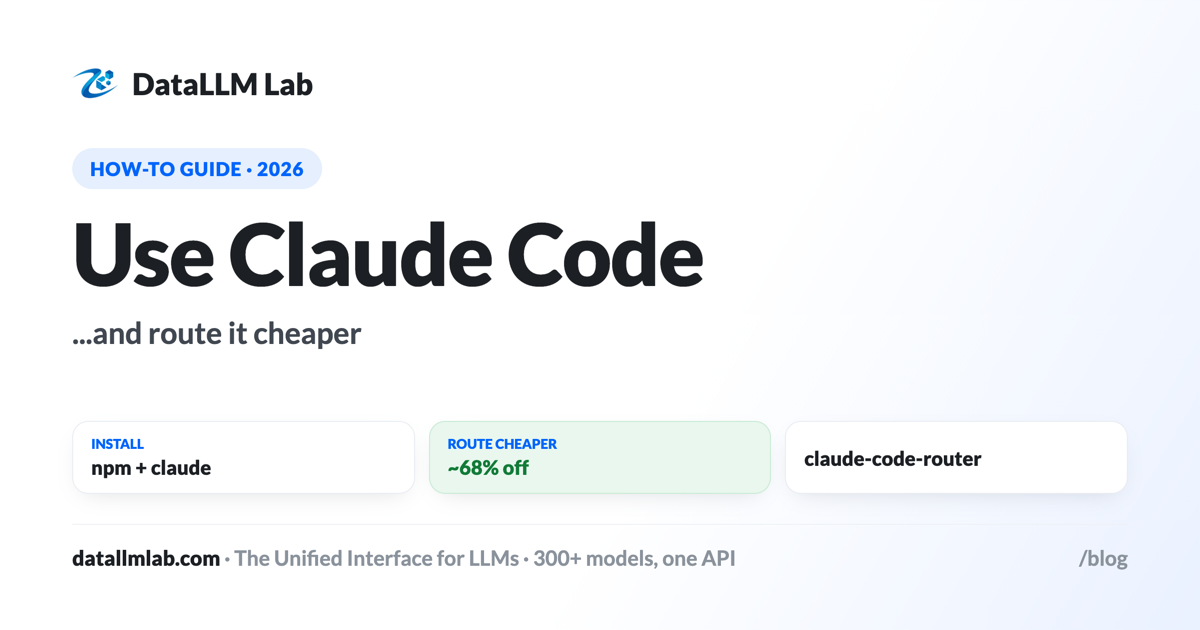
How to use Claude Code in 2026: install, set up auth, run the CLI coding agent, and the part most guides skip — how to route it to cheaper models with claude-code-router to cut the bill.
Read article →
How to use DeepSeek in 2026: the chat app, the cheap API, or self-hosting the open weights. Getting a key, a worked code example, what it costs on real workloads, context caching, and which model to pick.
Read article →
How to use Grok in 2026: the Grok app and X, or the xAI API. Getting a key, a worked code example, what each model costs on real workloads, Grok's live-search edge, and which model to pick.
Read article →
Kimi (Moonshot) API pricing for K2.6, K2.5 and K2.7 Code, what it costs on real workloads, how the cache-hit discount works and saves you money, the license, and how to call it.
Read article →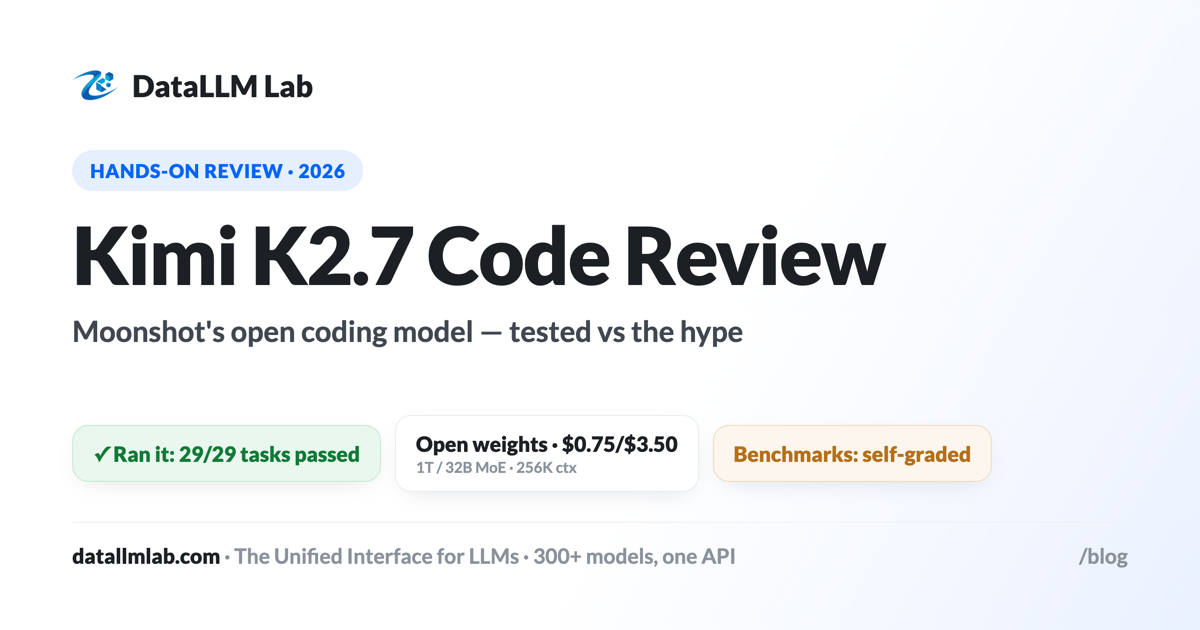
We fact-checked Moonshot's Kimi K2.7 Code against independent data and our own executed test. The 30% thinking-token cut holds up and then some — but the capability story is a trade, not an upgrade.
Read article →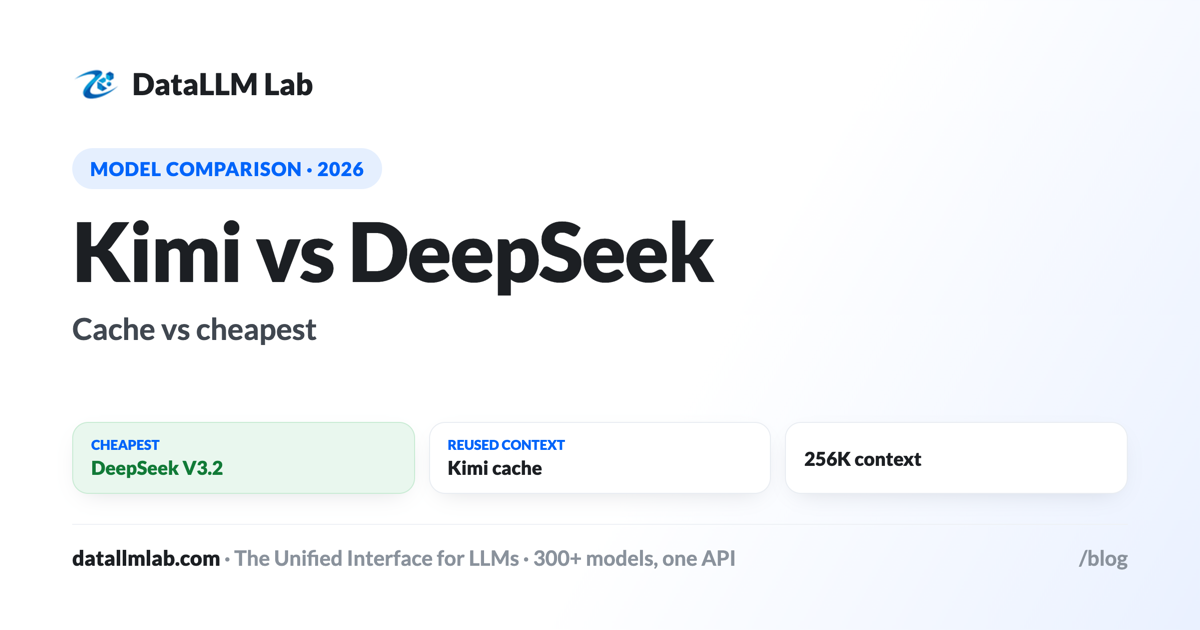
Kimi vs DeepSeek compared: Kimi's deep cache-hit discount and 256K context vs DeepSeek's cheapest-baseline pricing and reasoning depth. Modeled costs and which to pick.
Read article →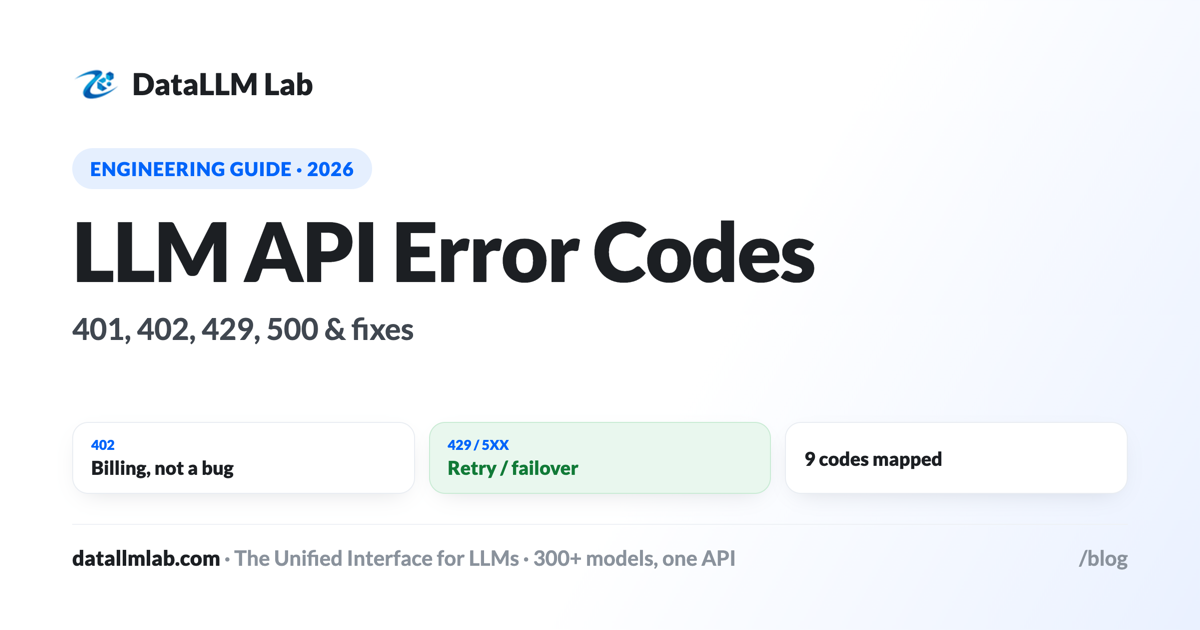
Every common LLM API error code explained — 400, 401, 402, 403, 404, 422, 429, 500, 503 — with the cause, the fix, handling code, and how failover hides provider outages.
Read article →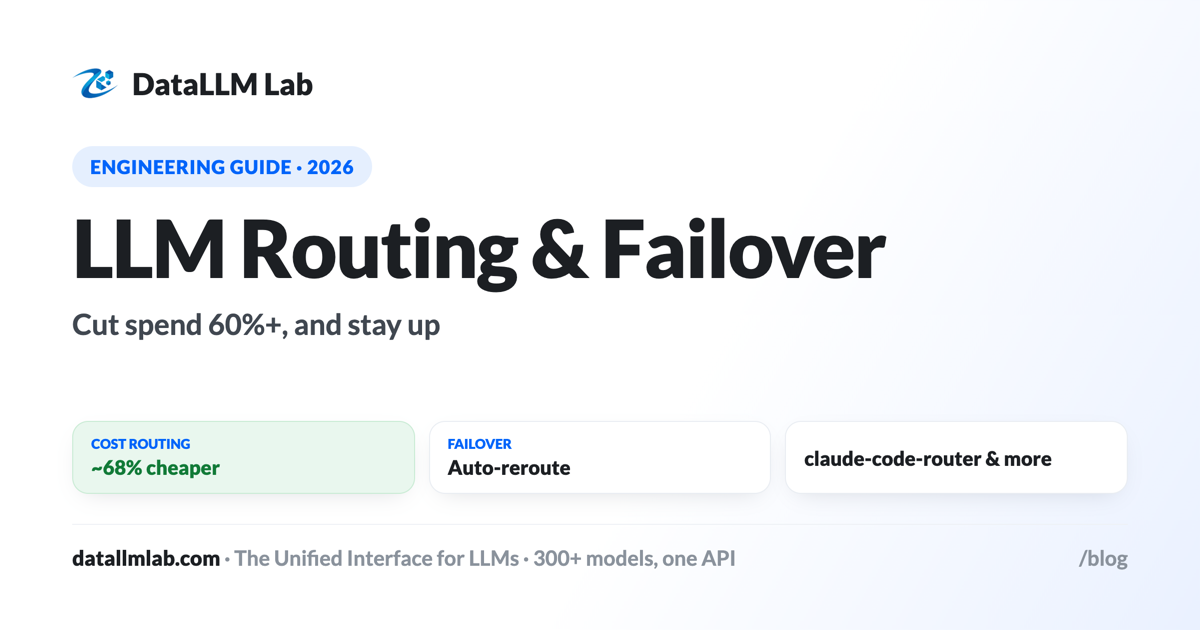
How LLM routing and failover work in 2026: cost routing (cheap-first) that cuts spend 60%+, quality routing, automatic failover, and tools like claude-code-router.
Read article →
The best Ollama alternatives for running open LLMs — LM Studio, llama.cpp, Jan, GPT4All and vLLM compared by ease, hardware and cost, plus the skip-hardware cloud gateway option.
Read article →
OpenAI-compatible APIs let you reach Claude, Gemini, DeepSeek and more by changing only the base URL and model id. What it means, why it's the standard, how to switch, and the caveats.
Read article →
An honest 2026 comparison of OpenRouter alternatives — hosted gateways, self-host routers, and direct APIs. Real fees, model counts, and who each one is actually for.
Read article →
Qwen API pricing for every tier, plus what Qwen actually costs to run on real workloads (modeled), which models are open vs closed, how to get a DashScope key, and how to call it.
Read article →
Qwen vs DeepSeek compared: both cheap and open-weights. Licenses, lineup, modeled costs, and where each wins — Qwen for breadth and Apache-2.0, DeepSeek for reasoning depth and value.
Read article →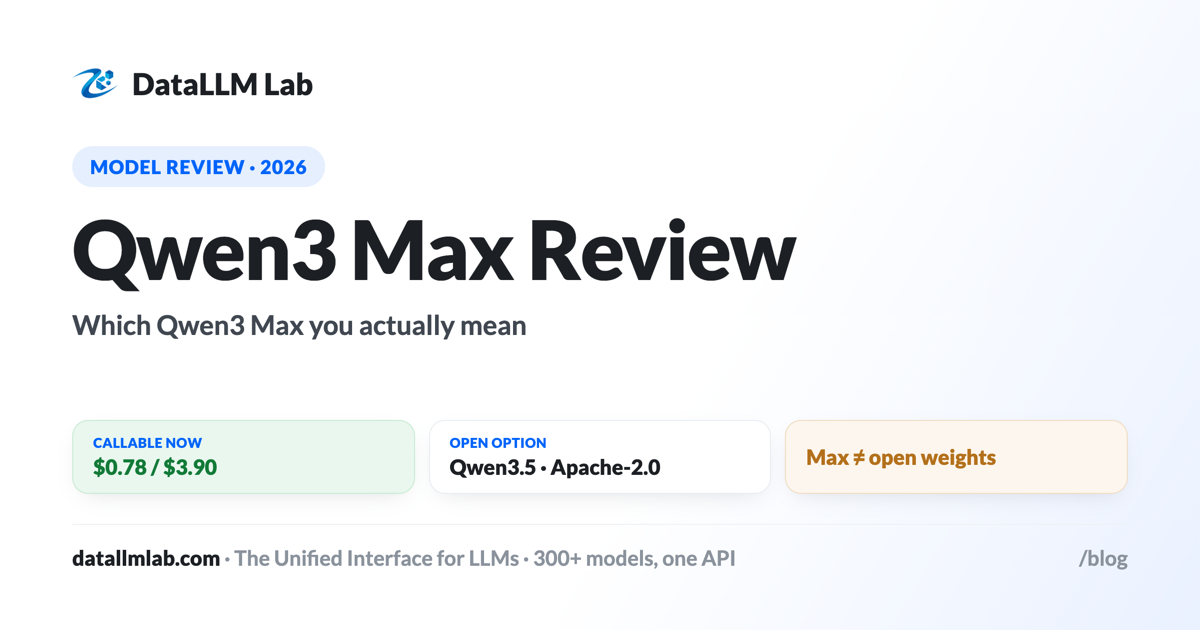
A Qwen3 Max review for 2026: real benchmarks, $0.78/$3.90 pricing, the Qwen3-Max vs Qwen3.5 vs 3.7-Max confusion cleared up, and how to call it through one API today.
Read article →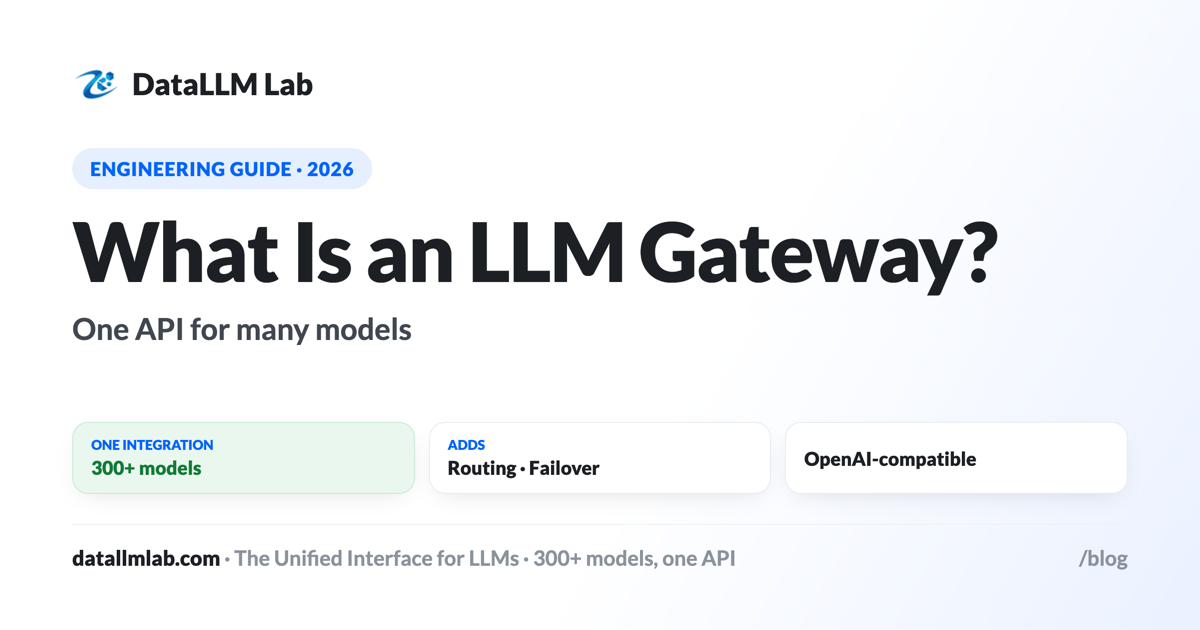
An LLM gateway is one API in front of many model providers, adding routing, failover, cost control and observability. How it works, key features, gateway vs router, and when to use one.
Read article →Opus 4.8 (most capable, $5/
Claude vs GPT-5 compared: independent benchmarks (Claude leads coding, GPT-5 leads agents), modeled monthly costs across real workloads, and worked scenarios for which to pick by job.
Read article →The best DeepSeek alternatives in 2026: Qwen, Kimi, Llama, Mistral and GLM compared on price, license, and use case — with a modeled cost table and one-line migration notes.
Read article →DeepSeek API pricing, how to get a key, rate limits, and how to call it (OpenAI-compatible). V4-Pro at $0.435/$0.87 — the cheapest frontier-class API in 2026.
Read article →DeepSeek R1 vs OpenAI o1: the open reasoning model that matched o1 at ~1/27th the price. Benchmarks, the modeled cost gap, why it reset the market, and what to deploy instead in 2026.
Read article →An honest DeepSeek V4 review: real benchmarks, the official API price ($0.435/$0.87 — not the inflated host rates), Pro vs Flash, and when to actually use it.
Read article →DeepSeek V4 vs GPT-5.5 vs Claude Opus 4.8 — independent SWE-bench scores, reconciled real pricing, 1M context, and which frontier model you can actually use today.
Read article →DeepSeek vs Claude compared: Claude leads quality, DeepSeek is open-weights and roughly 30x cheaper. Benchmarks, modeled monthly costs, and worked scenarios for which to pick.
Read article →DeepSeek vs Gemini compared: DeepSeek is open-weights and far cheaper, Gemini brings the largest context and native multimodal. Modeled costs and which to pick by job.
Read article →DeepSeek vs OpenAI compared: independent benchmarks, the order-of-magnitude price gap, open weights vs ecosystem, and which API to pick for coding, agents, and scale.
Read article →Claude Fable 5 was suspended June 12, 2026 by a U.S. export-control directive — unavailable to everyone. Here are the frontier alternatives you can call right now.
Read article →The real free LLM APIs in 2026 — which providers have genuine free tiers, the rate limits and catches, free vs trial vs self-host, and the cheapest paid options when you scale.
Read article →A Gemini 3.5 Flash review: real benchmarks (SWE-bench Verified 78.8%),
Gemini API pricing for every tier (Pro, Flash, Flash-Lite), the free tier and its limits, how to get a Google AI Studio key, and how to call it — direct or via a gateway.
Read article →Gemini vs Claude compared: Claude leads coding, Gemini wins on price, context window and multimodal. Benchmarks, modeled monthly costs, and worked scenarios for which to pick.
Read article →GLM-5.2 vs Claude: Claude leads overall quality, GLM-5.2 is the #1 open-weights model at ~1/6 the price and MIT-licensed. Benchmarks, modeled costs, and which to pick.
Read article →A GPT-5.5 review grounded in independent benchmarks (82.6% SWE-bench Verified), the real $5/$30 pricing, what it adds over GPT-5.4, and what you can call today.
Read article →A practical 2026 comparison of GPT-5.5 vs Claude Opus 4.7 — context window, pricing and a clear pick for coding, writing and agents, with our own gateway test data.
Read article →GPT-5 API pricing for the whole family (5.5, 5.4, mini, nano, Codex), how to get an OpenAI key, and how to call it — directly or through a gateway with 300+ models.
Read article →GPT-5 Codex vs GPT-5: Codex is tuned for terminal and agentic coding, base GPT-5 is the general model. Differences, modeled costs, worked scenarios, and how to call each.
Read article →GPT-5 mini vs GPT-5 nano compared: nano is ~5x cheaper for the simplest tasks, mini handles harder ones. Prices, modeled costs, where each wins, and how to call them.
Read article →GPT-5 vs Gemini 3 compared: independent benchmarks, the big price gap (Gemini is far cheaper), where each wins, and which to pick for coding, agents, and multimodal.
Read article →Grok API pricing for every model (Grok 4, Grok Code Fast, Grok 3), how to get an xAI key, and how to call it (OpenAI-compatible) — directly or through a gateway.
Read article →Grok vs GPT-5 compared: Grok's live X data and cheap Code Fast tier vs GPT-5's frontier quality and ecosystem. Spec table, modeled costs, and worked scenarios for which to pick.
Read article →How to access GPT-5 in 2026: ChatGPT, the OpenAI API, or a gateway. Getting API access, what each tier costs on real workloads, a worked code example, rate-limit tiers, and how to cut the bill.
Read article →How to cut LLM API costs in 2026: right-tier routing, prompt caching, batch, tighter prompts, and cheaper models — each lever quantified with modeled monthly costs, plus a stacked example.
Read article →How to estimate LLM API costs before you build: the cost formula, how token counting works, a worked monthly estimate, a modeled cost table, and the assumptions that make or break it.
Read article →Hitting 429 rate-limit errors? How LLM rate limits work (RPM/TPM, usage tiers), why you hit them, backoff and retry code, requesting increases, and failover across providers.
Read article →How to implement BYOK (bring your own key) for LLMs: how it works, BYOK vs credits vs direct, the fee model with a worked calculation, per-provider setup, key-scoping, and security best practices.
Read article →How to use Claude Code in 2026: install, set up auth, run the CLI coding agent, and the part most guides skip — how to route it to cheaper models with claude-code-router to cut the bill.
Read article →How to use DeepSeek in 2026: the chat app, the cheap API, or self-hosting the open weights. Getting a key, a worked code example, what it costs on real workloads, context caching, and which model to pick.
Read article →How to use Grok in 2026: the Grok app and X, or the xAI API. Getting a key, a worked code example, what each model costs on real workloads, Grok's live-search edge, and which model to pick.
Read article →Kimi (Moonshot) API pricing for K2.6, K2.5 and K2.7 Code, what it costs on real workloads, how the cache-hit discount works and saves you money, the license, and how to call it.
Read article →Kimi K2.7 Code is Moonshot's cheap, open-weights coding model. We ran it on real coding tasks and read the benchmarks — here's where the hype holds up and where it doesn't.
Read article →Kimi vs DeepSeek compared: Kimi's deep cache-hit discount and 256K context vs DeepSeek's cheapest-baseline pricing and reasoning depth. Modeled costs and which to pick.
Read article →Every common LLM API error code explained — 400, 401, 402, 403, 404, 422, 429, 500, 503 — with the cause, the fix, handling code, and how failover hides provider outages.
Read article →How LLM routing and failover work in 2026: cost routing (cheap-first) that cuts spend 60%+, quality routing, automatic failover, and tools like claude-code-router.
Read article →The best Ollama alternatives for running open LLMs — LM Studio, llama.cpp, Jan, GPT4All and vLLM compared by ease, hardware and cost, plus the skip-hardware cloud gateway option.
Read article →OpenAI-compatible APIs let you reach Claude, Gemini, DeepSeek and more by changing only the base URL and model id. What it means, why it's the standard, how to switch, and the caveats.
Read article →An honest 2026 comparison of OpenRouter alternatives — hosted gateways, self-host routers, and direct APIs. Real fees, model counts, and who each one is actually for.
Read article →Qwen API pricing for every tier, plus what Qwen actually costs to run on real workloads (modeled), which models are open vs closed, how to get a DashScope key, and how to call it.
Read article →Qwen vs DeepSeek compared: both cheap and open-weights. Licenses, lineup, modeled costs, and where each wins — Qwen for breadth and Apache-2.0, DeepSeek for reasoning depth and value.
Read article →A Qwen3 Max review for 2026: real benchmarks, $0.78/$3.90 pricing, the Qwen3-Max vs Qwen3.5 vs 3.7-Max confusion cleared up, and how to call it through one API today.
Read article →An LLM gateway is one API in front of many model providers, adding routing, failover, cost control and observability. How it works, key features, gateway vs router, and when to use one.
Read article →GPT-5.5, Claude Opus 4.7, Nano Banana and 300+ more — one key, automatic price comparison and routing.
 DataLLM Lab