 DataLLM Lab
GLM-5 vs Claude in 2026: Open Frontier vs the Best
GLM-5.2 (Zhipu/Z.ai) and Claude (Anthropic) sit on opposite sides of the open-vs-closed divide. Claude's flagships rank at the very top of the independent Artificial Analysis Index; GLM-5.2 is the #1 open-weights model on that same Index, MIT-licensed, and lists at $0.72 input / $2.27 output per million tokens against Claude Opus 4.8's $5 / $25 — 6.9x cheaper on input, 11.0x on output (list prices captured 29 July 2026). That price gap turns out to be the misleading number: when we ran GLM-5.2, Claude Sonnet 5, and Claude Opus 4.8 through the same nine executed coding tasks, GLM-5.2's real saving against Sonnet 5 came to under 10% per finished task, not the 4x its rate card advertises — and at the list prices in force on the run date it cost more per finished task, not less. This guide compares them on independent benchmarks, on our own measured run, and on modeled cost, then gives a clear pick by job and constraint.
The short answer
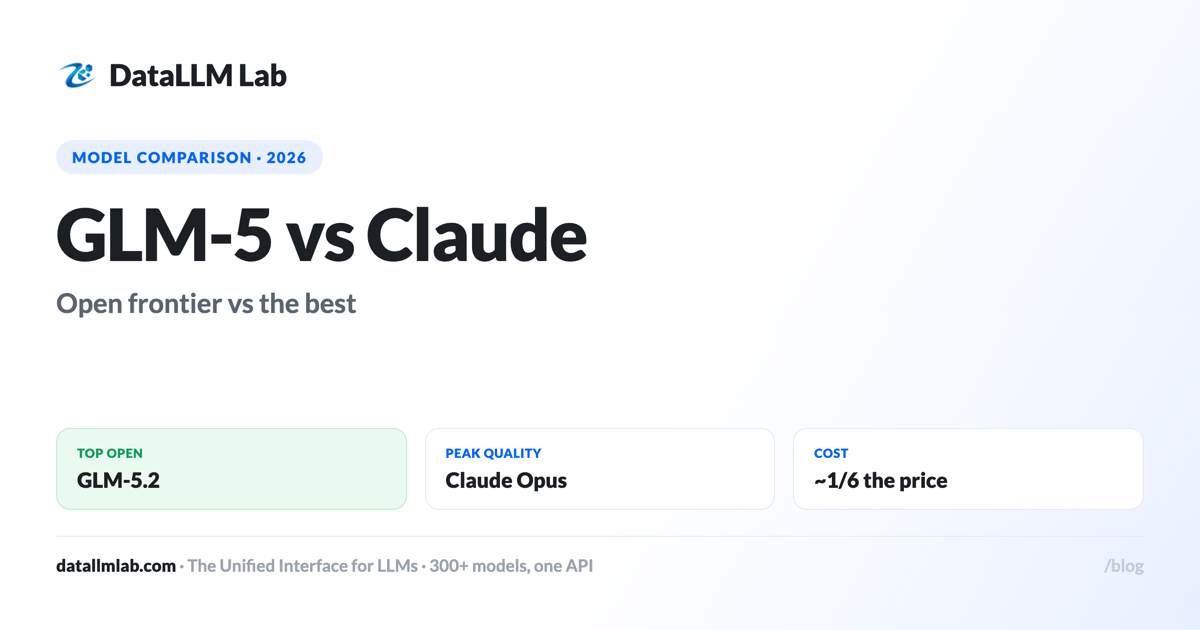
Claude for peak quality; GLM-5.2 for open weights and self-hosting. On the independent Artificial Analysis Index, Claude's flagships rank at the top and GLM-5.2 ranks #4 overall — but GLM-5.2 is the #1 open-weights model, MIT-licensed, self-hostable, and much cheaper per token: $0.72 / $2.27 per million against Claude Opus 4.8's $5 / $25 (6.9x on input, 11.0x on output) and Claude Sonnet 5's $2 / $10. All list prices here were captured 29 July 2026.
The cheap-vs-expensive framing does not survive contact with a real workload. We ran GLM-5.2, Claude Sonnet 5, and Claude Opus 4.8 through the same nine executed coding tasks. All three scored 9/9. At the list prices in force on the run date, GLM-5.2 cost $1.99 per 1,000 tasks — more than Claude Sonnet 5 at $1.67, despite listing about 3x cheaper per token at the time. Z.ai's late-July cut to $0.72 / $2.27 reprices that same run to roughly $1.5 and does put GLM-5.2 back in front — but by under 10%, not by the 4.0x its rate card now advertises. It was also the slowest of the three (12.3 s average latency, against 7.2 s for Sonnet 5). If your reason for picking GLM-5.2 is price, size the saving against your own workload before committing; the list-price multiple is not it. If it's the MIT license, that reason holds unconditionally. Full numbers below.
Side by side
| GLM-5.2 (Z.ai) | Claude (Anthropic) | |
|---|---|---|
| Flagship | GLM-5.2 | Opus 4.8 |
| AA Intelligence Index | 51 (#1 open-weights) | Higher overall (Opus 4.8 above) |
| Flagship price (in/out) | $0.72 / $2.27 | $5 / $25 |
| Workhorse price (in/out) | $0.72 / $2.27 | $2 / $10 (Sonnet 5) |
| Open weights | Yes (MIT) | No (API-only) |
| Context window | 1M | 1M |
| Best at | Open-weights value, agentic coding | Peak quality, instruction-following |
Benchmarks
The independent signal is the Artificial Analysis Intelligence Index: GLM-5.2 scores 51 — #1 among open-weights models, #4 overall, behind Claude Fable 5, Claude Opus 4.8, and GPT-5.5. So on independent overall capability, Claude's flagships rank above GLM-5.2, while GLM-5.2 is the best open model you can run yourself.
On coding specifically, the two cite different benchmarks: Claude Opus leads independent SWE-bench Verified (88.6%); GLM-5.2 posts a vendor-reported SWE-bench Pro 62.1 (a different, harder benchmark — not directly comparable). Treat GLM's vendor numbers as framing until independently reproduced, and lean on the Index for the apples-to-apples read.
What we measured ourselves
Indexes rank models. They don't tell you what a finished piece of work costs. So we ran our own harness: 13 models, 9 executed Python tasks, temperature 0, max_tokens 4000, scored by running each model's returned code against assertions it never sees. Three of those 13 are the models this article is about.
| Model | Score | $ / 1,000 tasks at 17 Jul 2026 list prices | Avg latency | Reasoning tokens |
|---|---|---|---|---|
| Claude Sonnet 5 | 9/9 | $1.67 | 7.2 s | 0 |
| GLM-5.2 | 9/9 | $1.99 | 12.3 s | 559 |
| Claude Opus 4.8 | 9/9 | $4.05 | 6.1 s | 0 |
All three got every task right, so the separation is cost and speed, not correctness — and the per-token discount mostly evaporated on the way to a finished task. Priced at the list rates in force on the run date, GLM-5.2 came in at $1.99 per 1,000 tasks against Claude Sonnet 5's $1.67 — the reverse of what the price sheet predicted, since GLM-5.2 then listed at $0.93 / $3.00 per million against Sonnet 5's $2 / $10, about 3.1x cheaper on the two rates added together before a single token was spent. The reason is in the last column: GLM-5.2 logged 559 reasoning tokens; both Claude models logged 0. A cheaper token you have to buy more of is not a cheaper task. Claude Opus 4.8 is genuinely the expensive one here at $4.05, but it was also the fastest of the three at 6.1 s — the tidy assumption that the premium model is the slow one did not hold.
Z.ai has since cut the price, which flips the ordering but not the lesson. As of 29 July 2026 GLM-5.2 lists at $0.72 / $2.27 — about 23% off input and 24% off output. We have not re-run the harness, so the $1.99 above stands as measured, at the older rates. Repricing the same token counts at the new rates puts GLM-5.2 near $1.5 per 1,000 tasks, under Claude Sonnet 5's $1.67. So on this workload GLM-5.2 is now the cheaper of the two per finished task — by under 10%, against per-token rates that make it look 4.0x cheaper ($2.99 versus $12.00 per million, the two rates added). That collapse from 4x on the rate card to single digits in the bill is the durable finding here, and no price cut repairs it: reasoning tokens you never asked for eat most of a per-token discount.
Two things follow. First, per-token list prices are a lower bound on cost, not a forecast: any model that thinks before it answers spends tokens you're billed for and didn't ask for. Second, the reasoning-token gap is a workload variable, not a constant — on harder tasks GLM-5.2 would think more, and the gap would widen; on trivial ones it would shrink. Measure on your own prompts before you assume a direction.
What they cost to run
Below the measured run sits the ordinary token math, which is where the big multiples come from. Against Claude Opus 4.8, GLM-5.2 is 6.9x cheaper on input ($0.72 vs $5), 11.0x cheaper on output ($2.27 vs $25), and 10.0x cheaper on the two rates added together ($2.99 vs $30 per million) — which of those three applies to you depends entirely on your input/output mix, so a bare cheaper by Nx with no basis attached is worth nothing. All of it assumes both models emit the same number of tokens for the same job, the assumption our harness just showed is wrong. Prices below were captured 29 July 2026; treat this table as a dated list-price comparison, not a bill:
| Monthly workload | Claude Opus 4.8 $5 / $25 | Claude Sonnet 5 $2 / $10 | GLM-5.2 $0.72 / $2.27 | Claude Haiku 4.5 $1 / $5 |
|---|---|---|---|---|
| Support chatbot | $500 | $200 | $56 | $100 |
| RAG / knowledge base | $1,500 | $600 | $189 | $300 |
| Coding agent | $1,025 | $410 | $114 | $205 |
| Batch extraction | $950 | $380 | $126 | $190 |
| Content generation | $1,100 | $440 | $105 | $220 |
On list price alone, GLM-5.2 undercuts even Claude Haiku 4.5 — the cheapest Claude tier, which we did not benchmark — on every row of this model. Whether that holds in a bill depends on how much your workload makes GLM-5.2 think: on the nine tasks we actually executed, its advantage over Claude Sonnet 5 shrank from the 3.0x-to-4.2x this table implies, depending on the row, to under 10% — and at the prices in force on the run date it disappeared altogether. Run the model math for planning, then measure.
Where GLM-5.2 wins
- Open weights (MIT) — self-host, fine-tune, full data control. Claude can't. This is the durable advantage; the price one is conditional.
- Per-token list price — $0.72 / $2.27 against Claude Opus 4.8's $5 / $25: 6.9x cheaper on input, 11.0x on output, 10.0x on the two rates added together (captured 29 July 2026). The per-task gap we measured was far smaller — under 10% against Sonnet 5, and at the run date's prices it ran the other way.
- Top open model — #1 open-weights on the independent Index, and 9/9 in our own executed-code run.
Where Claude wins
- Peak quality — Opus 4.8 ranks above GLM-5.2 on the independent Index.
- Coding — leads independent SWE-bench Verified; strong planning/instruction-following.
- Predictable token spend — Sonnet 5 and Opus 4.8 logged 0 reasoning tokens in our run; GLM-5.2 logged 559. At the prices in force on the run date that alone put Sonnet 5 ahead on cost per finished task ($1.67 against $1.99). GLM-5.2's July price cut has since taken that particular win away, but the effect remains: it turns a 4x list-price gap into a single-digit one.
- Latency — Claude Opus 4.8 was the fastest of the three at 6.1 s average, and Sonnet 5 at 7.2 s beat GLM-5.2's 12.3 s.
- Ecosystem & reliability — mature tooling and agentic track record.
Which to pick
Peak quality Claude Opus
- When the outcome justifies the top model and the price.
Open weights GLM-5.2
- Frontier-adjacent quality under an MIT license, 6.9x cheaper than Opus 4.8 on input tokens and 11.0x on output — verify the saving on your workload; ours came out far smaller.
Self-host GLM-5.2
- Data must stay in your infrastructure — Claude is API-only.
Best move Route both
- GLM-5.2 for the bulk, escalate to Claude on the hardest tasks.
Route GLM-5.2 and Claude from one key
GLM-5.2, Claude Opus 4.8, and 300+ more — one OpenAI-compatible endpoint, cheap-first routing, escalate to a flagship on hard tasks.
FAQ
Is GLM-5 better than Claude?
Overall, Claude leads — Opus 4.8 ranks above GLM-5.2 on the independent Index (GLM-5.2 is #4 overall, #1 open-weights). GLM-5.2 wins on openness and on per-token list price — $0.72 / $2.27 against Opus 4.8's $5 / $25, so 6.9x cheaper on input and 11.0x on output (captured 29 July 2026) — though in our own run its real per-task edge over Claude Sonnet 5 came to under 10%, and at the run date's prices it was not cheaper at all. Claude for peak; GLM-5.2 for open weights.
Is GLM-5.2 cheaper than Claude?
Per token, yes — GLM-5.2 is $0.72/$2.27 per million, against Sonnet 5 at $2/$10 and Opus 4.8 at $5/$25 (captured 29 July 2026). Per finished task, by much less: in our nine-task executed-code run, priced at the rates in force on 17 July 2026, GLM-5.2 cost $1.99 per 1,000 tasks, above Claude Sonnet 5 at $1.67 (Opus 4.8 was $4.05). GLM-5.2 logged 559 reasoning tokens there; both Claude models logged 0. Its later price cut reprices that run to about $1.5 — now under Sonnet 5, but by under 10%, not the 4x the rate card suggests.
GLM-5 or Claude for coding?
Claude Opus leads SWE-bench Verified (88.6%) and planning; GLM-5.2 is a strong agentic coder (vendor SWE-bench Pro 62.1). On our nine executed Python tasks all three scored 9/9, so the split was cost and speed: at the run date's list prices, Sonnet 5 $1.67/1,000 at 7.2 s, GLM-5.2 $1.99 at 12.3 s, Opus 4.8 $4.05 at 6.1 s. GLM-5.2's July price cut reprices its run to roughly $1.5, just under Sonnet 5; the latency gap is unchanged.
Is GLM-5 open source and Claude not?
Yes — GLM-5.2 is open-weights (MIT), self-hostable; Claude is proprietary, API-only. For self-hosting, GLM-5.2 is the option.
When should I use Claude over GLM-5.2?
When peak quality/reliability/instruction-following drives the outcome — Claude ranks above on the Index and leads coding. Use GLM-5.2 for cost-sensitive, open, or self-hosted work.
Can I use both with one API?
Yes — via an OpenAI-compatible gateway like DataLLM Lab, reach GLM-5.2 and Claude Opus 4.8 (and 300+ others) with one key and route by difficulty.
Does GLM-5.2 beat Claude on any benchmark?
It leads all open-weights on the independent Index and posts strong vendor numbers, and in our nine-task executed-code run it matched both Claude models at 9/9 — a tie, not a win. Claude's flagships still rank above it overall. Treat GLM's competitor comparisons as vendor framing.
Which has the bigger context window?
Tied — both GLM-5.2 and the latest Claude offer 1M-token context.