 DataLLM Lab
GPT-6 Sol Review: Same Rate Card, Three Different Bills (9/9 at $2.03)
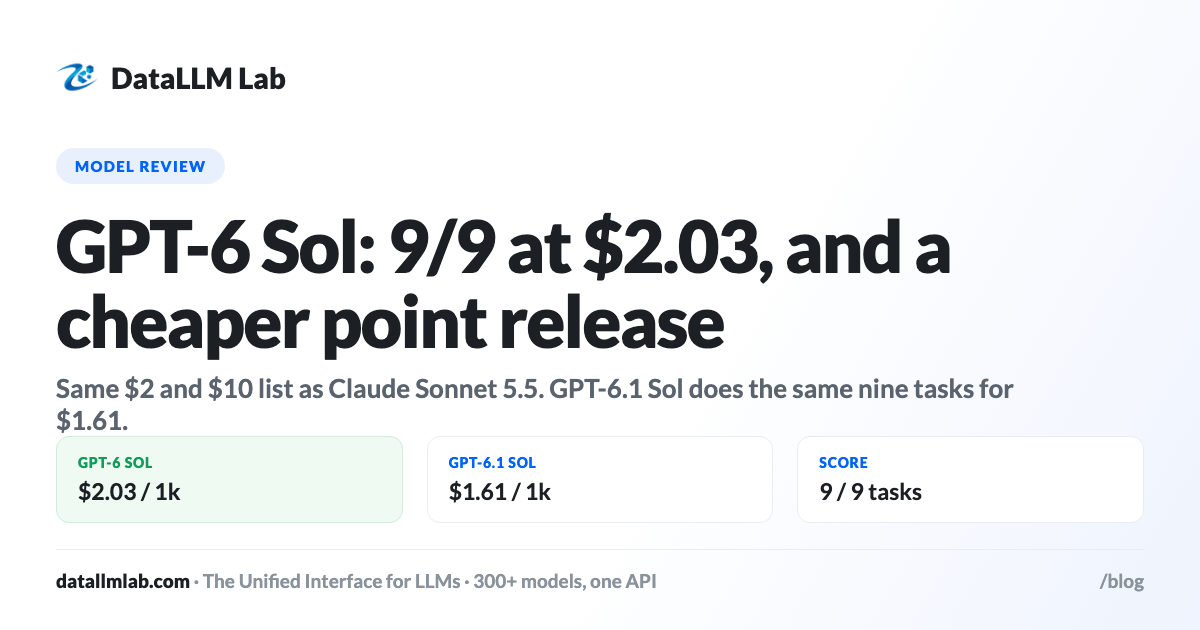
GPT-6 Sol scored 9 out of 9 on our executed Python benchmark at $2.03 per 1,000 tasks (priced 2026-10-02), with a 5.2-second mean and 85 reasoning tokens per call. That is roughly a quarter of what GPT-6 Astra cost on the same suite (priced 2026-09-15). The surprise is what sits beside it. In our 2026-10-02 sweep, three standard, non-Pro models list at exactly $2 in and $10 out per million tokens, all three scored 9 out of 9 — and GPT-6 Sol is the most expensive of those three. Claude Sonnet 5.5 came in at $1.95. GPT-6.1 Sol, OpenAI's own point release a week later, came in at $1.61. And GPT-6 Sol Pro, same list price again, cost $7.45 because it consumed 16,898 input tokens on the nine prompts that plain Sol read in 604.
A rate card tells you the price of a token. It does not tell you how many tokens a model will spend to answer you, and on this suite that second number decided the ranking among models that cost exactly the same per token.
The result
| Metric | GPT-6 Sol | GPT-6 Sol Pro |
|---|---|---|
| Score | 9/9 | 9/9 |
| Measured cost / 1,000 tasks (priced 2026-10-02) | $2.03 | $7.45 |
| Mean latency | 5.2s | 5.9s |
| Reasoning tokens per call | 85 | 158 |
| Input tokens across the suite | 604 | 16,898 |
| Output tokens across the suite | 1,704 | 3,322 |
| List price in / out, per 1M | $2 / $10 | $2 / $10 |
| Context window | 1,050,000 | 1,050,000 |
| Rank among the 75 models at 9/9 | 36th cheapest · 26th fastest | 64th cheapest · 30th fastest |
Plain GPT-6 Sol is a tidy model on short coding work: it solved every task first time, thought for 85 tokens a call, and finished mid-table on both cost and speed among the 75 models that had scored 9 out of 9 as of 2026-10-02. Against its own family flagship the price gap is large. GPT-6 Astra scored the same 9 out of 9 at $8.19 (priced 2026-09-15) on a $10 / $50 rate card; Sol's $2 / $10 is exactly one-fifth of that, and its measured cost is about a quarter ($8.19 ÷ $2.03 = 4.0).
Third-party context, read 2026-10-02: The New Stack dates the GPT-6 Sol and Luna release to 2026-09-22, under a headline saying OpenAI cut token prices in half. We have not verified the size of that cut against our own records, so we report only the price we measured at.
One rate card, three bills
Four models in our 2026-10-02 sweep list at $2 per million input and $10 per million output — three standard tiers plus Sol Pro — and all four cleared the suite:
| Model | Score | Cost / 1k tasks (2026-10-02) | Latency | Reasoning / call | In / out tokens |
|---|---|---|---|---|---|
| GPT-6.1 Sol | 9/9 | $1.61 | 5.9s | 48 | 604 / 1,329 |
| Claude Sonnet 5.5 | 9/9 | $1.95 | 3.4s | 31 | 914 / 1,569 |
| GPT-6 Sol | 9/9 | $2.03 | 5.2s | 85 | 604 / 1,704 |
| GPT-6 Sol Pro | 9/9 | $7.45 | 5.9s | 158 | 16,898 / 3,322 |
GPT-6 Sol and Claude Sonnet 5.5 are, on this workload, the same purchase: eight cents per thousand tasks apart ($2.03 − $1.95), inside the noise of a single scored run. They get there differently. Sonnet 5.5 read 914 input tokens to Sol's 604 — 310 more, most likely because the two vendors' tokenisers count the identical prompts differently — but wrote 1,569 output tokens to Sol's 1,704, 135 fewer. On a card where output costs five times input ($10 ÷ $2), fewer output tokens wins. Where Sonnet 5.5 does pull clear is speed: 3.4 seconds mean against 5.2, ninth fastest of the 75 models at 9/9. If latency matters to you more than eight cents, that is the deciding row. We compare the Claude tiers in more depth in Sonnet versus Opus.
Why GPT-6.1 Sol is cheaper per task
Third-party context, read 2026-10-02: TechCrunch reported that OpenAI announced GPT-6.1 Sol on 2026-09-29 as an upgrade to GPT-6 Sol, and that OpenAI claims it nearly matches GPT-6 Astra at one-fifth of Astra's token prices. That capability claim is OpenAI's, not ours, and our suite cannot test it.
What we can measure is the bill. GPT-6.1 Sol lists at the same $2 / $10 as GPT-6 Sol and read the identical 604 input tokens. So the whole of its 42-cent saving ($2.03 − $1.61) comes from the output side: 1,329 output tokens against 1,704, 375 fewer, and 48 reasoning tokens per call against 85. The point release thinks less and writes less, and still solved all nine tasks. GPT-6 Sol costs about 26% more per task to get the same score ($2.03 ÷ $1.61 = 1.26).
The trade is speed, slightly: GPT-6.1 Sol's mean was 5.9 seconds against Sol's 5.2, ranking it 31st fastest to Sol's 26th. Fewer tokens did not mean a faster answer on this run, which says more about provider-side serving than about the model. If you are calling openai/gpt-6-sol today and nothing pins you to it, our numbers give you no reason to stay on the older point release.
GPT-6 Sol Pro and the hidden-prompt pattern
GPT-6 Sol Pro scored the same 9 out of 9 at the same $2 / $10 list and cost $7.45 — 3.7 times plain Sol ($7.45 ÷ $2.03). Most of the increase is input: 16,898 tokens across nine prompts that plain Sol read in 604, 28 times as many (16,898 ÷ 604) for identical text. Pro also thought harder, 158 reasoning tokens a call against 85, and wrote 3,322 output tokens against 1,704, without any change in score.
This is the same shape we found in every GPT-6 tier with a Pro sibling. On the identical nine prompts, Luna read 604 and Luna Pro 17,806; Astra read 604 and Astra Pro 17,011. For Astra we went further: a single 65-token request billed 65 prompt tokens on Astra and 1,721 on Astra Pro, 1,389 of them cached — the probe is written up in our GPT-6 Astra review, with the tier compared in the Astra Pro piece. We have not run that single-request probe on Sol Pro, so treat the Sol Pro figure as the same pattern measured across the suite, not as an independently confirmed hidden prompt. The mechanics, and why a rate card cannot show them, are in our piece on hidden system-prompt tokens.
The practical rule holds: on short prompts, a Pro tier's fixed overhead dominates the bill. On long prompts it becomes noise. Size it on your own prompt lengths.
Is GPT-6 Sol worth $2.03?
On nine self-contained Python functions, no model needs to be worth $2.03. Solar Mini 4 scored the same 9 out of 9 at $0.03 per 1,000 tasks in 2 seconds — the cheapest and fastest 9/9 in our data as of 2026-10-02, about 68 times cheaper than Sol ($2.03 ÷ $0.03). Inside OpenAI's own family, GPT-6 Luna scored 9 out of 9 at $0.16 on a $0.1 / $0.5 card (both priced 2026-10-02). Our cheap coding roundup covers that end of the field.
That is not a verdict that Sol is a bad model. It is a statement about the limits of this suite: nine short, self-contained functions cannot separate a frontier model from a competent small one, and we will not pretend they can. What the suite does measure precisely is the price of the capability it tests, and whether a sibling is buying anything at that level. On those two questions the answers are concrete. At $2 / $10, GPT-6.1 Sol was the cheapest per task and Claude Sonnet 5.5 the fastest of the three; GPT-6 Sol was neither. And Pro bought no measurable change for 3.7 times the cost. If you want to know whether Sol earns its place over Luna on harder agentic work, measure it on that work — our earlier GPT-5.6 Sol review separates the vendor claims from independent results for the previous generation.
How these numbers were produced
Nine Python tasks, each a function signature plus a spec and no example tests. Generated code executes against hidden asserts in an isolated python3 -I subprocess with a 12-second timeout. Temperature 0, max_tokens 4000, one scored attempt per task. An API-layer failure is recorded separately from a wrong answer; none of the four models in this review had one. Cost is derived — measured input and output token counts multiplied by the list price captured 2026-10-02 — not a billing statement. Runs go through OpenRouter, not through the DataLLM Lab gateway. Full method on the methodology page, and prices move.
What we did not measure
- Anything Sol is sold on. Agentic coding, computer use and long professional workflows are not in a suite of nine single-turn functions.
- The 1,050,000-token context. Our prompts are short; a long-context bill could rank these models differently.
- A single-request probe on Sol Pro. We measured its suite-level input, not the size of any injected prompt per call.
- Caching discounts. We price every input token at the full list rate. If a provider caches the Pro tier's repeated prefix, our derived $7.45 overstates what you would pay.
- Repeat runs. One scored attempt per task. An eight-cent gap between Sol and Sonnet 5.5 could flip on a re-run; the 42-cent gap to GPT-6.1 Sol is larger but still a single run.
FAQ
How much does GPT-6 Sol cost? $2 per million input tokens and $10 output as of 2026-10-02. On our nine tasks that worked out to $2.03 per 1,000 tasks.
GPT-6 Sol or GPT-6.1 Sol? Same list price, same 9 out of 9. GPT-6.1 Sol cost $1.61 against $2.03 (2026-10-02) because it wrote fewer tokens. It was slightly slower, 5.9 seconds against 5.2.
GPT-6 Sol or Claude Sonnet 5.5? On this suite, effectively tied on cost — $2.03 against $1.95 on the same $2 / $10 card — with Sonnet 5.5 faster at 3.4 seconds.
Is GPT-6 Sol Pro worth it? Not on our benchmark. It scored the same 9 out of 9 and cost $7.45 against $2.03, driven by 16,898 input tokens on prompts plain Sol read in 604.
Evidence: dated measurements and catalogue fields; method, latency statistics and limitations. Measurements describe these runs, not all providers or future versions.