 DataLLM Lab
GPT-6 Sol vs Claude Sonnet 5.5: A Cost Tie and a 1.8-Second Gap
GPT-6 Sol vs Claude Sonnet 5.5 is about as clean a head-to-head as our data allows: both list at $2 in and $10 out per million tokens, both scored 9 out of 9 on our executed Python benchmark on 2026-10-02, and their measured costs landed eight cents apart — $2.03 for GPT-6 Sol and $1.95 for Sonnet 5.5 per 1,000 tasks, priced 2026-10-02. On one scored run that is a tie. The difference you will actually feel is speed: Sonnet 5.5 returned in 3.4 seconds mean, GPT-6 Sol in 5.2. And if cost is what you care about, OpenAI already has a cheaper answer at the same list price: GPT-6.1 Sol, at $1.61.
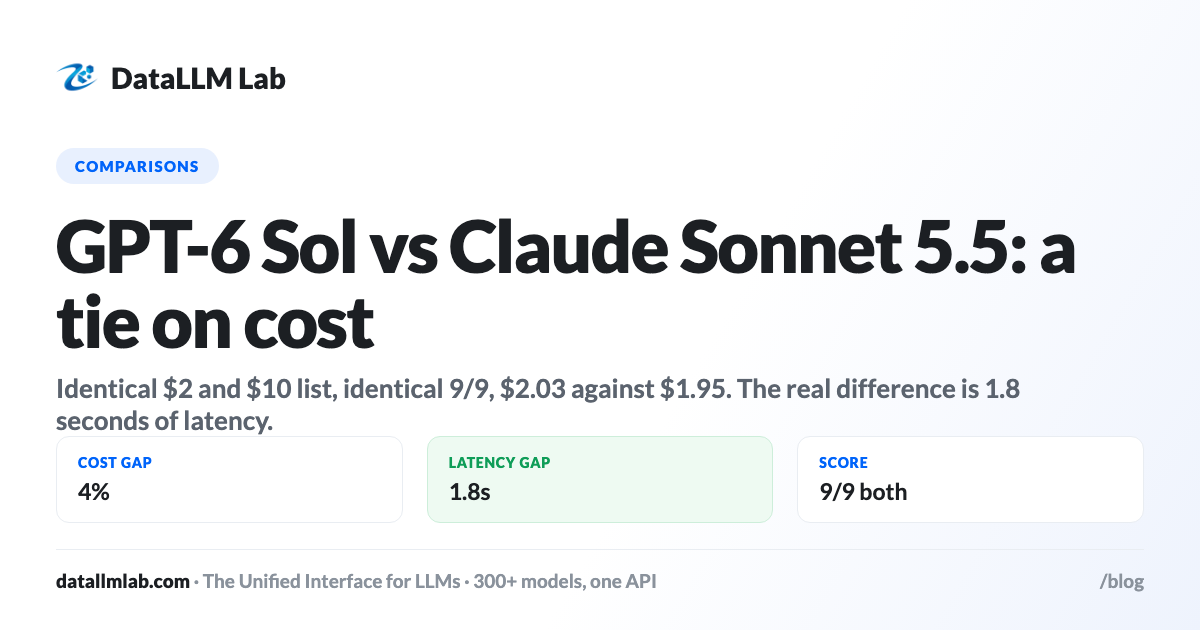
Two vendors, one rate card, one score. When the price and the pass rate are identical, the comparison stops being about which model is better and starts being about which one wastes less of your time.
The result
| Metric | GPT-6 Sol | Claude Sonnet 5.5 |
|---|---|---|
| Score | 9/9 | 9/9 |
| Measured cost / 1,000 tasks | $2.03 | $1.95 |
| Mean latency | 5.2s | 3.4s |
| Reasoning tokens per call | 85 | 31 |
| Input tokens across the suite | 604 | 914 |
| Output tokens across the suite | 1,704 | 1,569 |
| List price in / out, per 1M | $2 / $10 | $2 / $10 |
| Context window | 1,050,000 | 1,000,000 |
| Rank among the 75 models at 9/9 | 36th cheapest · 26th fastest | 34th cheapest · 9th fastest |
| Run date / price date | 2026-10-02 / 2026-10-02 | 2026-10-02 / 2026-10-02 |
Both models run on the same list price on the day we priced them, 2026-10-02. That price is the third-party fact here, and it checks out against launch coverage: The New Stack reported GPT-6 Sol at $2 and $10 when OpenAI shipped it alongside Luna, and Unite.ai reported that Anthropic kept Claude Sonnet 5's $2 and $10 pricing for Sonnet 5.5 (both read 2026-10-02).
Eight cents on one run is a tie
The cost gap is $2.03 − $1.95 = $0.08 per 1,000 tasks, and $0.08 / $1.95 = 4.1%. Call it 4%. We would not make a purchasing decision on it, and neither should you.
Each of our figures comes from one scored attempt per task. A single extra paragraph of explanation in one answer moves the output-token total by more than the gap between these two. Rank tells the same story: Sonnet 5.5 sits 34th cheapest of the 75 models that scored 9 out of 9 and GPT-6 Sol sits 36th — two places apart in the middle of the pack. We publish the eight cents because it is what we measured; we refuse to call it a win.
The same thing happened one tier up. GPT-6 Astra vs Claude Fable 5.1, the flagship equivalent of this pairing, also shared a rate card and finished ten cents apart — $8.19 against $8.09, priced 2026-09-15. Two price tiers, two near-identical cost results. When OpenAI and Anthropic price the same, our suite says they cost the same.
The real difference is latency
Latency is where the pairing actually separates. Sonnet 5.5 returned its answers in a 3.4-second mean; GPT-6 Sol took 5.2 seconds. That is 5.2 − 3.4 = 1.8 seconds per call, and 5.2 / 3.4 = 1.53, so GPT-6 Sol takes about half as long again. Sonnet 5.5 ranks 9th fastest of the 75 models at 9/9; GPT-6 Sol ranks 26th.
Three caveats keep this honest. The means come from nine calls each, not thousands. The calls went through OpenRouter, so the clock includes routing and whichever upstream provider served the request on 2026-10-02. And latency is a property of the endpoint on the day, not of the weights — it can move without the model changing.
Even so, the direction is consistent with the launch story. Anthropic's own announcement, as reported by SiliconANGLE (read 2026-10-02), pitched Sonnet 5.5 as generating output faster than the previous generation. Our earlier run of Claude Sonnet 5 recorded a 7.2-second mean; Sonnet 5.5 recorded 3.4. Those two runs were made at different times under different conditions, so read that as a direction, not a measured speed-up factor.
If your workload is interactive — an editor completion, a chat turn, an agent step that blocks a human — 1.8 seconds per call compounds. Across a multi-step agent loop, that is the difference between waiting and not noticing. Our latency guide covers what else you can cut.
Where the eight cents come from
The token profile is more interesting than the cost total. Sonnet 5.5 consumed 914 input tokens on the same nine prompts for which GPT-6 Sol consumed 604 — 310 more, almost certainly a tokenizer difference, since the text sent was identical. It still came out cheaper, because it wrote 1,704 − 1,569 = 135 fewer output tokens, and output is billed at $10 / $2 = 5 times the input rate.
The reasoning column tells you why the output differs. GPT-6 Sol spent 85 reasoning tokens per call; Sonnet 5.5 spent 31. On problems this size, neither needs to think much, and the model that thinks less both finishes sooner and bills less. That is the same mechanism behind the latency gap.
One warning on the OpenAI side. GPT-6 Sol Pro, on the same $2 and $10 list, scored the same 9 out of 9 at $7.45 per 1,000 tasks, priced 2026-10-02 — $7.45 / $2.03 = 3.7x plain Sol. Its input tokens across the identical nine prompts were 16,898 against 604. That is the same input-token pattern we traced to a provider-side prompt on Astra Pro; we have not run the single-request probe on Sol Pro, and the mechanics are in our piece on hidden system prompt tokens. If you are choosing between the Sol tiers, the price page will not show you this.
GPT-6.1 Sol: the cheaper OpenAI option at the same list
OpenAI has since shipped GPT-6.1 Sol, which TechCrunch reported (read 2026-10-02) as OpenAI's claim to nearly match GPT-6 Astra at the Sol price. We cannot test that claim on this suite. What we can say is what it cost:
| Model | Score | Cost / 1k, priced 2026-10-02 | Latency | Reasoning / call | Output tokens |
|---|---|---|---|---|---|
| GPT-6.1 Sol | 9/9 | $1.61 | 5.9s | 48 | 1,329 |
| Claude Sonnet 5.5 | 9/9 | $1.95 | 3.4s | 31 | 1,569 |
| GPT-6 Sol | 9/9 | $2.03 | 5.2s | 85 | 1,704 |
GPT-6.1 Sol is $2.03 − $1.61 = $0.42 cheaper than GPT-6 Sol per 1,000 tasks at an unchanged list price, entirely because it is terser: 48 reasoning tokens per call instead of 85. It ranks 31st cheapest of the 75 at 9/9. Against Sonnet 5.5 it is $1.95 − $1.61 = $0.34 cheaper — a wider gap than the Sol-vs-Sonnet tie, though still one run per task. The trade is speed: at a 5.9-second mean it ranks 31st fastest, and is the slowest of the three. If you are already on GPT-6 Sol, moving to 6.1 is the obvious cost change; it is not a latency fix.
What this suite cannot separate
Be clear about the ceiling of the instrument. Nine self-contained Python functions cannot separate a frontier model from a competent small one. As of 2026-10-02, Solar Mini 4 is both the cheapest and the fastest model to score 9 out of 9 on the same tasks — $0.03 per 1,000 tasks, priced 2026-10-02, and a 2-second mean. Sonnet 5.5 cost $1.95 / $0.03 = 65 times as much for the same score.
That does not mean Solar Mini 4 is a substitute for either model here. It means our suite is a floor test: it tells you what passing ordinary, well-specified coding tasks costs and how long it takes, not what either model does on a large refactor or a long agent run. Both vendors pitch these models at exactly that harder work, and we did not test it. For the cheap end, see our cheap coding roundup; for Anthropic's own tier spread, Sonnet vs Opus.
How these numbers were produced
Nine Python tasks, each a function signature plus a spec and no example tests. Generated code executes against hidden asserts in an isolated python3 -I subprocess with a 12-second timeout. Temperature 0, max_tokens 4000, one scored attempt per task. An API-layer failure is recorded separately from a wrong answer; neither model here had one. Cost is derived from measured input and output token counts multiplied by the list price captured 2026-10-02 — it is not a billing statement, and prices move. Runs go through OpenRouter, not through the DataLLM Lab gateway. Full method on the methodology page.
What we did not measure
- Variance. One scored attempt per task and nine calls per latency mean. We cannot put an error bar on the eight-cent gap or the 1.8-second gap, which is exactly why we call the first a tie and treat the second as a direction.
- Provider routing. OpenRouter chose the upstream for each call. A direct API call, a different region or a different hour could produce a different latency for either model.
- Prompt caching. Our prompts are short and each is sent once, so cached-input pricing played no part. On long, repeated system prompts, the 914-vs-604 input difference could matter more than it did here.
- Long context. Both carry a context window of at least a million tokens; we used a sliver of it.
- Agentic and multi-file work, which is where both vendors market these models. Our tasks are single-turn and self-contained.
- Why GPT-6 Sol reasons more. We see 85 reasoning tokens per call against 31; we used each endpoint's default settings and did not test whether a lower effort setting would close the latency gap.
Evidence: dated measurements and catalogue fields; method, latency statistics and limitations. Measurements describe these runs, not all providers or future versions.