 DataLLM Lab
DeepSeek V4-Pro vs V4-Flash: Which to Actually Run
DeepSeek's V4 family ships in two tiers: V4-Pro, the 1.6-trillion-parameter flagship, and V4-Flash, the lean efficiency model. The intuitive call is "use Pro for hard work, Flash to save money" - but our executed coding test flips that. On the same nine tasks, the cheap Flash scored higher than the big Pro, for about a sixth of the cost when we priced that run on July 17, 2026 - and still roughly a quarter of Pro's cost after Flash's list price rose to $0.14/$0.28 per 1M on July 29. Here's the data, and the honest rule for when Pro still earns its price.
The short answer
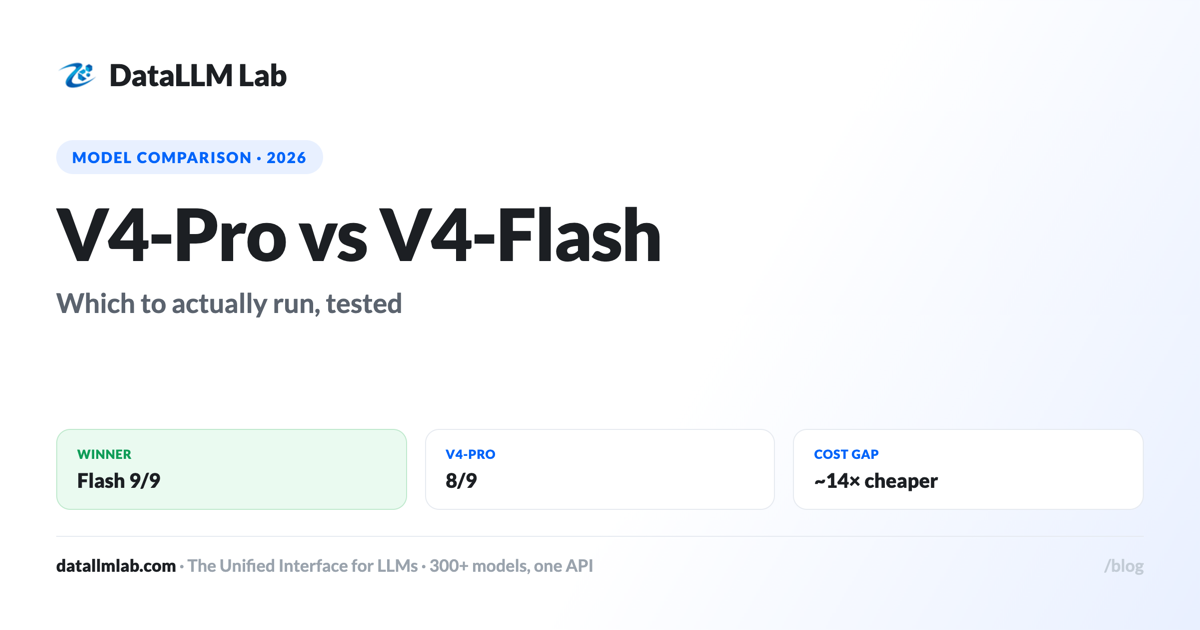
For coding, default to V4-Flash. In our executed test it scored 9/9 versus V4-Pro's 8/9, at roughly 1/6th the cost on the list prices that run was priced with (July 17, 2026). Flash has since got dearer — $0.14/$0.28 per 1M as of July 29, 2026, up from $0.09/$0.18 — which on the same measured tokens works out to about $0.20 per 1,000 tasks against Pro's $0.74, so call it a quarter of the cost today. The bigger, pricier Pro is built for the hardest reasoning — but on bounded coding tasks it didn't buy extra correctness. Keep Pro for genuinely hard problems; let Flash carry the routine load.
Side by side
| V4-Flash | V4-Pro | |
|---|---|---|
| Released | Apr 24, 2026 | Apr 24, 2026 |
| Parameters (MoE) | ~284B total / ~13B active | ~1.6T total / ~49B active |
| Context | 1M | 1M |
| OpenRouter price (in/out), Jul 29 2026 | $0.14 / $0.28 | $0.43 / $0.87 |
| SWE-bench Verified (vendor) | 79.0 | 80.6 |
| Our 9-task score | 9/9 | 8/9 |
What we tested
Nine coding tasks chosen to separate models — two-sum, valid-parentheses, merge-intervals, Roman-to-integer, longest-common-subsequence, a nested-dict flatten, top-k words, a token-bucket limiter, and a CSV-line parser — each executed against hidden tests. Same set as our coding-cost benchmark.
Results: Flash won
V4-Flash solved all nine; V4-Pro missed the CSV-line parser. And the cost gap was clear — Pro's heavier reasoning made it ~6x pricier per task in practice. The figures below are what the run actually cost, priced on July 17, 2026; Flash's list price rose about 56% on July 29, which would lift its $0.13 to roughly $0.20 and shrink the gap to ~3.7x:
| Model | Score | $/1,000 tasks | Avg latency | Reasoning tokens/task |
|---|---|---|---|---|
| DeepSeek V4-Flash | 9/9 | $0.13 | 14.5s | 568 |
| DeepSeek V4-Pro | 8/9 | $0.74 | 18.2s | 732 |
| Claude Opus 4.8 (anchor) | 9/9 | $4.05 | 6.1s | 0 |
When V4-Pro is still worth it
This test bounds what it measures: one-shot, well-specified coding. That's not where a 1.6T-parameter model is supposed to pull ahead. V4-Pro's case is the opposite of these tasks — long, ambiguous, multi-step reasoning where extra capacity reduces the chance of a costly miss, and where one wrong answer is expensive enough to justify paying more. If your workload is research-grade reasoning or hard architecture problems, Pro (or Claude Opus) is a reasonable default. If it's day-to-day coding, the data says Flash.
Which to pick
Default V4-Flash
- Routine coding, refactors, high volume — top correctness at roughly a quarter of Pro's cost on July 29, 2026 prices.
Hard reasoning V4-Pro
- Ambiguous, long-horizon problems where capacity and a low error rate matter most.
Need speed neither
- Both reason (~15s/task). For snappy latency, a non-thinking coder like Qwen3 Coder Next is faster.
Best move route both
- Flash by default, escalate to Pro/Opus on the hard tasks — one key.
Route V4-Flash and V4-Pro from one key
Default to Flash for the cheap, correct bulk; escalate to V4-Pro or Claude Opus when it's genuinely hard — one OpenAI-compatible endpoint with failover.
FAQ
Difference between V4-Pro and V4-Flash?
Both Apr 24, 2026, 1M context, open weights. Pro is the ~1.6T flagship for hard reasoning; Flash is the ~284B efficiency tier. OpenRouter, July 29, 2026: Pro ~$0.43/$0.87, Flash ~$0.14/$0.28 (~3x gap).
Is V4-Pro better than V4-Flash for coding?
Not in our test — Flash 9/9 vs Pro 8/9, at ~1/6th the cost as priced on July 17, 2026 (~1/4 at Flash's July 29 price). Pro's edge is meant for the hardest, most ambiguous reasoning, which a nine-task one-shot test doesn't fully exercise.
Which is cheaper?
Flash — ~3x cheaper per token as of July 29, 2026 (it was ~5x until Flash went from $0.09/$0.18 to $0.14/$0.28), and ~6x cheaper per task in our July 17 test ($0.13 vs $0.74 per 1,000) because Pro reasons more per answer. Re-price those tokens today and Flash lands near $0.20 — still ~3.7x cheaper.
When should I use V4-Pro?
On genuinely hard, ambiguous, long-horizon reasoning where a wrong answer is costly. For routine coding, default to Flash and escalate only when needed.
Same context window?
Yes — both native 1M tokens. The choice is reasoning depth vs cost/speed, not context.
Are they open source?
Yes — open-weights, self-hostable, though both are large MoE models that need serious hardware; most use a hosted API.
Can I route between them automatically?
Yes — via an OpenAI-compatible gateway like DataLLM Lab, call both with one key and route by difficulty (Flash default, Pro for hard tasks), with failover.
Limits of this comparison?
Nine standard tasks, one run, pass/fail — a cost-efficiency check, not agentic/repo-scale. SWE-bench Verified (Pro 80.6, Flash 79.0) is vendor-reported.