 DataLLM Lab
DeepSeek Harness (dsh): What Shipped, What v0.2 Adds, and Which Model to Run In It
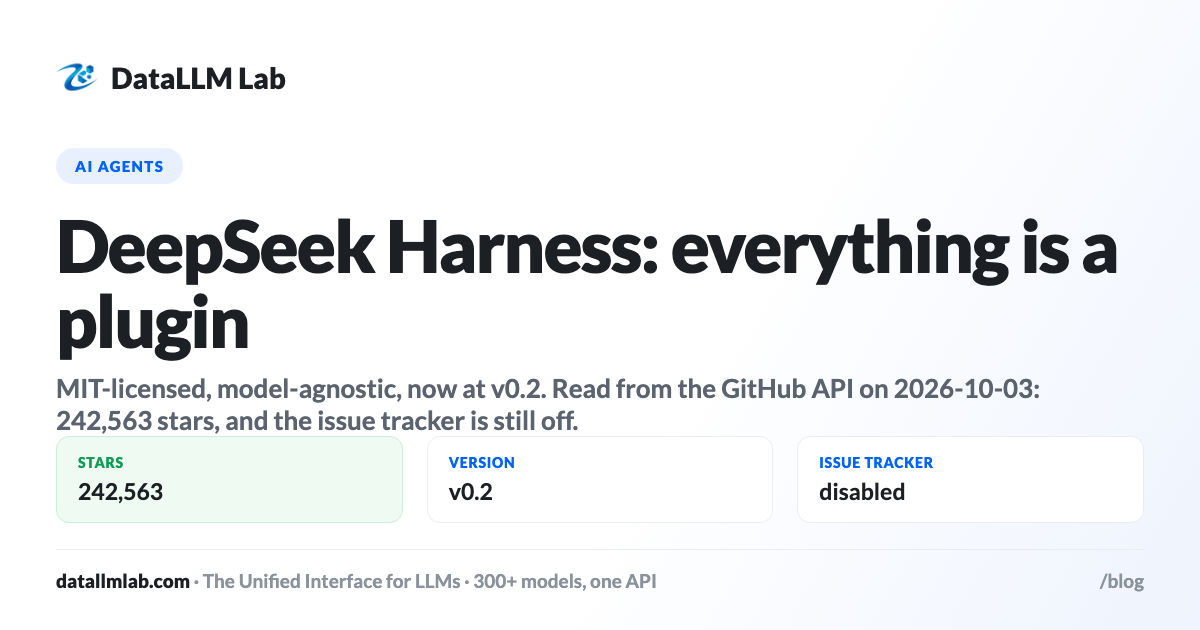
DeepSeek Harness, command name dsh, is an MIT-licensed agent harness whose organising idea is that everything is a plugin — models, tools, skills, sessions, sandboxes, storage, the agent loop, scheduling, and the UI all mount on a kernel and can be swapped. We read the repository directly rather than quoting coverage: at 2026-10-03T08:01:58Z it had 242,563 stars and 29,079 forks, up from 183,972 when we first published on 2026-08-22, and its issue tracker is still switched off. The v0.2 line is out as release candidates, with desktop builds for macOS and Windows. None of that changes the operational point: dsh is model-agnostic, and in a harness that fires many calls per task, the model you choose moves your bill by two orders of magnitude. The last sections are our measured numbers on which models survive a loop.
Update, 2026-10-03
We re-read the repository, its releases and the npm registry on 2026-10-03. What changed since the 2026-08-22 version of this page:
- Stars 242,563, forks 29,079, watchers 1,042, read at 2026-10-03T08:01:58Z. The repository table below keeps the earlier snapshots so the growth is visible rather than asserted.
- Issues are still disabled; discussions are still on. Last push 2026-10-03T06:02:48Z. Still MIT.
- v0.2 exists only as pre-releases:
dsh-v0.2.0-rc.1(2026-09-28),dsh-v0.2.0-rc.2(2026-09-29) anddsh-v0.2.1-alpha.1(2026-10-03). The npm package@deepseek-ai/dshhaslatestpointing at 0.2.0-rc.2 — a release candidate is whatnpxinstalls by default. - Desktop builds for macOS and Windows are confirmed by the project's own release notes. The Linux-via-npm claim is less settled than coverage suggests; the ledger below sorts it.
- The model table is refreshed against our 2026-10-03 data, which now covers 110 entries, 93 usable, 75 at 9/9.
What actually shipped
From the project and its launch coverage, first read 2026-08-22 and re-checked 2026-10-03:
- Version 0.1, a developer preview, announced 2026-08-17. The repository was created 2026-08-13. On 2026-10-03 the README still calls it a developer preview and warns, in capitals, of compatibility-breaking changes. Take that at face value.
- MIT licence, repository
deepseek-ai/deepseek-harness, written in TypeScript. - Built on Cordis, a meta-framework that handles plugin mounting, unmounting and dependencies. Runtime components are isolated, interchangeable plugins rather than modules of one program.
- Four runtime modes — Standard, Code, Minimal and Creator — each loading a different default plugin set.
- Model-agnostic. DeepSeek, Anthropic and OpenAI via API keys; Bedrock, Vertex, Azure and Codex via native credentials; and any OpenAI-compatible endpoint.
- Running it: the README's npm route is
npx @deepseek-ai/dsh web, which needs Node.js and serves the web UI on127.0.0.1:3080. The Python SDK needed Python 3.10 or newer on Linux x64, Linux arm64, or macOS 14+ on arm64 when we read it on 2026-08-22.
What v0.2 adds: confirmed, attributed, unsourced
A digest circulating this week says v0.2 added a desktop app for macOS and Windows, with Linux served through npm. Part of that is solid, part is older than v0.2, and part we could not trace to a source we could read. Sorted by where each claim comes from, read 2026-10-03:
| Claim | Tier | Source |
|---|---|---|
| Pre-releases rc.1 (2026-09-28), rc.2 (2026-09-29), v0.2.1-alpha.1 (2026-10-03); no stable 0.2.0 yet | Confirmed | GitHub releases for deepseek-ai/deepseek-harness, all flagged pre-release |
npm latest is 0.2.0-rc.2 | Confirmed | npm registry for @deepseek-ai/dsh |
macOS and Windows desktop builds bundle the dsh command for plugin management, with no separate Node or pnpm install | Confirmed | rc.2 release notes |
| The desktop app is new in v0.2 | Not quite | The v0.1.7-rc.2 notes (2026-09-24) already add desktop onboarding and fix desktop installer packages that failed to start |
| v0.2 preview announced September 29, with installers for macOS on Apple silicon and 64-bit Windows from the official site | Attributed | Mpost, published 2026-10-02, read 2026-10-03 |
| Linux users get it from the npm package rather than a desktop installer | Unsourced, for us | Search results attribute this to DeepSeek's own post on X, which we could not load. The README does document the npm route, and the rc.2 notes mention graphical desktop launches on Linux, so Linux packaging is unsettled |
| Experimental Claude Code Mods compatibility layer | Confirmed | v0.2.1-alpha.1 notes, which say the aim is to check that the Mods API is roughly a subset of dsh plugins, not to offer full compatibility |
| Third-party model catalogue updated to pi-ai 0.87.1; some old model IDs removed | Confirmed | rc.2 release notes |
The last row is the one that touches this article. If you saved a model selection in an earlier build, the rc.2 notes say it may need re-selecting — which is a moment to check what that model costs per task.
Everything is a plugin, concretely
The slogan is easy to repeat and easy to leave vague. The list of what is actually a plugin is the substance:
The session log deserves its own note. It is append-only and records system prompts, reasoning, tool calls and their results, subagent scheduling, and every context injection — then supports resume, fork, search and replay. Forking a session at an arbitrary point is what makes agent behaviour debuggable rather than merely observable, and it is rare.
What the repository says, read directly
We query the GitHub API rather than quote a star count from coverage. Three snapshots:
| Field | 2026-08-22T14:49:54Z | 2026-08-31T13:28:06Z | 2026-10-03T08:01:58Z |
|---|---|---|---|
| Stars | 183,972 | 205,981 | 242,563 |
| Forks | 20,271 | 23,879 | 29,079 |
| Watchers | 807 | not recorded | 1,042 |
| Last push | 2026-08-21T12:35:08Z | not recorded | 2026-10-03T06:02:48Z |
| Issue tracker | disabled | not recorded | disabled |
| Discussions | enabled | not recorded | enabled |
| Licence | MIT | — | MIT |
Unchanged across snapshots: language TypeScript, created 2026-08-13T11:56:32Z, topics ai-agents, cordis, dsh, dsh-plugin.
The point that has not changed is the tracker: issues are still off on a repository with 242,563 stars, with discussions on instead. DeepSeek is publishing infrastructure, not opening a support queue, and six weeks of growth have not changed that. If you are considering building on dsh, that says more about the support you will get than any star count.
The choice dsh leaves you: which model
A model-agnostic harness moves the most expensive decision to you. These are our numbers from our nine-task Python benchmark — generated code executed against hidden asserts. Cost is derived from measured tokens at the list price on the date shown, not a bill.
| Model | Score | Cost / 1k tasks | Priced on | Latency | Reasoning tokens per call |
|---|---|---|---|---|---|
| Solar Mini 4 | 9/9 | $0.03 | 2026-10-02 | 2s | 0 |
| DeepSeek V3.2 | 9/9 | $0.08 | 2026-07-30 | 7.1s | 0 |
| DeepSeek Chat | 9/9 | $0.10 | 2026-07-30 | 3.8s | 0 |
| Qwen3 Coder Next | 9/9 | $0.10 | 2026-07-17 | 7s | 0 |
| DeepSeek V4-Flash | 9/9 | $0.13 | 2026-07-17 | 14.5s | 568 |
| DeepSeek V4.1 Flash | 9/9 | $0.36 | 2026-09-15 | 15.6s | 478 |
| Claude Haiku 4.5 | 9/9 | $0.94 | 2026-07-29 | 3.7s | 0 |
| GLM-5.1 | 9/9 | $4.35 | 2026-07-30 | 23.6s | 1,327 |
Every model in that table scored 9 out of 9. As of 2026-10-03, Solar Mini 4 is both the cheapest and the fastest of the 75 models that score 9/9 on our suite. GLM-5.1 costs 54x what DeepSeek V3.2 does and 145x what Solar Mini 4 does, and the reasoning-token column is why.
DeepSeek's own newer Flash is the instructive row. V4.1 Flash costs 4.5x what V3.2 does per task, because it spends 478 reasoning tokens a call where V3.2 spends none. And its list price has moved since our run — from $0.15 / $0.6 per million tokens on 2026-09-15 to $0.3 / $1.2 on 2026-10-03 — so the $0.36 is a 2026-09-15 figure and should not be recomputed at today's price by mixing the two.
Be clear about what this table cannot tell you. Nine self-contained Python functions are a floor, not a ranking: a frontier model and a competent small one both clear them, so a 9/9 here does not separate them on the long, stateful, tool-heavy sessions a harness actually runs. What the table does separate is the price of clearing the floor.
Why reasoning tokens decide a harness bill
Reasoning tokens bill at the output rate. You cannot see them, you cannot cache them, and a harness multiplies them by every turn in a session. A dsh session that fires twenty tool calls multiplies the per-call gap twenty times over, and the per-call latency gap — 23.6 seconds for GLM-5.1 against 2s for Solar Mini 4 — compounds into wall-clock you actually feel.
That is multiplication on measured numbers, not a measurement, and it is the most useful thing to know before you point a harness at a model. We worked the same problem through for a different harness in our agent model comparison, and cutting token costs in coding agents covers the prompt-side levers. For background, what an agent harness actually is; for budgeting, agent cost. If you would rather let a router pick per call, our router measurement covers that trade.
One nuance: our tasks are single-turn. A model that reasons heavily on a one-shot function might reason less per turn inside a long session with accumulated context, or more. We have not measured that.
How our model numbers were produced
Nine Python tasks, each a function signature plus a spec and no example tests. Generated code executes against hidden asserts in an isolated python3 -I subprocess with a 12-second timeout. Temperature 0, max_tokens 4000, one scored attempt per task. An API-layer failure is recorded separately from a wrong answer. Cost is derived from measured token counts at the list price on each model's measurement date, not a billing statement — and prices move. Runs go through OpenRouter. Full method on the methodology page.
What we did not test
- We have not run dsh, the web UI or the desktop builds. Everything about the harness is read from the repository, its release notes and the npm registry, not executed or audited.
- The plugin API. No opinion on whether writing a plugin is pleasant, or whether the Claude Code Mods layer works beyond what its own notes claim.
- Multi-turn model behaviour, which is the workload a harness actually creates. Our benchmark is single-turn.
- The star count is a snapshot at 2026-10-03T08:01:58Z and will be wrong by the time you read it. That is the point of stamping it.
FAQ
What is DeepSeek Harness? An MIT-licensed, model-agnostic agent harness, command name dsh, released as a v0.1 developer preview on 2026-08-17. Models, tools, skills, sessions, sandboxes, storage, the agent loop, scheduling and the UI all load as plugins on the Cordis kernel.
Is DeepSeek Harness free? Yes, MIT licensed. The models you point it at are not.
Does dsh only work with DeepSeek models? No. DeepSeek, Anthropic and OpenAI via API keys, Bedrock, Vertex, Azure and Codex via native credentials, and any OpenAI-compatible endpoint, per the project documentation we read on 2026-08-22.
Is v0.2 out? As release candidates only, as of 2026-10-03: rc.1 on 2026-09-28, rc.2 on 2026-09-29, plus v0.2.1-alpha.1 on 2026-10-03. npm's latest tag is 0.2.0-rc.2.
Is there a desktop app? Yes for macOS and Windows, per the project's release notes. Linux is served by the npm route documented in the README; whether a packaged Linux desktop build is official, we could not confirm.
How many GitHub stars does DeepSeek Harness have? 242,563 at 2026-10-03T08:01:58Z, with 29,079 forks — up from 183,972 on 2026-08-22.
Which model should I run in it? On our tasks, as of 2026-10-03, Solar Mini 4 scored 9 out of 9 at $0.03 per 1,000 tasks (priced 2026-10-02) with zero reasoning tokens, and DeepSeek V3.2 did the same at $0.08 (priced 2026-07-30). Zero reasoning tokens is the profile that holds up best in a many-turn loop.
Where do I report a bug? Not the issue tracker — it is still disabled. Discussions are enabled instead.