 DataLLM Lab
GPT-5.5 Review: What It Adds Over GPT-5.4
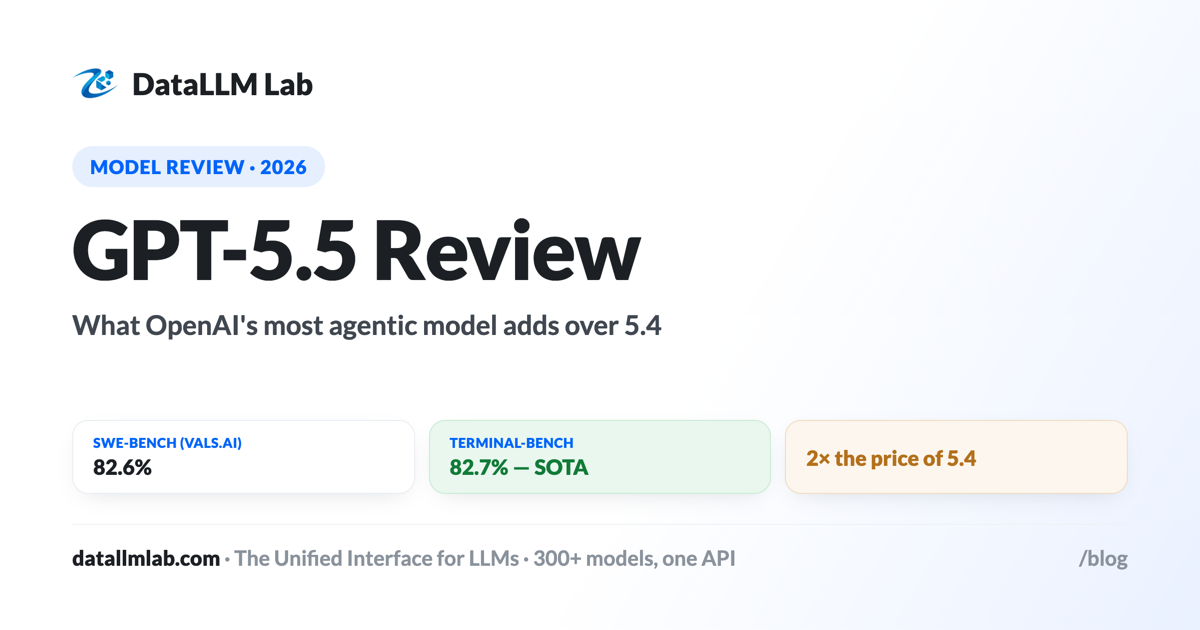
GPT-5.5 is OpenAI's most agentic model yet — a real step up for long-horizon, tool-using work, and the new leader on terminal-based agent benchmarks. It's also twice the price of GPT-5.4. This review sticks to what's verifiable: the independent benchmark score (not just OpenAI's own), the real cost, exactly what it improves over 5.4, where it doesn't, and what you can call today if you're still on the 5.4 tier.
GPT-5.5 in one line
GPT-5.5 is the agentic upgrade: if you build tool-using agents, long-horizon coding loops, or terminal automation, it's a meaningful jump over GPT-5.4. If you mostly do chat, extraction, or one-shot tasks, it's a 2× price increase for gains you may never see. Here's the evidence.
| GPT-5.5 | GPT-5.4 | |
|---|---|---|
| SWE-bench Verified (vals.ai) | 82.6% | — |
| Terminal-Bench 2.0 | 82.7% | lower |
| Long-context retrieval (MRCR) | ~74% | ~37% |
| Price (in / out) | $5 / $30 | $2.50 / $15 |
| On DataLLM Lab | Not yet | Yes |
Benchmarks: independent vs official
Every model launch comes with a benchmark table from its maker. The more useful number is the independent one. On vals.ai's SWE-bench Verified — a third party running the same real-world bug-fixing test on every model — GPT-5.5 scores 82.6%:
| SWE-bench Verified (independent) | Score |
|---|---|
| Claude Fable 5 (suspended) | 95.0% |
| Claude Opus 4.8 | 88.6% |
| GPT-5.5 | 82.6% |
| Claude Opus 4.7 | 82.0% |
| Gemini 3.5 Flash | 78.8% |
So GPT-5.5 is a genuine frontier coder — third on the independent board, essentially level with Claude Opus 4.7, behind the two newest Claude models. On agentic terminal tasks, though, it's the leader: ~82.7% on Terminal-Bench 2.0, ahead of its rivals. That split — strong-but-not-top at raw bug-fixing, best-in-class at agentic execution — is the real story of this release.
What it adds over GPT-5.4
- Long-context retrieval roughly doubles. On the MRCR multi-round retrieval test, GPT-5.5 lands around 74% versus ~37% for GPT-5.4 — the single biggest jump. If you stuff large contexts (codebases, document sets) into prompts, this matters.
- Agentic / terminal leadership. The Terminal-Bench lead means more reliable multi-step tool use and command execution — the core of coding agents.
- Stronger long-horizon coding. Reports of multi-hour autonomous tasks completing in one go; the SWE-bench gain backs this up.
What it doesn't dramatically change: raw single-turn chat quality, where 5.4 is already excellent.
The real cost
GPT-5.5 is $5 / $30 per million tokens — exactly double GPT-5.4's $2.50 / $15. Two levers soften that:
- Cached input drops to roughly $0.50/M — big for agents that re-send the same system prompt and context every turn.
- Batch pricing is about half for non-interactive jobs.
There's also GPT-5.5 Pro at $30 / $180 for maximum reasoning depth — a specialist tier, not an everyday default. The honest framing: GPT-5.5 costs 2× GPT-5.4, so it only pays for itself on workloads where the agentic gains translate into fewer retries or higher task success.
Where it's not worth it
- Simple, high-volume tasks. Classification, extraction, short chat — GPT-5.4 (or a cheaper model entirely) gets the same result for half to a tenth of the price.
- Budget-sensitive scale. At 2× the output price, a chatty workload can get expensive fast. Route cheap-first, escalate to 5.5 only on hard cases (see our cheapest LLM APIs guide).
- If you need the absolute top coder. Claude Opus 4.8 leads the independent SWE-bench board; for pure bug-fixing it's ahead.
What you can call today
GPT-5.5 is available directly via OpenAI. On DataLLM Lab the current OpenAI lineup is GPT-5.4 ($2.50/$15), GPT-5.4 Pro, and the GPT-5 Codex variants — the closest you can call through the gateway right now. Switching to 5.5 when it lands is a one-line model-id change:
from openai import OpenAI
client = OpenAI(base_url="https://www.datallmlab.com/v1", api_key="$DATALLMLAB_API_KEY")

resp = client.chat.completions.create(
    model="openai/gpt-5.4",            # swap to gpt-5.5 when available on the gateway
    messages=[{"role": "user", "content": "Plan and execute this multi-step task..."}],
)
print(resp.choices[0].message.content)
For the cross-vendor question — GPT-5.5 against Claude — see our dedicated GPT-5.5 vs Claude Opus 4.7 head-to-head, and where GPT-5.5 fits among coders in the best coding LLM guide.
A/B GPT against Claude and Gemini on your own task
GPT-5.4, Claude Opus 4.7, Gemini 3.1 Pro and 300+ more — one OpenAI-compatible key, live price comparison, swap models with a one-line change.
FAQ
Is GPT-5.5 worth the price increase over GPT-5.4?
For agentic, long-horizon, and terminal/tool-use workloads, yes — it leads Terminal-Bench and roughly doubles 5.4's long-context retrieval. For everyday chat and simple tasks, 5.4 is often indistinguishable at half the price ($2.50/$15 vs $5/$30).
What's the difference between GPT-5.5 and GPT-5.4?
GPT-5.5's biggest gains are agentic: it leads Terminal-Bench (~82.7%) and improves long-context retrieval dramatically (MRCR ~74% vs ~37%). It scores 82.6% on independent vals.ai SWE-bench Verified. Pricing is double 5.4's.
How does GPT-5.5 score on SWE-bench Verified?
82.6% on the independent vals.ai board — third behind Claude Fable 5 (95.0%) and Opus 4.8 (88.6%), level with Opus 4.7 (82.0%). That's an independent score, not OpenAI's self-report.
How much does the GPT-5.5 API cost?
$5/M input and $30/M output, with cached input around $0.50/M and batch roughly half — about double GPT-5.4 ($2.50/$15). GPT-5.5 Pro is $30/$180.
Is GPT-5.5 better than Claude Opus 4.7?
Close on real-world coding (82.6% vs 82.0% on vals.ai). GPT-5.5 tends to lead terminal/agentic tasks; Claude is often preferred for planning. Test both — see our head-to-head.
Can I use GPT-5.5 through an API gateway today?
Not on every gateway yet. DataLLM Lab carries GPT-5.4, GPT-5.4 Pro, and GPT-5 Codex variants; GPT-5.5 is available directly via OpenAI. Switching when it lands is a one-line model-id change.