 DataLLM Lab
Claude Opus 4.8 vs 4.7: What Changed, and Is It Worth It?
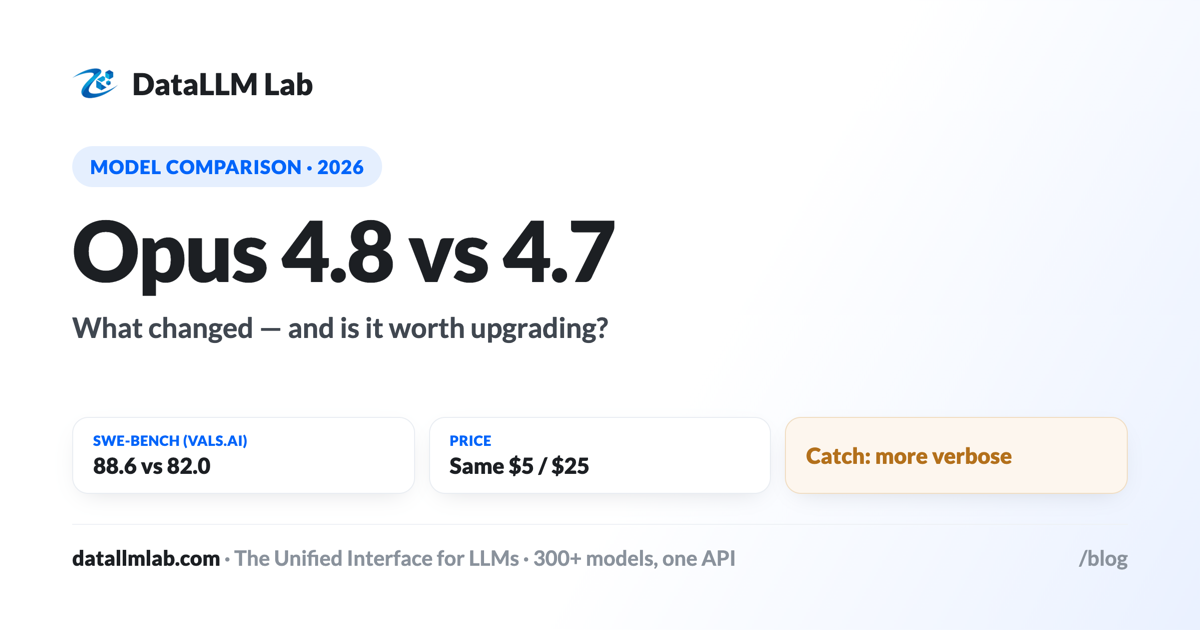
Anthropic shipped Claude Opus 4.8 on May 28, 2026 — same $5/$25 price as 4.7, a real jump on the hardest agentic-coding benchmarks, and a notable honesty improvement. So is it a free upgrade or a sidegrade? Here's what actually changed, what the independent benchmarks (not just Anthropic's own) say, the one catch that can quietly raise your bill, and a clear upgrade call by use case.
The short answer
Opus 4.8 is a genuine step up for hard, agentic, coding-heavy work — at the same price as 4.7. If that's your workload, upgrade. If you mostly do chat, summarization, or retrieval, the gain may be invisible and not worth re-testing for. One catch either way: 4.8 tends to write more, so budget for a slightly higher output-token bill.
| Claude Opus 4.8 | Claude Opus 4.7 | |
|---|---|---|
| SWE-bench Verified (vals.ai) | 88.6% | 82.0% |
| Standard price (in / out) | $5 / $25 | $5 / $25 |
| Released | May 28, 2026 | Earlier 2026 |
| Context / max output | 1M / 128K | 1M / 128K |
| On DataLLM Lab | Not yet | Yes |
What changed in 4.8
Opus 4.8 is an iterative release on the same architecture and request surface as 4.7 — not a new model family. The headline changes:
- Better agentic coding. The largest gains show up on real-world software-engineering and computer-use tasks (details below).
- A more honest coder. Anthropic reports 4.8 is markedly less likely to let a flaw in its own code slip through unflagged.
- A cheaper, faster "fast mode." $10/$50 for ~2.5× the output speed — which Anthropic says is about three times cheaper than fast mode on previous models.
- Same price, same shape. Standard pricing, context window, and API surface are unchanged from 4.7 — so migrating is essentially a model-id swap.
Benchmarks: independent vs vendor
Most "Opus 4.8 vs 4.7" articles just reprint Anthropic's own benchmark table. We'll do something more useful and cite the independent board too, because the gap between the two is itself informative.
| Benchmark | Opus 4.8 | Opus 4.7 | Source |
|---|---|---|---|
| SWE-bench Verified | 88.6% | 82.0% | vals.ai (independent) |
| Online-Mind2Web (browser agent) | 84% | lower | Anthropic |
| Legal Agent Benchmark | first to break 10% all-pass | — | Anthropic |
Two honest notes. First, the SWE-bench Verified gain is real and large — about six points on the independent board, the benchmark that best tracks agentic coding. Second, a caution that benefits you: Anthropic's self-reported numbers run higher than independent ones (its system card reports a higher SWE-bench figure for 4.7 than vals.ai's 82.0%). That's normal — vendor harnesses differ — but it's why we anchor on the independent board and suggest you verify on your own tasks before trusting any single number.
The honesty upgrade
The most underrated change isn't a benchmark percentage — it's that Opus 4.8 is, per Anthropic, roughly four times less likely than 4.7 to let a flaw in code it wrote pass without flagging it. In an agentic loop, a model that silently ships a subtle bug is far more expensive than one that says "this might be wrong." If you run Claude as a coding agent with limited human review, this reliability improvement can matter more than the raw SWE-bench delta.
Pricing reality & the verbosity catch
Sticker price is unchanged: $5 per million input, $25 per million output — identical to 4.7. The new fast mode is $10/$50 for about 2.5× the speed (and, Anthropic says, ~3× cheaper than fast mode used to be).
effort level for routine work and adding a "final answer only" instruction where you don't need the reasoning narrative. Net cost is usually still a wash-to-slightly-up — just don't assume "same price" means "same bill."Should you upgrade? By use case
Upgrade Agentic & hard coding
- The +6-point SWE-bench gain and the honesty improvement are exactly what long-horizon coding agents need. Same price — low-risk win.
Maybe Chat, retrieval, simple tasks
- The delta is often invisible here. If 4.7 already works, there's little urgency — but no penalty to switching either, since price is flat.
Compare first Terminal & tool-use
- For terminal-heavy agents, GPT-5.5 still leads on Terminal-Bench. Worth A/B-testing rather than assuming Opus wins. See our best LLM for agents guide.
Watch Cost-sensitive at scale
- Same per-token price, but verbosity can lift the output bill. Tune
effortdown for bulk jobs, or route cheaper models for easy work (see cheapest LLM APIs).
What you can run today
Opus 4.8 is available directly via the Claude API. On DataLLM Lab the current top Anthropic models are Claude Opus 4.7 and 4.6 (both $5/$25) — the closest you can call through the gateway right now, alongside GPT-5.4 and Gemini 3.1 Pro. Because the gateway is OpenAI-compatible, moving to 4.8 when it lands is a one-line change:
from openai import OpenAI
client = OpenAI(base_url="https://www.datallmlab.com/v1", api_key="$DATALLMLAB_API_KEY")

resp = client.chat.completions.create(
    model="anthropic/claude-opus-4.7",    # swap to claude-opus-4.8 when available
    messages=[{"role": "user", "content": "Refactor this module and add tests."}],
)
print(resp.choices[0].message.content)
Run Opus, GPT and Gemini side by side
Claude Opus 4.7, GPT-5.4, Gemini 3.1 Pro and 300+ more — one OpenAI-compatible key, live price comparison, so you can A/B a real task before you commit.
FAQ
Is Claude Opus 4.8 worth upgrading from 4.7?
For agentic and hard coding work, yes — the independent SWE-bench Verified jump (82.0% to 88.6% on vals.ai) is real and the price is unchanged at $5/$25, so the downside is low. For general chat or retrieval the difference may be invisible. Watch one catch: 4.8 can be more verbose, raising your output-token bill.
How much does Claude Opus 4.8 cost compared to 4.7?
Standard pricing is identical: $5/M input and $25/M output, unchanged from 4.7. Opus 4.8 also adds a fast mode at $10/$50 (2.5× the speed), which Anthropic says is about three times cheaper than fast mode on previous models.
What's the difference between Opus 4.8 and 4.7 on SWE-bench?
On the independent vals.ai SWE-bench Verified board, Opus 4.8 scores 88.6% vs 82.0% for 4.7 — about a 6-point gain on real-world bug-fixing. Anthropic publishes its own (higher) self-reported figures in the system card; we cite the independent board for a fair comparison.
Does upgrading from 4.7 to 4.8 break anything?
It's largely drop-in: the request surface matches 4.7 (adaptive thinking only; temperature and other sampling params aren't accepted). Swap the model id to claude-opus-4-8, re-tune your effort setting, and budget for slightly more verbose output.
What is the context window for Claude Opus 4.8?
A 1-million-token context window with up to 128K output tokens, per Anthropic's developer documentation — the same as Opus 4.7.
Can I use Claude Opus 4.8 through an API gateway today?
Not on every gateway yet. DataLLM Lab currently carries Opus 4.7 and 4.6 at $5/$25; 4.8 is available directly via the Claude API. Since the gateway is OpenAI-compatible, switching when 4.8 lands is a one-line model-id change.