 DataLLM Lab
The Best LLM for AI Agents in 2026
Most "best LLM for agents" lists rank models on SWE-bench — a coding benchmark — and call it a day. But agents live or die on tool use, long-horizon reliability, and cost-per-completed-task, not bug-fixing alone. This guide ranks the real contenders on the benchmarks that actually predict agent performance, separates independent scores from vendor hype, gives you a function-calling snippet you can paste, and names the models you can call through one key today.
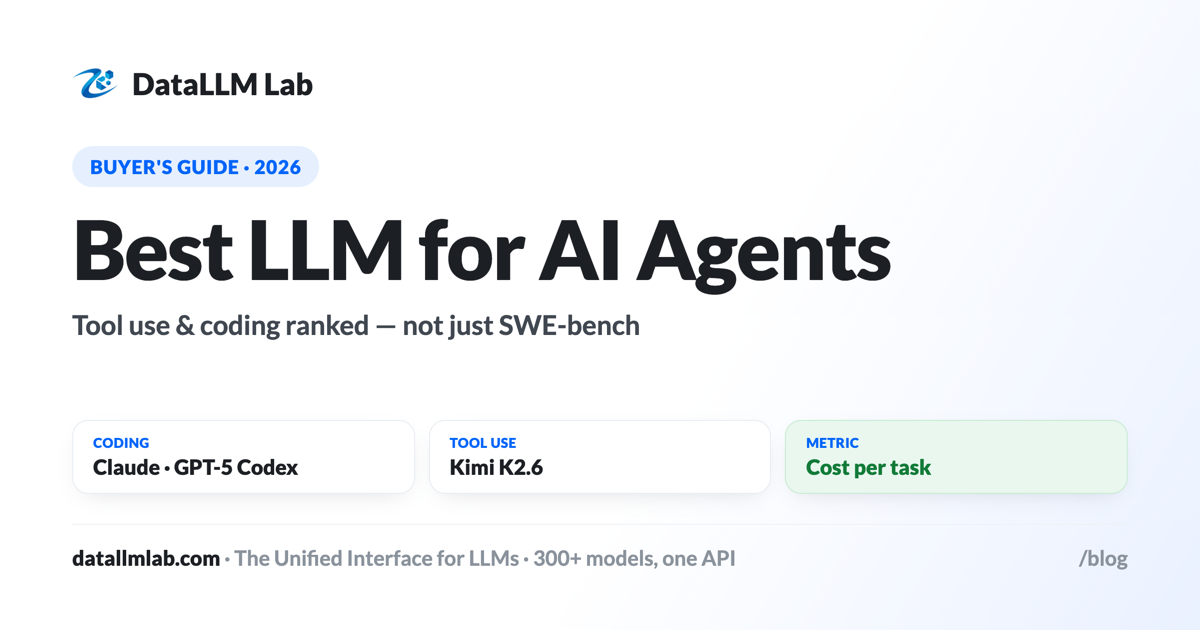
Best LLM for agents, by use case
| If your agent mainly… | Use | On DataLLM Lab |
|---|---|---|
| Writes & fixes code | Claude Opus 4.7 · GPT-5 Codex | Yes |
| Runs terminal / shell tasks | GPT-5 line | Yes (5.4 + Codex) |
| Calls many tools / APIs | Claude · Kimi K2.6 | Yes |
| Runs cheaply at fleet scale | Kimi K2.6 · DeepSeek · Qwen Coder | Yes |
What "best for agents" actually means
An agent isn't a chatbot — it plans, calls tools, reads results, and loops, sometimes for hours. So the qualities that matter are different:
- Tool use & schema adherence — does it produce valid function calls, reliably, across many tools?
- Long-horizon reliability — can it stay on task over dozens of steps without drifting or looping?
- Recovery — when a tool errors, does it adapt or spiral?
- Cost per completed task — retries and tool calls multiply token use; per-token price is only half the story.
Ranking agents on SWE-bench alone measures coding skill, not any of these. That's the gap this guide fills.
The benchmarks that matter (and what each measures)
- SWE-bench Verified — real-world bug-fixing. Predicts coding-agent quality; the cleanest independent board is vals.ai.
- Terminal-Bench — multi-step command-line agent tasks. Predicts terminal/automation reliability.
- tau-2-bench (Sierra) — tool use against a written policy with a simulated user (retail/airline/telecom). The closest thing to "can it run a real workflow."
- BFCL v4 (Berkeley) — function-calling format, multi-turn, and hallucination. The tool-calling standard; leaders rotate, so check the live board.
The contenders, ranked
The agent-capable models you can call today, with the facts that decide them:
| Model | SWE-bench Verified | Agentic strength | Price (in / out) |
|---|---|---|---|
| Claude Opus 4.7 | 82.0 (vals.ai) | Planning, computer use, instruction-following | $5 / $25 |
| GPT-5.4 + Codex | strong | Terminal & code-agent execution | $2.50 / $15 |
| Kimi K2.6 | ~80.2 (indep.) | Tool use (~96% tau-2-bench), open | $0.68 / $3.41 |
| Gemini 3.1 Pro | strong | Multimodal, long-context agents | $2 / $12 |
| Grok 4 | — | Fast, lower-cost agent loops | $3 / $15 |
Newer frontier models (Claude Opus 4.8, GPT-5.5) score higher still on the independent board — see Opus 4.8 vs 4.7 and the GPT-5.5 review — but the lineup above is what you can call through the gateway right now.
Tool use & function calling
If your agent's job is orchestrating tools rather than writing code, weight tool-use benchmarks over SWE-bench. Kimi K2.6 posts standout tau-2-bench Telecom results (~96%) and is open-weight; Claude models are consistently reliable on schema adherence and multi-tool calls. Because the BFCL leaderboard shifts with each snapshot, don't hard-commit to a "#1" — check the live board, then validate on your own tool set.
Cost per completed task
The metric that actually governs an agent's bill isn't per-token price — it's cost per completed task, because agents retry and call tools repeatedly. A model that's twice the price but one-shots a task can be cheaper than a bargain model that loops three times. The practical pattern: route cheap-first (a Kimi/DeepSeek/Qwen tier), and escalate to a frontier model only on failure. That keeps the bulk of agent traffic on low-cost models while preserving success rates on the hard cases — and through one gateway it's a routing rule, not a rewrite. (See cheapest LLM APIs for the low-cost tier.)
Call any of these (function-calling)
All of these speak the OpenAI tools format, so swapping the agent's model is one line. A minimal function-calling call:
from openai import OpenAI
client = OpenAI(base_url="https://www.datallmlab.com/v1", api_key="$DATALLMLAB_API_KEY")

tools = [{"type": "function", "function": {
    "name": "get_weather",
    "parameters": {"type": "object", "properties": {"city": {"type": "string"}}},
}}]

resp = client.chat.completions.create(
    model="anthropic/claude-opus-4.7",    # or openai/gpt-5.4, moonshotai/kimi-k2.6
    messages=[{"role": "user", "content": "What's the weather in Tokyo?"}],
    tools=tools,
)
print(resp.choices[0].message.tool_calls)
Same code, any model — so you can benchmark agent reliability across vendors without re-plumbing.
Build agents on any model, one key
Claude Opus 4.7, GPT-5.4 + Codex, Kimi K2.6, Gemini 3.1 Pro and 300+ more — one OpenAI-compatible endpoint with tool calling, live price comparison, and automatic failover.
FAQ
What's the best LLM for AI agents in 2026?
It depends on the agent: Claude Opus and GPT-5 Codex for agentic coding; Claude and Kimi K2.6 for tool use; DeepSeek and Qwen Coder for cheap fleets. No single winner — match the model to the agent's main job and route by difficulty.
Which model is best for agentic coding?
On independent SWE-bench Verified, Claude Opus leads, with GPT-5 and DeepSeek V4 close behind at lower cost. GPT-5.5 leads terminal execution specifically. For open-weights, Kimi K2.6 is the standout.
What's the best LLM for tool use and function calling?
Leaders rotate by snapshot. Kimi K2.6 posts ~96% on tau-2-bench Telecom; Claude is consistently strong on schema adherence and multi-tool calls. Check the live Berkeley Function-Calling Leaderboard for the current snapshot.
What's the best open-weight model for agents?
Kimi K2.6 — high SWE-bench Verified (~80%) and excellent tool use, and callable on the gateway. DeepSeek V4 and Qwen3 Coder Next are strong cheaper open alternatives.
SWE-bench vs Terminal-Bench vs tau-bench — what's the difference?
SWE-bench Verified tests bug-fixing; Terminal-Bench tests command-line agent tasks; tau-2-bench (Sierra) tests tool use against a policy with a simulated user; BFCL tests function-calling. Agents need all of these, so ranking on SWE-bench alone is misleading.
How much does running an AI agent cost?
More than token price implies — agents retry and call tools, so the real metric is cost-per-completed-task. A cheaper model that occasionally retries can still beat an expensive one-shot. Route cheap-first and escalate on failure.