 DataLLM Lab
MiniMax M3 Review: The Multimodal Open Model That Reads Screens
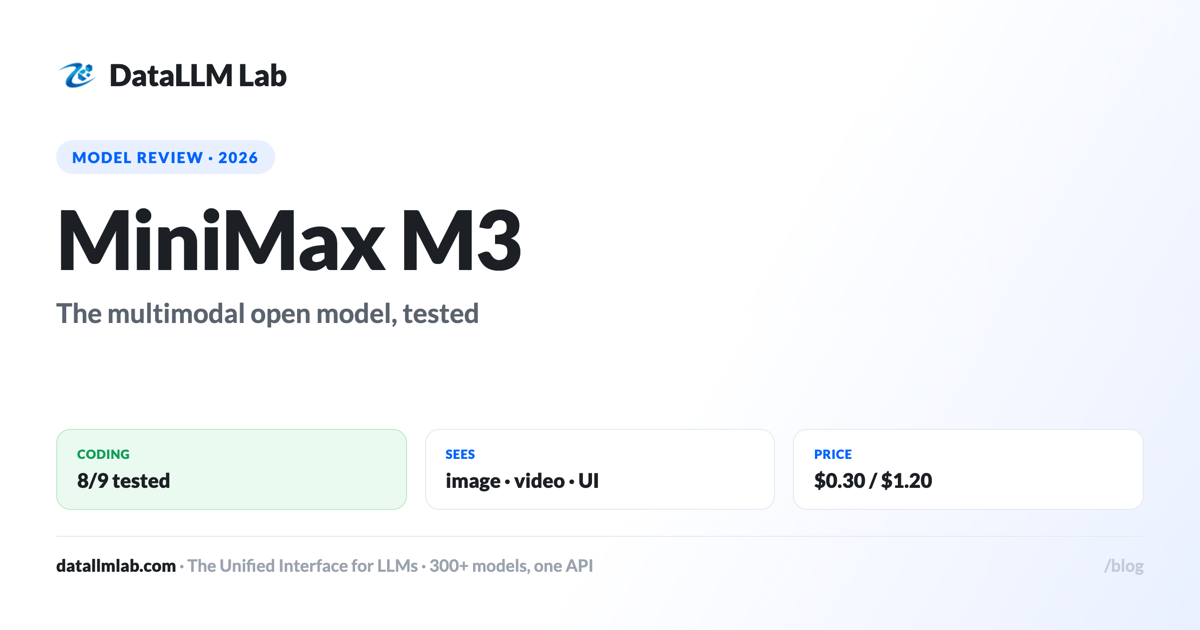
MiniMax M3 is the most unusual model in the current cheap-open crop: alongside text it natively reads images and video and can drive a computer (clicking through UIs), all at a promotional price under most rivals. We ran it through our executed coding benchmark to see how the core model holds up. The verdict: a clean 9/9 at low cost, with one real caveat - it is a very heavy reasoner. Here's what it is, the tested numbers, and where it actually fits.
What MiniMax M3 is
MiniMax M3 is an open-weights model from MiniMax, released May 31, 2026. What sets it apart from the rest of the cheap-open crop is breadth: a native 1M-token context, native multimodality (text, image, and video in), and computer-use (it can drive graphical interfaces) — at a promotional price below most rivals. Its MiniMax Sparse Attention (MSA) architecture is built to make long-context inference far cheaper than dense attention.
What we tested
We ran MiniMax M3's text-coding ability through the same nine-task harness as our coding-cost benchmark — two-sum, valid-parentheses, merge-intervals, Roman-to-integer, longest-common-subsequence, a nested-dict flatten, top-k words, a token-bucket limiter, and a CSV-line parser — executing every answer against hidden tests. We did not test its image/video or computer-use abilities; those need a different harness.
Results: 9/9, cheaply
M3 solved all nine at a low per-task cost, joining the 9/9 group:
| Model | Score | $/1,000 tasks | Avg latency |
|---|---|---|---|
| Qwen3 Coder Next | 9/9 | $0.10 | 7.0s |
| DeepSeek V4-Flash | 9/9 | $0.13 | 14.5s |
| MiniMax M3 | 9/9 | $0.90 | 13.4s |
| Claude Opus 4.8 | 9/9 | $4.05 | 6.1s |
So on pure coding, M3 now matches the 9/9 leaders on correctness — it just costs more per task than the cheapest of them (Qwen3 Coder Next at $0.10, DeepSeek V4-Flash at $0.13). M3's case isn't "cheapest coder"; it's "capable coder that can also see and click."
The catch: a heavy reasoner
The number that defines M3's behavior is its reasoning volume. Across the nine tasks it generated ~5,600 reasoning tokens — the second-most of any model we tested, just behind DeepSeek V4-Pro — and far more than the zero from non-thinking coders:
That verbosity has consequences: it makes M3 slower (~11.7s/task) and pushes real spend above what its low sticker price implies (it even hit our token cap on one task in an earlier run). For complex problems the reasoning helps; for simple ones it's overhead you pay for.
The real draw: multimodal + computer-use
If you only need to write code, cheaper text models beat M3. Its reason to exist is what they can't do: read a screenshot, a diagram, or a video frame, and act on a GUI. MiniMax reports an OSWorld-Verified computer-use score of 70.06% and a SWE-bench Pro of 59.0 — vendor figures we didn't reproduce, but they point at the niche.
We did run a quick first-party vision check of our own: we sent M3 four images with known content — the number 73, the word ORANGE, a picture of three circles, and a two-bar chart — and asked it to read each. It got all four right (4/4): "73", "ORANGE", "3", and correctly named the taller bar, in 2-3 seconds and well under a cent per image. It's a small probe, not a vision benchmark, but it confirms the core claim is real — M3 genuinely reads images, it's not just a spec-sheet boast. For agents that operate software, parse UI mockups, or reason over mixed media, a single cheap open model that does all of it is genuinely useful. Just don't pick it as a pure coder when V4-Flash exists.
Pricing & access
On OpenRouter (minimax/minimax-m3): about $0.30 input / $1.20 output per 1M on the current promo, with a list price near $0.60 / $2.40. Open weights mean self-hosting is possible; the MSA design keeps long-context inference cheap. Quote the $0.30 as promotional — confirm the live rate before budgeting.
Who should use it
Multimodal agents
- Need one cheap model to read images/video and drive a UI — M3's whole point.
Long-context, mixed media
- 1M context with MSA's cheap long-context inference.
Pure coding? look elsewhere
- DeepSeek V4-Flash / Qwen3 Coder Next score higher for less.
Latency-critical? no
- Heavy reasoning makes it slower and more verbose than lean coders.
Mix MiniMax M3 with the right model per job — one key
Use M3 for multimodal/computer-use, a cheap coder for code, and a flagship for the hard calls — all on one OpenAI-compatible endpoint.
FAQ
What is MiniMax M3?
An open-weights model from MiniMax (May 31, 2026) with native 1M context, native multimodality (text/image/video) and computer-use, using MiniMax Sparse Attention. ~$0.30/$1.20 on OpenRouter (promo).
Is MiniMax M3 good for coding?
Reasonably — 9/9 in our test at ~$0.90/1,000 tasks. A clean sweep at low cost, matching the 9/9 models. SWE-bench Pro 59.0 is vendor-reported.
How much does MiniMax M3 cost?
~$0.30/$1.20 per 1M on OpenRouter (promo; list ~$0.60/$2.40). ~$0.90 per 1,000 tasks in our test — its heavy reasoning pushes real spend above the sticker price.
Can it use a computer or read images?
Yes — native text/image/video input and computer-use (vendor OSWorld-Verified 70.06%). We verified the vision side first-party: 4/4 on a small known-content image probe. Computer-use scores remain vendor-reported.
MiniMax M3 vs DeepSeek V4-Flash?
Both scored 9/9 in our test; V4-Flash ($0.13/1k) is cheaper than M3 ($0.90/1k). Choose M3 when you need multimodal + computer-use, which V4-Flash lacks.
Is MiniMax M3 open source?
Yes — open-weights, self-hostable; MSA makes long-context inference cheap.
What's the downside?
It's a heavy reasoner (~5,600 reasoning tokens across 9 tasks, ~623/task) — more verbose, slower (~13.4s/task), and pricier in practice than its sticker price.
Limits of this test?
Text-coding only: nine standard tasks, one run, pass/fail via executed code — not the multimodal/computer-use/agentic abilities (those scores are vendor-reported).