 DataLLM Lab
Cohere North Mini Code Review: A Free Open Coder, Tested
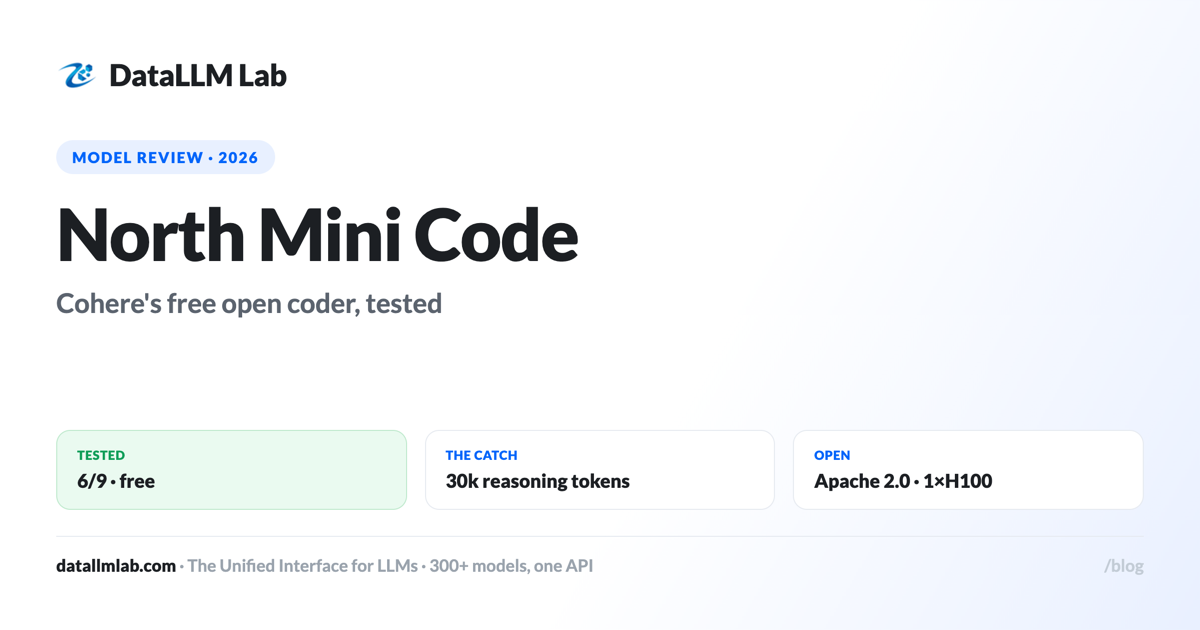
North Mini Code is Cohere's first developer-focused model - a tiny, open Apache-2.0 coder with only 3 billion active parameters, free to call on OpenRouter and free to self-host. On paper that's a dream for an on-prem coding agent with no per-token lock-in. We ran it through our coding benchmark to see what the small active-parameter count actually costs you. The answer: it's genuinely capable and genuinely free, but it compensates for its size with an enormous amount of reasoning - making it the slowest, most verbose model we've tested.
What North Mini Code is
North Mini Code is Cohere's first developer-focused model, released June 9, 2026 (added to OpenRouter June 17). It's a sparse Mixture-of-Experts with 30B total but only 3B active parameters per token (128 experts, 8 active), a 256K context, built for code generation and agentic software engineering. It's open-weights under Apache 2.0 and runs on a single H100 at FP8 — a deliberately small, deployable coder.
What we tested
We ran North Mini Code's free tier (cohere/north-mini-code:free) through our earlier nine-task coding harness — RPN, word-break, atoi, int-to-Roman, LRU and LFU caches, edit distance, and two bug-fixes (a different task set from the current 13-model benchmark) — executing every answer against hidden tests.
Results: 6/9, free
It solved six of nine, missing word-break, string-to-integer, and the LFU cache — solid for a free 3B-active model, but behind the leaders:
| Model | Score | Cost | Avg latency |
|---|---|---|---|
| Qwen3 Coder Next | 9/9 | $0.10 / 1k | 7.0s |
| DeepSeek V4-Flash | 9/9 | $0.13 / 1k | 14.5s |
| Claude Opus 4.8 | 9/9 | $4.05 / 1k | 6.1s |
| North Mini Code | 6/9 | Free | 54.1s |
The headline is the price column: it's free. For a model you can run yourself at no per-token cost, 6/9 on a deliberately hard set is respectable. But "free" hides a real cost — time. (North Mini Code emits ~30,000 reasoning tokens per answer, which exceeds the output cap of our current 13-model benchmark, so we report it on the earlier harness and its 6/9 is not directly comparable to that set.)
The catch: it over-thinks
With only 3B active parameters, North Mini Code compensates by reasoning a lot — far more than any model we've tested:
That ~30,000 reasoning tokens translated into the slowest run we've recorded: ~54 seconds per task on average, with the quicksort fix taking 146 seconds and the LFU cache burning 8,300 reasoning tokens before failing. The lesson mirrors the cost trap in other reviews: a small, "cheap" model isn't free of cost — it spends your time and compute on long reasoning instead of your money on per-token fees. Whether that's a good trade depends entirely on whether latency matters for your use.
The real draw: free, open, tiny footprint
North Mini Code isn't trying to win raw benchmarks — it's trying to be the coding model you can actually own and run cheaply. Apache 2.0, 3B active, single-H100 deployable, free tier to try: that's a strong package for an on-prem or air-gapped coding agent with no per-token lock-in. One honest caveat from independent testing: it's a specialist — Artificial Analysis flags it as weak on non-coding agentic work (~14% GDPval-AA). Use it for code, not as a general assistant.
Pricing & access
On OpenRouter: a free tier (cohere/north-mini-code:free, $0/$0, rate-limited) plus a paid variant whose per-token price wasn't published at the time of writing — so the practical cost story is "free tier or self-host." The weights are Apache 2.0 on Hugging Face (bf16/fp8/w4a16) and Ollama. For most teams the appeal is running it themselves.
Who should use it
Self-host / on-prem
- Apache-2.0, 3B active, one H100 — a free coding agent with no lock-in.
Zero-budget prototyping
- The free tier lets you wire a coder into an agent at $0.
Latency-critical? no
- ~54s/task — by far the slowest we've tested; not for interactive UX.
General assistant? no
- A coding specialist; weak on non-coding agentic work.
Try North Mini Code next to 300+ models — one key
Compare the free Cohere coder with DeepSeek V4-Flash, Qwen and Claude on your own tasks, and route to whatever fits — one OpenAI-compatible endpoint.
FAQ
What is Cohere North Mini Code?
Cohere's first dev-focused coding model (Jun 9, 2026) — a sparse MoE, 30B total / 3B active, 128 experts, 256K context, Apache 2.0, runs on one H100 at FP8.
Is it free?
Yes — a free OpenRouter tier (cohere/north-mini-code:free, rate-limited) and free to self-host under Apache 2.0. A paid variant exists but its per-token price wasn't published.
Is it good for coding?
Decent for a free 3B-active model — 6/9 in our test (missed word-break, atoi, LFU cache), behind the 9/9 leaders. Vendor SWE-bench Verified 80.2% pass@10 is vendor-reported.
Why is it so slow?
Only 3B active params, so it reasons heavily to compensate — ~30,000 reasoning tokens across 9 tasks (the most we've measured) and ~54s/task average.
North Mini Code vs DeepSeek V4-Flash?
V4-Flash wins raw coding (9/9 vs 6/9, ~15s vs ~54s). North Mini Code wins on license/footprint: Apache 2.0, 3B active, one H100, free — best for self-hosted, no-lock-in coding.
Can I self-host it?
Yes — Apache 2.0 weights on Hugging Face (bf16/fp8/w4a16) and Ollama; one H100 at FP8. That low footprint + permissive license is the main reason to pick it.
Is it a general-purpose model?
No — a coding specialist. Independent Artificial Analysis flags weakness on non-coding agentic work (~14% GDPval-AA). Use it for code.
Limits of this test?
Text-coding only: nine standard tasks, one run, pass/fail via executed code — not agentic/repo-scale. Cohere's SWE-bench is vendor-reported.