 DataLLM Lab
Gemini vs Claude in 2026: Benchmarks, Real Costs & Which to Pick
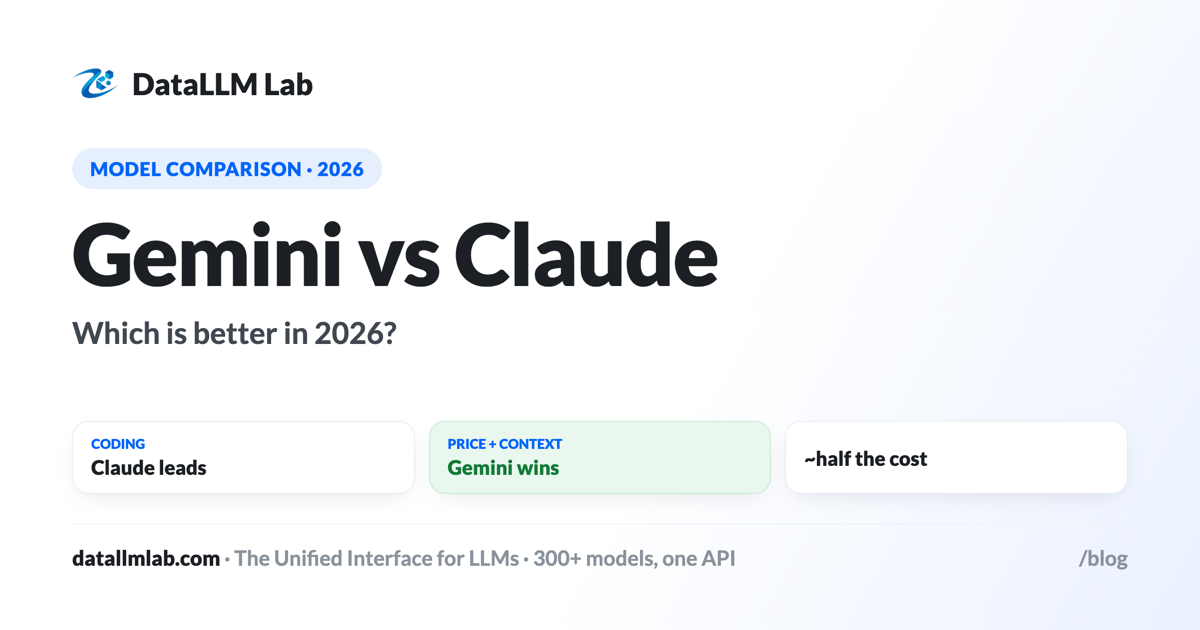
Gemini and Claude pull in different directions: Claude (Opus) is the stronger coder and instruction-follower, while Gemini wins on price, context window, and native multimodal. Neither is simply better — it depends on whether your bottleneck is code quality or cheap long-context multimodal throughput. This guide puts both on benchmarks, models what they actually cost across real workloads, and walks through worked scenarios so you can pick by job.
The short answer
Claude for coding and instruction-following; Gemini for price, context window, and multimodal. Claude Opus leads independent coding benchmarks; Gemini costs about half as much at the flagship, ingests more context, and is the stronger multimodal model. Pick by whether your bottleneck is code quality or cheap long-context throughput.
Side by side
| Claude (Anthropic) | Gemini (Google) | |
|---|---|---|
| Flagship | Opus 4.8 / 4.7 | Gemini 3.1 Pro |
| SWE-bench Verified | 88.6% (Opus 4.8) | Strong, below Opus |
| Flagship price (in/out) | $5 / $25 | $2 / $12 |
| Cheap tier | Haiku $1 / $5 | Flash (very low) |
| Context window | 1M | ~1M+ (largest) |
| Multimodal | Vision | Image, audio, video + gen |
| Best at | Coding, planning | Cheap long-context, multimodal |
What we measured, and what we did not
Every other number on this page is a vendor price sheet or somebody else's benchmark. This section is ours. We ran 13 models through 9 executed Python tasks at temperature 0 and max_tokens 4000, scoring each by running the returned code against assertions the model never sees. Two Claude models were in that run. No Gemini model was.
| Model | Score | $ / 1,000 tasks | Avg latency |
|---|---|---|---|
| Claude Sonnet 5 | 9/9 | $1.67 | 7.2 s |
| Claude Opus 4.8 | 9/9 | $4.05 | 6.1 s |
| Any Gemini model | not tested | — | — |
| Qwen3 Coder Next (cheapest 9/9 in the run) | 9/9 | $0.10 | 7.0 s |
| GPT-5.5 (priciest 9/9 in the core sweep) | 9/9 | $8.83 | 10.5 s |
Two things there are not on any spec sheet. First, both Claude models returned the same perfect score, so the $4.05 Opus run bought no additional correctness over the $1.67 Sonnet run on this class of work — and Opus was the faster of the two, 6.1 s against 7.2 s, which inverts the usual assumption that the bigger model makes you wait. Second, both Claude models emitted zero reasoning tokens on these tasks, so there is no hidden thinking-token surcharge sitting on top of those billed figures. Across the whole run, 10 of 13 models scored 9/9, from $0.10 to $8.83 — an 88x spread for identical output.
The Gemini side of this article is vendor-reported or third-party throughout. We have no first-party figure for any Gemini model: not a score, not a cost per thousand tasks, not a latency. Where Gemini sits next to Claude in the tables above and below, only the Claude cells were measured by us. An empty column is more useful than an estimated one.
Pricing
Gemini is roughly half Claude's price at the flagship tier — the clearest practical difference:
What they cost to run
Output price is one number; the real bill depends on your traffic shape. Here's the modeled monthly cost across five workloads:
| Monthly workload | Claude Opus 4.8 | Claude Sonnet 5 | Gemini 3.1 Pro | Claude Haiku 4.5 |
|---|---|---|---|---|
| Support chatbot | $500 | $200 | $224 | $100 |
| RAG / knowledge base | $1,500 | $600 | $640 | $300 |
| Coding agent | $1,025 | $410 | $460 | $205 |
| Batch extraction | $950 | $380 | $396 | $190 |
| Content generation | $1,100 | $440 | $520 | $220 |
On a RAG workload, Gemini 3.1 Pro runs about $640/month versus $1,500 for Claude Opus — and Claude's own cheap tier (Haiku) is cheaper still where its quality suffices. The pattern: Gemini wins flagship-vs-flagship on cost, but it does not win the whole table — Claude Sonnet 5 at $2/$10 undercuts Gemini 3.1 Pro's $2/$12 on every row here. Within Claude, dropping a tier is a bigger lever than switching vendors.
Where Claude wins
- Coding — leads independent SWE-bench Verified.
- Instruction-following & planning — strong at staying on-task across complex, multi-step work.
- Agentic reliability — a favorite for coding agents where precision matters.
One correction from our own run, though: which Claude you pick matters less than the flagship framing implies. On nine executed Python tasks, Claude Sonnet 5 and Claude Opus 4.8 both scored 9/9, at $1.67 and $4.05 per 1,000 tasks. The Opus premium is for work harder than routine function-writing, not for routine function-writing.
Where Gemini wins
- Price — about half Claude's flagship cost; very cheap Flash tier.
- Context window — the largest, for ingesting huge documents or codebases at once.
- Multimodal — built multimodal-first; strong image/audio/video plus generation.
Worked scenarios
Scenario Document-analysis app
- Big inputs, cost-sensitive → Gemini — largest context + low input price ingest whole documents cheaply.
Scenario Production coding agent
- Quality first → Claude, but start at Sonnet 5: it matched Opus 4.8 at 9/9 in our run, $1.67 vs $4.05 per 1,000 tasks. Escalate to Opus only where Sonnet visibly fails.
Scenario Multimodal product
- Image/audio/video → Gemini, the broader, cheaper multimodal model.
Scenario Budget chatbot
- Cost dominates → Gemini Flash or Claude Haiku. Modeled: Haiku $100/mo against $500 for Opus on the same chatbot traffic; Flash is not in our cost model, but it prices below the $224 Gemini 3.1 Pro line.
Which to pick by job
Coding
- Claude for quality, but try Sonnet 5 before Opus — both hit 9/9 in our executed run. See best coding LLM.
Long context / RAG
- Gemini for huge documents at low cost. See best LLM for RAG.
Multimodal
- Gemini for image/audio/video understanding and generation.
Best move Route both
- Claude for code, Gemini for cheap long-context — one key.
Run Gemini and Claude side by side
Gemini 3.1 Pro, Claude Opus 4.7, and 300+ more — one OpenAI-compatible key, live price comparison, route per request.
FAQ
Is Gemini better than Claude?
Task-dependent. Claude Opus leads coding (88.6% SWE-bench) and instruction-following; Gemini wins price (~half), context window, and multimodal. Coding → Claude; cheap long-context multimodal → Gemini.
Is Gemini or Claude cheaper?
Gemini — 3.1 Pro ~$2/$12 vs Claude Opus $5/$25. On a RAG workload, Gemini ~$640/mo vs Opus $1,500. Gemini Flash and Claude Haiku are both cheap on the low tier.
Gemini or Claude for coding?
Claude — Opus leads SWE-bench and planning. Gemini is a strong, much cheaper budget coder, but Claude is the quality pick.
Which has the bigger context window?
Gemini — its Pro models offer the largest context (~1M+, historically up to 2M), ahead of or matching Claude's 1M, at lower cost per token.
Gemini or Claude for multimodal?
Gemini — built multimodal-first with strong image/audio/video and image generation. Claude has solid vision but Gemini is broader and cheaper.
Gemini or Claude for long documents?
Gemini — largest context window plus low input price is ideal for analyzing/rewriting big documents in one pass. Claude's 1M is capable but costs more per token.
Can I use both with one API?
Yes — via an OpenAI-compatible gateway like DataLLM Lab you reach Gemini 3.1 Pro and Claude Opus 4.7 (and 300+ others) with one key and route by task.
Is Gemini good enough to replace Claude for coding?
For routine coding at a fraction of the price, often yes. For the hardest agentic coding, Claude Opus still leads — route Gemini for the bulk, escalate to Claude on hard tasks.