 DataLLM Lab
GPT-5 vs Gemini 3: Which Should You Use?
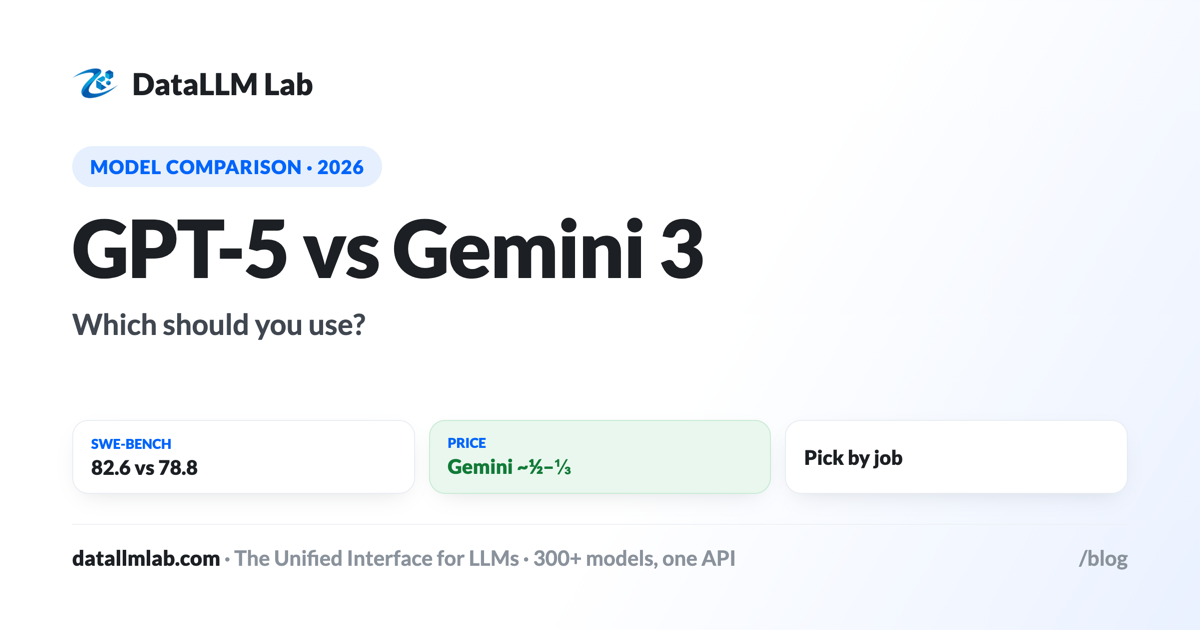
GPT-5 and Gemini 3 are the OpenAI and Google flagships of 2026, and the choice usually comes down to one trade-off: GPT-5 edges ahead on agentic and coding tasks, while Gemini 3 is materially cheaper and stronger on long-context multimodal work. This guide puts both on independent benchmarks, shows the real price gap, and gives a clear pick by job — coding, agents, multimodal, and cost-sensitive scale.
The short answer
GPT-5 for hard agentic and coding work; Gemini 3 for cheap, long-context, multimodal work. GPT-5 leads independent coding and terminal benchmarks; Gemini 3 trails by a few points but costs a half to a third as much and is the stronger multimodal/long-context family. For most cost-sensitive workloads Gemini wins on value. One correction to that framing, from our own executed run: on routine coding tasks GPT-5.5's premium buys nothing measurable. It scored 9/9, the same as nine other models, one of which finished the same work at $0.10 per 1,000 tasks against GPT-5.5's $8.83. The premium has to be earned on the harder agentic work our suite does not cover. No Gemini model has been through that harness, so every Gemini figure here is vendor-reported or independent, never ours.
| GPT-5 (OpenAI) | Gemini 3 (Google) | |
|---|---|---|
| Flagship | GPT-5.5 / GPT-5.4 | Gemini 3.1 Pro / 3.5 Flash |
| SWE-bench Verified | 82.6% (5.5) | 78.8% (3.5 Flash) |
| Price (flagship out) | $30 (5.5) / $15 (5.4) | $12 (Pro) / $9 (Flash) |
| Strength | Agentic, terminal, coding | Multimodal, long-context, value |
Specs & price
| Model | Input | Output | Context |
|---|---|---|---|
| GPT-5.5 | $5 | $30 | ~1M |
| GPT-5.4 | $2.50 | $15 | 1.1M |
| Gemini 3.1 Pro | $2 | $12 | 1M |
| Gemini 3.5 Flash | $1.50 | $9 | 1M |
Per 1M tokens, USD, June 2026.
The price gap
The clearest practical difference is cost. On output — the expensive side — Gemini undercuts GPT-5 across the board:
Benchmarks
On the independent SWE-bench Verified board, GPT-5.5 (82.6%) leads Gemini 3.5 Flash (78.8%) — a real but single-digit gap. GPT-5 also tends to lead agentic terminal benchmarks. The honest read: GPT-5 is a few points better on coding and agentic execution, not categorically ahead. But note what that gap is measured on: a leaderboard score, not the cost of finishing a task. When we ran GPT-5.5 through our own executed suite — no Gemini model is in it — the price axis turned out to matter more than the score axis, and by a much wider margin than any list-price table suggests.
What we measured ourselves: GPT-5.5 only
We run our own executed benchmark: 13 models, 9 Python tasks, temperature 0, max_tokens 4000, scored by running the code each model returns against assertions it never sees. GPT-5.5 is in that run. No Gemini model is. So this section is one half of the head-to-head, and we are not going to invent the other half. Everything below is measured; anything about Gemini elsewhere in this article is vendor-reported or from the independent board.
| Model | Score | $ / 1,000 tasks | Avg latency |
|---|---|---|---|
| Qwen3 Coder Next | 9/9 | $0.10 | 7.0s |
| DeepSeek V4-Flash | 9/9 | $0.13 | 14.5s |
| Mistral Medium 3.5 | 9/9 | $0.87 | 2.9s |
| Claude Sonnet 5 | 9/9 | $1.67 | 7.2s |
| Claude Opus 4.8 | 9/9 | $4.05 | 6.1s |
| GPT-5.5 | 9/9 | $8.83 | 10.5s |
| Any Gemini 3 model | not tested | not tested | not tested |
Six of the 13 models in our July 2026 executed run, plus the gap. Cost = measured token usage priced at list rates, extrapolated to 1,000 tasks. GPT-5.5 also spent 176 reasoning tokens per task. Full field, including the three models that scored 8/9: the complete coding cost benchmark. How it was scored: methodology.
GPT-5.5 was the most expensive model in the run, and the money bought no extra correctness. It tied at the top with nine others, one of them 88x cheaper for output that passed the identical assertions. That reframes the question this article opened with: the list-price gap between the families ($30 vs $12 per 1M output tokens) is real, but it is small next to the gap between any flagship and a competent cheap coding model on work a cheap model can already do. And the premium is not runaway thinking tokens: GPT-5.5 used only 176 reasoning tokens per task, well under DeepSeek V4-Flash's 568 or MiniMax M3's 623. It is simply priced high.
Where GPT-5 wins
- Agentic coding & terminal execution — leads the benchmarks; the GPT-5 Codex variants are tuned for coding agents.
- Peak reasoning — GPT-5.5 and the Pro tier for the hardest multi-step problems.
- Ecosystem — the widest tooling and integration support, being the native OpenAI format.
Where Gemini 3 wins
- Cost — a half to a third of GPT-5's output price; the value pick at scale.
- Multimodal — natively handles image, audio, video, and PDF input.
- Long context — strong, cheap 1M-token processing for document and media pipelines.
- A usable free tier — via Google AI Studio, unlike OpenAI's paid-only API.
Which to pick
Pick GPT-5
- Hard agentic coding, terminal automation, peak reasoning, deep OpenAI tooling.
Pick Gemini 3
- Cost-sensitive scale, multimodal pipelines, long-context document work, prototyping on the free tier.
Best move Use both
- Route Gemini for cheap/multimodal, GPT-5 for hard agentic — one key, per-request choice.
Also consider The full field
- Claude leads independent coding overall; DeepSeek is cheaper still. See best LLM API.
Run GPT-5 and Gemini 3 side by side
GPT-5.4, Gemini 3.1 Pro, Gemini 3.5 Flash, Claude Opus 4.7 and 300+ more — one OpenAI-compatible key, live price comparison, route per request.
FAQ
Is GPT-5 better than Gemini 3?
On independent SWE-bench Verified, GPT-5.5 (82.6%) edges Gemini 3.5 Flash (78.8%), and GPT-5 leads agentic/terminal tasks. Gemini 3 is competitive on coding, much cheaper, and stronger on multimodal/long-context. It depends on the workload.
Is Gemini cheaper than GPT-5?
Yes — Gemini 3.1 Pro $2/$12, 3.5 Flash $1.50/$9 versus GPT-5.5 $5/$30 and GPT-5.4 $2.50/$15. Typically a half to a third of GPT-5's output price.
Which is better for coding?
GPT-5 has the edge on coding benchmarks and agentic execution (Codex variants). Gemini 3 codes well and is cheaper — a strong value pick for high-volume coding.
Which is better for long context and multimodal?
Gemini 3 — both offer ~1M context, but Gemini is natively multimodal and priced low for long-context work.
GPT-5 or Gemini 3 for agents?
GPT-5 (5.5 / Codex) tends to lead agentic terminal/tool-use. Gemini 3 is capable and cheaper for agent fleets where cost-per-task matters. Test both.
Can I use both with one API?
Yes — via an OpenAI-compatible gateway like DataLLM Lab you reach GPT-5.4 and Gemini 3.1 Pro (and 300+ others) with one key and route by task.