 DataLLM Lab
Gemini 3.6 Flash Review: 9/9 Correct, $8.02 per 1,000 Tasks
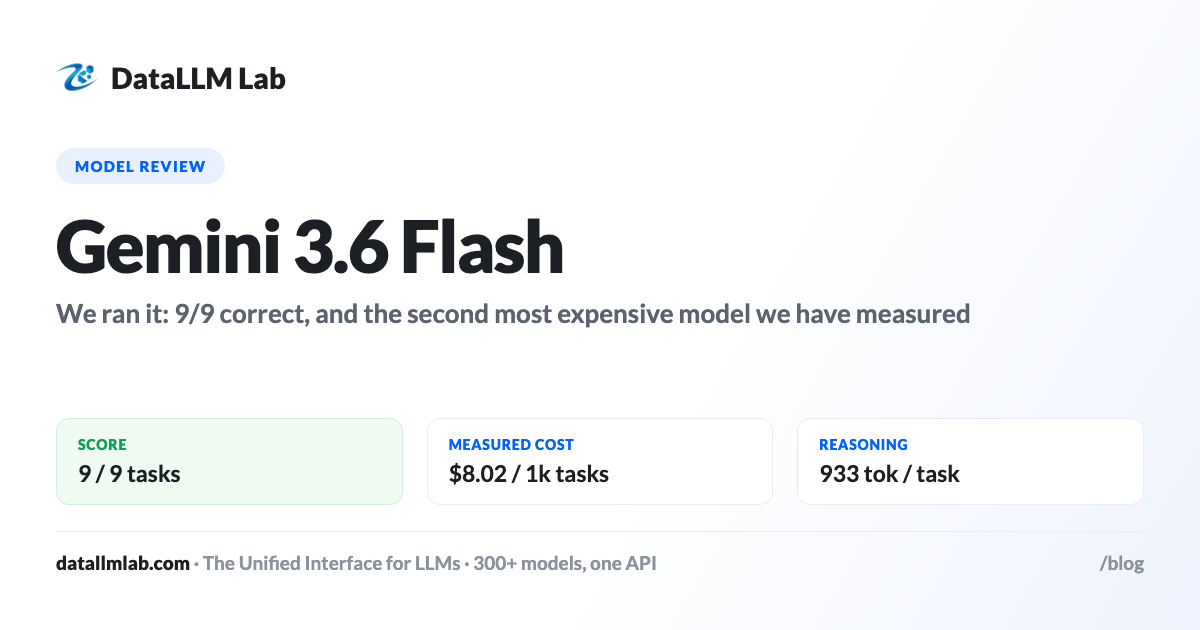
Gemini 3.6 Flash launched on 2026-07-21 at $1.50 / $7.50 per 1M tokens with a 1,048,576-token context. That is budget-tier pricing. We ran it on our executed coding harness on 2026-07-28 and got a result we did not expect: it scored a perfect 9/9, and it cost $8.02 per 1,000 tasks — behind only Gemini 3.1 Pro at $14.70 and GPT-5.5 at $8.83 among the 21 models we have run. The reason is one number: 933 reasoning tokens per task, more than any model in the 13-model core sweep, where the top was 732. Qwen3 Coder Next scored the same 9/9 on the same nine tasks for $0.10. This review shows the measurements, the arithmetic behind them, and where the comparison stops being fair.
What we measured
- Score: 9/9. It did not miss a single task.
- Measured cost: $8.02 per 1,000 tasks. Third highest of the 21 models we have run.
- Speed: 6.5 s average per task. Third fastest of everything we have run.
- Reasoning tokens: 933 per task on average, against a 13-model core-sweep top of 732.
- List price: $1.50 in / $7.50 out per 1M tokens, 1,048,576-token context. List prices in this article are from our price capture of 2026-07-29.
- Run date: 2026-07-28, on the same harness as our 13-model sweep, after that sweep.
What Gemini 3.6 Flash is
Google shipped Gemini 3.6 Flash on 2026-07-21, alongside Gemini 3.5 Flash-Lite. The notable absence was a 3.5 Pro: Google said the Pro model fell short internally on coding and complex reasoning, so it did not ship, and Google pointed forward to Gemini 4 instead. That is unusual candour from a vendor, and it frames 3.6 Flash as the release carrying the generation.
| Fact | Value | Source |
|---|---|---|
| Released | 2026-07-21 | Vendor |
| Input price | $1.50 per 1M tokens | Verified list price, 2026-07-29 |
| Output price | $7.50 per 1M tokens | Verified list price, 2026-07-29 |
| Context window | 1,048,576 tokens | Verified list price, 2026-07-29 |
| Shipped alongside | Gemini 3.5 Flash-Lite | Vendor |
| No 3.5 Pro | Held back; short on coding and complex reasoning internally | Vendor statement |
| Output-token efficiency | ~17% fewer output tokens than 3.5 Flash | Vendor-reported, not verified by us |
| Coding, long-context, computer-use benchmarks | Higher than 3.5 Flash | Vendor-reported, not verified by us |
Two of those rows deserve a flag. Google's claim that 3.6 Flash uses roughly 17% fewer output tokens than Gemini 3.5 Flash while scoring higher on coding, long-context and computer-use benchmarks is vendor-reported. We did not verify it and we are not repeating it as fact. It is also worth noting that the output price moved with it: 3.5 Flash lists at $1.50 / $9, and 3.6 Flash at $1.50 / $7.50 — a 17% cut on the output rate. Cheaper per token, and Google says fewer tokens. On paper that is a double discount.
Our benchmark result: 9/9 at $8.02 per 1,000 tasks
We ran Gemini 3.6 Flash on 2026-07-28 through the same executed-code harness as our 13-model sweep. Nine Python tasks, temperature 0, max_tokens 4000, each answer scored by running the returned code against assertions the model never sees. One scored attempt per task — the harness retries only when the API errors, never when the model returns a wrong answer.
| Our benchmark metric | Gemini 3.6 Flash |
|---|---|
| Tasks passed (executed against hidden tests) | 9 / 9 |
| Misses | None |
| Measured cost per 1,000 tasks | $8.02 |
| Average latency per task | 6.5 s |
| Wall-clock range across the nine tasks | 3.4 s to 14.2 s |
| Reasoning tokens per task (average) | 933 |
| Run date | 2026-07-28 |
The correctness is not in question. It swept all nine. So did ten of the thirteen models in our core sweep, which is the honest context: on this task set, a perfect score is common. What separates models here is what the perfect score costs.
$8.02 per 1,000 tasks puts Gemini 3.6 Flash second on our all-time cost list, behind GPT-5.5 at $8.83 and ahead of Claude Opus 4.8 at $4.05. A model sold as the fast, cheap tier landed 9% below OpenAI's flagship on cost per completed job, and at roughly twice the per-task cost of Claude Opus 4.8.
Why it costs that much: 933 reasoning tokens per task
Gemini 3.6 Flash averaged 933 reasoning tokens per task — more than any model in the 13-model core sweep, where the top was 732. The previous high was DeepSeek V4-Pro at 732, and that model only managed 8/9. For comparison, GPT-5.5 spent 176, and Claude Sonnet 5, Claude Opus 4.8 and Qwen3 Coder Next spent zero.
Reasoning tokens bill at the output rate. At $7.50 per 1M output tokens, 933 tokens per task works out to about $7.00 per 1,000 tasks from thinking alone — roughly 87% of the $8.02 we measured. That is arithmetic on our own token counts at the published list price, not a separate measurement, but it locates the money precisely. You are not paying for the answer. You are paying for the deliberation before the answer.
The distribution is lopsided. Here is what Gemini 3.6 Flash spent on each of the nine tasks in our run:
On parse_csv_line — the task DeepSeek V4-Pro missed — Gemini 3.6 Flash spent 2,615 reasoning tokens. That is one task consuming more thinking than GPT-5.5 spent across all nine tasks put together — 176 per task, 1,584 in total. It got the answer right. At the $7.50 output rate, those 2,615 reasoning tokens cost about two cents on that single function, before a line of visible code.
This is the pattern to internalise: a low sticker price on a thinking model tells you very little about your bill. We wrote up the general version of this in cutting token costs in coding agents, and it is the whole reason our coding cost benchmark reports cost per completed task rather than cost per million tokens.
The comparison that matters: 80x for the same score
Qwen3 Coder Next also scored 9/9, on the same nine tasks, for $0.10 per 1,000 tasks, with zero reasoning tokens. That is 80x cheaper for an identical result. Claude Sonnet 5 also scored 9/9, at $1.67, also with zero reasoning tokens — 4.8x cheaper.
| Model | Score | Measured cost / 1k tasks | Avg latency | Reasoning tok / task | List price per 1M (captured 2026-07-29) |
|---|---|---|---|---|---|
| Gemini 3.6 Flash | 9/9 | $8.02 | 6.5 s | 933 | $1.50 / $7.50 |
| GPT-5.5 | 9/9 | $8.83 | 10.5 s | 176 | $5 / $30 |
| Claude Opus 4.8 | 9/9 | $4.05 | 6.1 s | 0 | $5 / $25 |
| Claude Sonnet 5 | 9/9 | $1.67 | 7.2 s | 0 | $2 / $10 |
| Qwen3 Coder Next | 9/9 | $0.10 | 7.0 s | 0 | $0.12 / $0.80 |
Note the column that does not separate them: score. Five models, five perfect sweeps, an 80x spread in cost. Note also the column that inverts the usual story: Gemini 3.6 Flash has the second-cheapest list price in this table and the second-highest measured cost. Sticker price and bill point in opposite directions.
Latency is where Gemini 3.6 Flash does best — though not where it wins outright. 6.5 s average is the third-fastest result across everything we have run, behind Mistral Medium 3.5 at 2.9 s and Claude Opus 4.8 at 6.1 s. Note what that means inside the table above: Claude Opus 4.8 is both faster and half the cost. It out-ran GPT-5.5 by 4 s per task while spending more than five times the reasoning tokens (933 against 176), which says something real about Google's serving stack. If your constraint is wall-clock rather than spend, that matters. If you are shipping thousands of small coding calls a day, it does not matter nearly enough to justify 80x.
For the cheap end of that spread, see the cheapest LLMs for coding; for the full field and how we ranked it, best coding LLM in 2026. Our review of the model that still holds the top of the cost list is here.
What our benchmark does not say
Nine short Python functions say nothing about the work a 1M-context Flash model is built for. We want to be blunt about this, because the headline number above is easy to over-read.
- We did not test long context. Every prompt in our harness is short. A 1,048,576-token window is completely unexercised by this benchmark. If you are feeding it a repository or a document set, our result predicts nothing.
- We did not test multimodal input. No images, no audio, no video, no PDFs.
- We did not test agentic or computer-use work. No tool calls, no multi-turn loops, no multi-file refactoring. Google's own claim of improved computer-use scores is exactly the axis we cannot speak to.
- We did not test non-Python work.
- The 4,000-token ceiling is a real constraint. A very verbose model can be cut off and scored as a miss. Gemini 3.6 Flash was not — it passed all nine — but the ceiling shapes what the harness can see.
- Nine tasks is nine tasks. One scored attempt each. It is a floor on capability, not a full profile.
The honest conclusion is narrow, and we will state it narrowly: on short, well-specified coding tasks, Gemini 3.6 Flash's thinking budget makes it expensive per job despite a cheap sticker price. That is what we measured. Extending it to "Gemini 3.6 Flash is a bad model" would be an unsupported leap — it did not miss a single task, and it was fast doing it. If long-context reasoning is your workload, the thing to read next is context rot, not this benchmark.
Pricing, and when the thinking is worth paying for
Gemini 3.6 Flash lists at $1.50 input / $7.50 output per 1M tokens. Against its predecessor, input is flat and output is 17% cheaper — Gemini 3.5 Flash lists at $1.50 / $9. For context in Google's own line, Gemini 3.1 Pro (preview) is $2 / $12. Those are the list prices as of our 2026-07-29 capture. Full per-vendor breakdowns are in our Gemini API pricing guide.
The output rate is the number to watch, because on a thinking model the output rate is the price of the thinking. Three cases where paying it makes sense:
- The task is genuinely hard and a wrong answer is expensive. Deliberation you pay for is cheaper than a bug you ship. Our nine tasks are not that; your production problems might be.
- You need a 1M-token window at a low input rate. At $1.50 per 1M input it is the cheapest input rate in our table apart from Qwen3 Coder Next, which tops out well short of 1M context. Claude Sonnet 5 and Claude Opus 4.8 do carry roughly 1M windows of their own, so the window alone is not the differentiator — and our harness never exercised it, so we cannot tell you whether Gemini 3.6 Flash uses it well.
- Latency is the binding constraint. 6.5 s average, third-fastest we have measured, with a 3.4 s to 14.2 s range.
And the case where it does not: routine, well-specified code generation at volume. There, a zero-reasoning coder that scores the same for a fraction of the cost is the correct answer, and the table above names three of them. The practical way to run that comparison on your own traffic is to keep one endpoint and swap the model id — see what an LLM gateway is.
Compare models on cost per completed task, not per token
One OpenAI-compatible endpoint, 300+ models, live price comparison and automatic failover — swap a model id and see what your own workload actually costs.
FAQ
How did Gemini 3.6 Flash do in your benchmark?
It scored 9/9 on our executed 9-task Python coding harness, run 2026-07-28. No misses. It averaged 6.5 s per task, with a range of 3.4 s to 14.2 s, and 933 reasoning tokens per task. Measured cost was $8.02 per 1,000 tasks.
Why is a Flash model so expensive per task?
Because it thinks a lot and thinking bills at the output rate. 933 reasoning tokens per task beat every model in the 13-model core sweep, where the top was DeepSeek V4-Pro at 732 and it only scored 8/9. We have since measured Gemini 3.1 Pro higher still, at 1,094. At $7.50 per 1M output tokens, the reasoning alone accounts for roughly $7.00 of the $8.02 we measured. On one task, parse_csv_line, it spent 2,615 reasoning tokens.
What is cheaper than Gemini 3.6 Flash for the same result?
On our nine tasks, Qwen3 Coder Next scored the same 9/9 at $0.10 per 1,000 tasks with zero reasoning tokens — 80x cheaper. Claude Sonnet 5 also scored 9/9 at $1.67, also with zero reasoning tokens. Claude Opus 4.8 scored 9/9 at $4.05.
How much does Gemini 3.6 Flash cost per token?
$1.50 per 1M input tokens and $7.50 per 1M output tokens, with a 1,048,576-token context window. That is a 17% cut on the output rate versus Gemini 3.5 Flash ($1.50 / $9). The sticker price is low; our measured cost per completed task was not.
Is Gemini 3.6 Flash actually more efficient than 3.5 Flash?
Google says it uses roughly 17% fewer output tokens than Gemini 3.5 Flash while scoring higher on coding, long-context and computer-use benchmarks. That is vendor-reported and we did not verify it — we have not run Gemini 3.5 Flash on this harness, so we cannot compare them first-party.
Does your result mean Gemini 3.6 Flash is a bad model?
No. It passed every task and was the third-fastest model we have ever run. Our harness tests short Python functions — it says nothing about long-context reasoning, multimodal input, agentic tool use or multi-file refactoring, which is what a 1M-context Flash model is built for. The finding is narrow: on short, well-specified coding tasks its thinking budget makes it expensive per job. Cost here is the token counts the API reported multiplied by list price, measured through OpenRouter rather than our own gateway — full details in our methodology.