 DataLLM Lab
Gemini 3.5 Flash Review: Fast, Cheap, and Mostly Smart
Gemini 3.5 Flash is Google's new fast-and-cheap workhorse — $1.50/$9 per million tokens, a 1M-token context, and benchmark scores that punch well above its price tier. Google says it's "4x faster," and the streaming speed is real, but there's a latency catch nobody mentions. Here's the honest review: the benchmarks (and the one everyone confuses), the true speed picture, when it beats Gemini 3.1 Pro, and how to use it today.
At a glance
- What it is: Google's newest fast tier — the first in the Gemini 3.5 series. Released May 19, 2026.
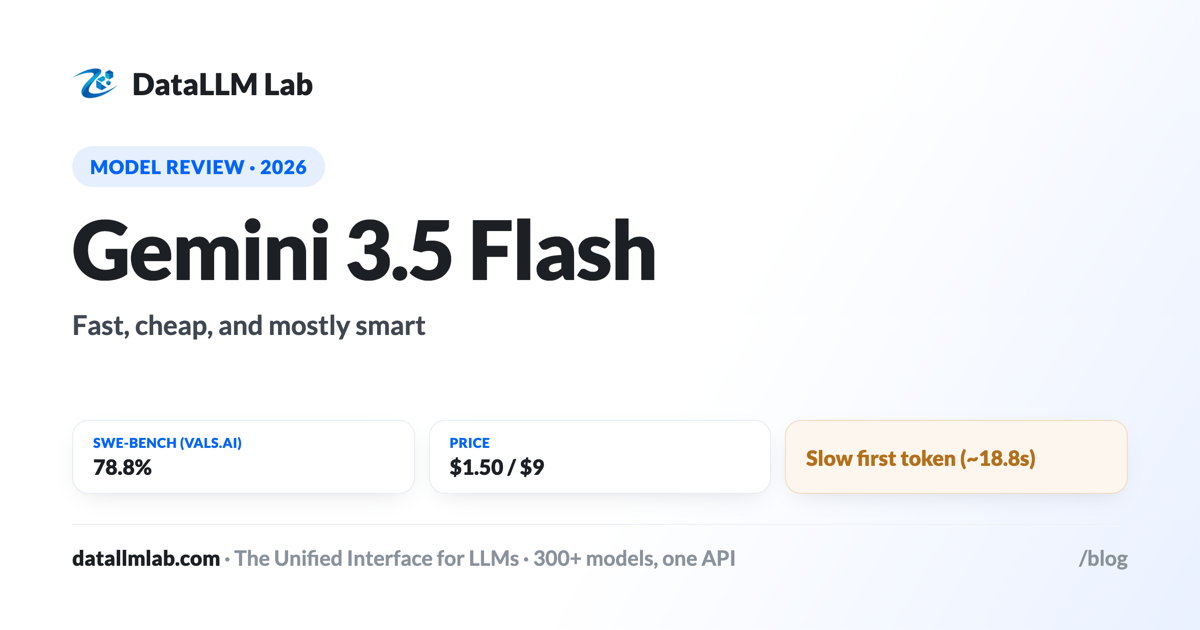
- Price: $1.50 / $9 per million tokens ($0.15 cached) — cheaper than Gemini 3.1 Pro, yet ahead of it on several coding/agentic benchmarks.
- Smarts: 78.8% on the independent SWE-bench Verified board — strong for a "Flash" model.
- Speed: genuinely fast streaming (~153 tok/s), but a slow start (high time-to-first-token) at high thinking levels.
- Context: ~1M tokens in, 64K out, fully multimodal (text, image, audio, video, PDF).
- Not on the gateway yet — closest you can call today is Gemini 3.1 Flash / 3.1 Pro.
What's new
Gemini 3.5 Flash brings frontier-tier capability into Google's cheap, fast tier. The pitch: near-flagship intelligence at a fraction of the cost and several times the speed of previous Gemini versions, with strong agentic and coding behaviour. It keeps the hallmark Gemini features — a 1M-token context, full multimodality, and "thinking levels" that trade quality for cost/latency.
Pricing decoded
The pricing has a paradox the headlines love: it's more expensive than the previous Flash, but cheaper than Gemini 3.1 Pro — while often outscoring Pro on agentic work.
| Model | Input / output (per 1M) | Cached input |
|---|---|---|
| Gemini 3.5 Flash | $1.50 / $9 | $0.15 |
| Gemini 3.1 Pro | $2 / $12 | — |
Benchmarks, honestly
Here's where most reviews trip up. There are two different SWE-bench numbers in circulation, and they're not the same test:
| Benchmark | Gemini 3.5 Flash | Source |
|---|---|---|
| SWE-bench Verified | 78.8% | vals.ai (independent) |
| SWE-Bench Pro (Public) | 55.1% | Google (harder test) |
| Terminal-Bench 2.1 | 76.2% | |
| MCP Atlas (tool use) | 83.6% |
The 78.8% (SWE-bench Verified, independent) is the one to compare against other models — it places Flash fifth on the frontier board, an excellent result for a cheap, fast model. The 55.1% is Google's score on SWE-Bench Pro, a deliberately harder benchmark; quoting it next to other models' Verified scores (as some articles do) makes Flash look worse than it is. Different test, different scale.
Speed & the latency catch
Google markets Gemini 3.5 Flash as roughly 4× faster than other frontier models. The streaming throughput backs this up — Artificial Analysis measures around 153 tokens/second, genuinely quick. But there's a catch the marketing skips:
vs Gemini 3.1 Pro
Pick Flash Most workloads
- Agentic coding, tool use, multimodal tasks, high-volume jobs — Flash matches or beats Pro at ~25% less cost.
Pick Pro Deepest reasoning
- The hardest reasoning and very long, intricate contexts can still favour 3.1 Pro. When correctness on a tough problem beats cost, test Pro.
How to use it today
Gemini 3.5 Flash is available directly via Google's API. On DataLLM Lab the current Gemini lineup is Gemini 3.1 Pro ($2/$12), 3.1 Flash, and 3.1 Flash Lite — the closest you can call through the gateway right now. When 3.5 Flash lands, it's a one-line swap:
from openai import OpenAI
client = OpenAI(base_url="https://www.datallmlab.com/v1", api_key="$DATALLMLAB_API_KEY")

resp = client.chat.completions.create(
    model="google/gemini-3.1-flash",   # swap to gemini-3.5-flash when available
    messages=[{"role": "user", "content": "Summarize this PDF and extract the tables..."}],
)
print(resp.choices[0].message.content)
For where Flash-class models fit among coders, see the best coding LLM guide; for the cheapest options overall, the cheapest LLM APIs.
Compare Gemini, GPT and Claude on your own prompts
Gemini 3.1 Pro, GPT-5.4, Claude Opus 4.7 and 300+ more — one OpenAI-compatible key, live price comparison, swap with a one-line change.
FAQ
How much does Gemini 3.5 Flash cost?
$1.50/M input and $9/M output, with cached input around $0.15/M — cheaper than Gemini 3.1 Pro ($2/$12) while scoring higher on several agentic and coding benchmarks.
Is Gemini 3.5 Flash better than Gemini 3.1 Pro?
On agentic and coding benchmarks it often matches or beats 3.1 Pro at ~25% less cost. Pro can still win on the deepest reasoning and very long contexts. For most workloads, Flash is now the better default.
What is Gemini 3.5 Flash's SWE-bench score?
78.8% on the independent vals.ai SWE-bench Verified board (rank #5). Google separately cites 55.1% on SWE-Bench Pro — a different, harder test that several reviews wrongly compare against other models' Verified scores.
How fast is Gemini 3.5 Flash really?
Streaming throughput is genuinely high (~153 tok/s per Artificial Analysis) and Google markets ~4× faster. The catch: at high thinking levels, time-to-first-token can be ~18.8s — fast to stream, slower to start.
What's the context window of Gemini 3.5 Flash?
About 1M input tokens with up to 64K output. It's multimodal — text, images, audio, video, and PDFs in.
Can I use Gemini 3.5 Flash on DataLLM Lab?
Not yet — the gateway carries Gemini 3.1 Pro, 3.1 Flash, and 3.1 Flash Lite. 3.5 Flash is available directly via Google's API; closest on the gateway today is 3.1 Flash or 3.1 Pro.