 DataLLM Lab
Best LLM for RAG in 2026: Picked by What Matters (with Costs)
The best LLM for RAG isn't the smartest model — it's the one that's cheap on input tokens, follows instructions faithfully to stay grounded in the retrieved context, and has a context window big enough for your chunks. Because RAG stuffs lots of retrieved text into every prompt, input price dominates the bill. This guide picks by what actually matters for retrieval-augmented generation, shows the input-price reality, models what RAG costs, and works through a real example.
The short answer
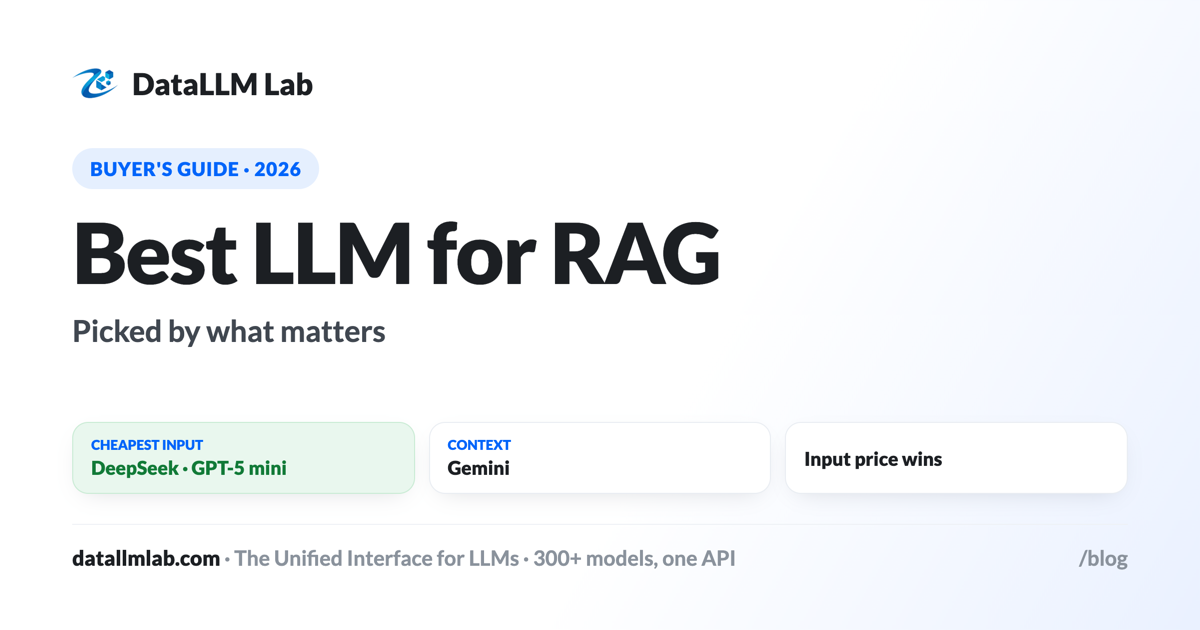
For RAG, pick cheap input, strong grounding, and a big-enough context window — not the highest benchmark score. GPT-5 mini and DeepSeek are excellent low-cost picks, Gemini for the largest context, and Claude when faithful grounding matters most. RAG rarely needs a flagship, because the answer lives in the retrieved context.
What actually matters for RAG
- Input price — RAG injects lots of retrieved text per prompt, so input cost dominates the bill.
- Grounding / instruction-following — the model must answer from the retrieved context and say when it can't.
- Context window — big enough to fit your retrieved chunks without aggressive truncation.
- Latency — for interactive RAG, a fast cheap model beats a slow flagship.
The input-price reality
Output benchmarks get the attention, but RAG is input-heavy — so the input price is what scales your cost. The cheap options are dramatically cheaper here:
What RAG costs
Modeled monthly cost across five workloads — the RAG row (input-heavy: 200M in / 20M out) is the one to watch:
| Monthly workload | Claude Sonnet 4.6 | Gemini 3.1 Pro | Claude Haiku 4.5 | GPT-5 mini | DeepSeek V3.2 |
|---|---|---|---|---|---|
| Support chatbot | $300 | $224 | $100 | $34.0 | $13.3 |
| RAG / knowledge base | $900 | $640 | $300 | $90.0 | $52.8 |
| Coding agent | $615 | $460 | $205 | $70.0 | $26.9 |
| Batch extraction | $570 | $396 | $190 | $53.5 | $37.2 |
| Content generation | $660 | $520 | $220 | $85.0 | $18.2 |
On the RAG row, DeepSeek V3.2 ($53) and GPT-5 mini ($90) run a knowledge base for a fraction of Claude Sonnet ($900) — because RAG's heavy input volume rewards a low input price above all else.
Best model by need
Cheapest input DeepSeek / GPT-5 mini
- Lowest input cost for high-volume RAG at scale.
Biggest context Gemini
- Largest window for many or long retrieved chunks in one prompt.
Best grounding Claude
- Faithful to provided context; flags when the answer isn't there.
Best move Default cheap, escalate
- Run a cheap model for most queries; escalate only the hard ones.
A worked RAG cost example
Make it concrete. A knowledge-base assistant answers 100,000 queries/month; each query retrieves ~2,000 tokens of context plus a short question (~2,100 input) and returns ~200 tokens — roughly 210M input / 20M output per month:
- On Claude Sonnet ($3/$15): ~$630 input + ~$300 output ≈ $930/month.
- On DeepSeek V3.2 ($0.23/$0.34): ~$48 input + ~$7 output ≈ $55/month.
- Add context caching (if a shared instruction/context repeats) and tighter retrieval (fewer, re-ranked chunks), and the input portion drops further.
Same retrieved answers, ~17x cheaper — and for grounded synthesis the quality gap on most queries is small. Reserve a flagship only for the genuinely hard questions, ideally via a gateway that escalates automatically.
Default cheap RAG, escalate the hard queries
DeepSeek, GPT-5 mini, Gemini and 300+ more — one OpenAI-compatible key, route most RAG calls cheap and step up only when needed.
FAQ
What is the best LLM for RAG in 2026?
A cheap, well-grounded model with a large context window — GPT-5 mini and DeepSeek for low input cost, Gemini for context, Claude for grounding. Optimize input price, instruction-following, and context size, not raw IQ.
Why does input price matter most for RAG?
RAG injects retrieved passages into every prompt, so input tokens are large and dominate cost. On a modeled RAG workload, DeepSeek V3.2 (~$53/mo) vs Claude Sonnet ($900) — a low input price wins.
What is the cheapest LLM for RAG?
On input, DeepSeek (~$0.23/M) and GPT-5 nano/mini ($0.05-$0.25), with Gemini Flash also very low. Great for high-volume RAG.
Does RAG need a frontier model?
Usually not — the answer is grounded in retrieved context, so mid/cheap tiers synthesize well. Reserve a frontier model for RAG over very complex material.
Which LLM has the best grounding?
Strong instruction-followers stay grounded best — Claude is well regarded for sticking to provided context and flagging gaps. GPT-5 and Gemini are also strong.
Does context window matter for RAG?
Yes — it must hold your chunks plus the prompt without truncation. Gemini's large context helps many-chunk/long-doc RAG; most models handle typical chunk counts fine.
Can I route RAG across models with one API?
Yes — DataLLM Lab reaches cheap RAG-friendly models and frontier options with one key, so you default cheap and escalate hard queries.
How do I reduce RAG costs?
Pick a low-input-price model, cache reused context, and retrieve tighter (fewer, re-ranked chunks). Together these can cut a RAG bill by more than half.