 DataLLM Lab
Reflection Beam Access and Deployment: What Developers Can Verify
Reflection Beam has an official announcement, but that is not the same as a model you can download, an API your account can call, or a deployment your team has accepted. Reflection describes Beam as a sparse mixture-of-experts model with 501 billion total parameters and 23 billion active, intended for coding, reasoning and agentic workloads. Those are vendor-reported specifications, not measurements made for this article. Reflection announcement.
The announcement, model limits, compatibility, reasoning guidance and commercial terms were rechecked on October 12, 2026, Asia/Shanghai. Reflection's public Hugging Face model listing was also checked again. This is a documentation review: no Beam API calls, performance tests or deployments were performed for this article.
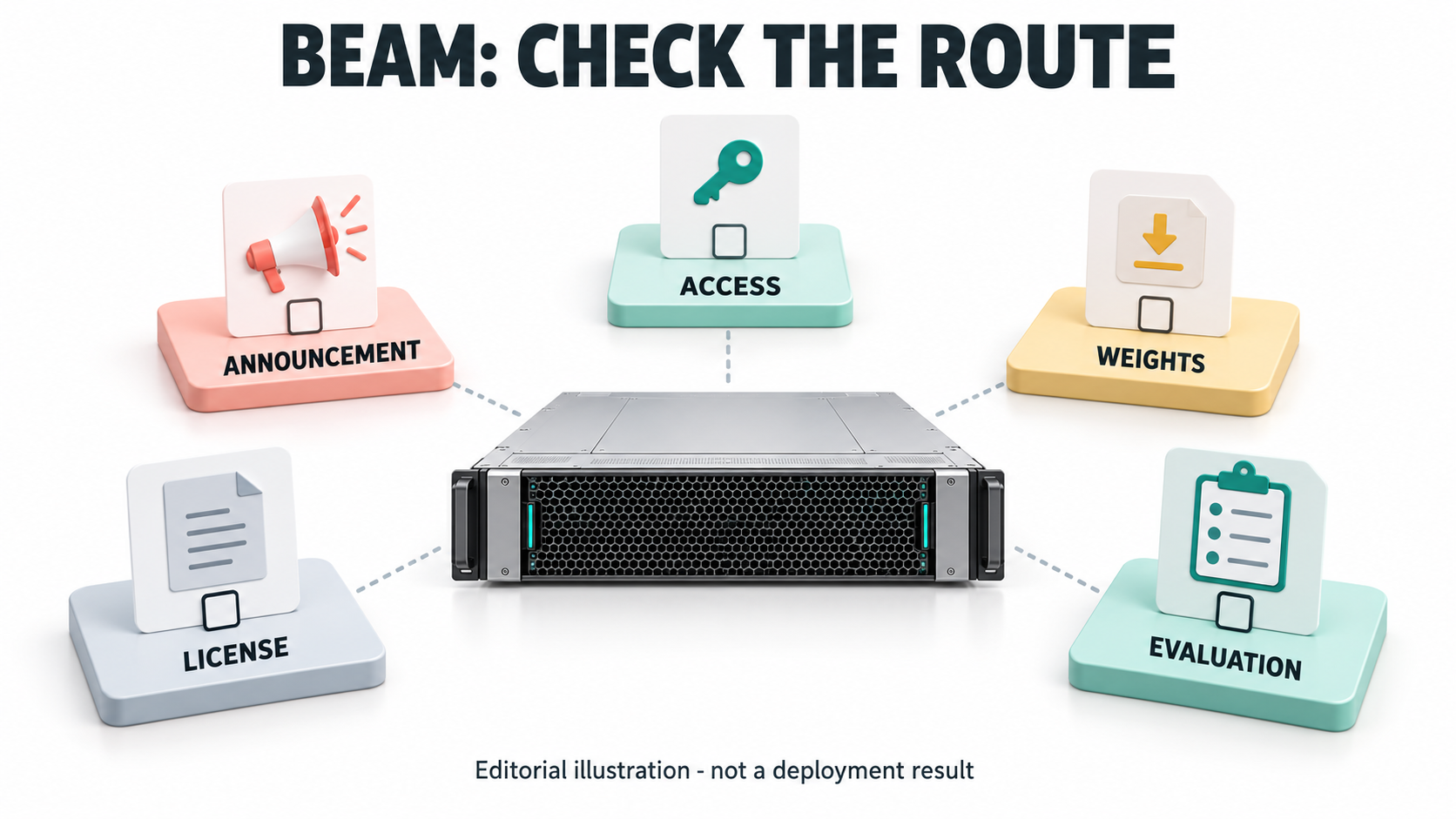
AI-generated editorial illustration of deployment checks, not a Reflection interface, Beam output or tested infrastructure configuration.
Reflection Beam readiness: separate five decisions
Use the following table to decide what can proceed and what still needs evidence. Passing one row does not automatically clear the others.
| Decision | Observed status on October 12 | Evidence needed for your next step |
|---|---|---|
| Announced | Confirmed by Reflection's dated announcement. | Record the announcement separately from a release artifact. |
| Downloadable | No public Beam model artifact located in the official channels checked; Reflection's Hugging Face organization lists zero public models. | Obtain an official checkpoint revision, tokenizer, configuration and license before planning a reproducible installation. |
| Callable | A gated beta API is documented; this review did not verify account access. | Your authorized account must list the model and complete a bounded request successfully. |
| Commercially licensed | Apache 2.0 is planned for future weights; hosted-service rights are governed separately. | Review the actual artifact license or applicable hosted contract for your delivery route. |
| Evaluated | Vendor results are published; no first-party Beam result was generated here. | Execute your own task suite and retain failures, settings and raw observations. |
Download status is a scoped observation of Reflection's model organization, not proof about every possible distribution channel. API access remains subject to the documented waitlist beta.
What the Beam API documentation actually supports
The model documentation lists Beam-501B-A23B with a 256K context window and 128K maximum output. Its example gives 262,144 and 131,072 tokens respectively; context includes prompt and generated output together. The beta window may change. Do not turn the announcement's 1M-token training-context statement into a promise about today's API limit.
For integration planning, Reflection documents the OpenAI-compatible endpoint as https://api.reflection.ai/openai/v1. Compatibility covers Chat Completions and Models, not the Responses endpoint. A client that depends on Responses needs a different integration, not just a replacement key. The compatibility guide also says stop sequences are accepted but ignored: an application relying on server-side stopping needs its own output handling. Compatibility guide.
Reasoning requires another budget check. The reasoning guide documents low, medium, high, xhigh and max, with medium as the default; reasoning cannot be switched off. Reasoning tokens count toward the completion budget. A response can exhaust that budget before producing a final answer, so inspect the finish reason and answer content rather than counting every HTTP success as a successful task.
These are documented contracts, not observed responses. After access is authorized, record the actual model metadata and client version before comparing runs. No price or account quota was verified for this review.
Why 23B active is not a self-hosting requirement
The active-parameter number does not establish the full deployment footprint. A serving design still needs a way to store or offload the expert weights; active parameters alone cannot tell you how much accelerator memory to provision. Hugging Face implementation guide.
Here is a planning calculation, not a Beam installation result. Using the announced 501 billion parameters, two bytes per parameter would mean 1,002 GB of weight storage in decimal units. An idealized four-bit representation would mean 250.5 GB. Neither figure includes quantization metadata, runtime buffers, cache, replicas or serving overhead, and neither confirms that such a checkpoint is available or supported.
Before buying capacity, require the actual checkpoint format, supported serving engine, sharding instructions and measured memory use at your intended context and concurrency. Installing an agent harness is also not installing model weights: Reflection's Mirror beta repository distributes an agent CLI, not a Beam checkpoint.
Commercial use needs a route-specific review
The planned weight license should not be applied to the hosted beta by assumption. Reflection's commercial terms distinguish hosted services from self-hosted models. Section 4 says exposing an API endpoint for third parties to integrate into their own products requires a separate written agreement.
Review that distinction with the person responsible for your contract before building a gateway or resale service. An end-user application and another developer-facing API are different delivery routes. Likewise, a promised weight license is not a verified license file attached to a downloadable revision. This is a narrow documentation observation, not legal advice or approval of either route for your organization.
Acceptance checklist before an agent evaluation
The following checks are proposed acceptance criteria, not completed tests. Obtain access, permission to use the intended data and an approved test budget first.
- Access: retain an authenticated model-list response naming the expected model, then one bounded text-completion result. Redact credentials. Treat access failure as an access finding, not a capability score.
- Request contract: test the exact endpoint and parameters your client sends. Check context accounting, output limits, finish reasons and unsupported fields before attempting a long agent run.
- Tool handling: validate names and JSON arguments before execution. Preserve each call ID and return exactly one corresponding tool result. Reflection's tool guide documents that conversation contract. Keep tools read-only until write permissions are explicitly approved.
- Correctness: freeze the repository revision, task prompts and expected outputs. Execute deterministic assertions; retain the unedited response and failing cases. A persuasive explanation is not a passing patch.
- Bounded operation: declare time, tool-step and token ceilings before testing. Stop on repeated errors. Follow the rate-limit documentation, including
Retry-After, instead of retrying indefinitely. - Comparable observations: record endpoint, model ID, effort, token usage, full-response latency and task outcome for every attempt. Keep infrastructure failures separate from incorrect answers. Calculate monetary cost only after verifying applicable prices; mark calculated cost separately from invoiced spend.
A concrete exercise to prepare without claiming a result
For a hypothetical CSV-parser repair, prepare a disposable repository containing a deliberately faulty parser and ten fixed assertions. Include an empty field, a quoted comma, an escaped double quote and a final line without a newline. Specify the expected output for each case before the model sees the task.
Limit the exercise to that parser and its tests, with no external network tools or production credentials. Require all ten assertions to pass, no changes outside the allowed files and human review of the patch before acceptance. Run the same frozen task at two supported reasoning efforts only after access and budget approval.
A useful result record would contain the revision, prompt, effort, response, test output, elapsed time and token counts. No such result exists in this review. DataLLM Lab's benchmark methodology provides context for executed correctness checks, but its existing one-shot coding results cannot establish Beam's multi-step agent reliability.
FAQ
Can I download Beam weights now?
No public Beam checkpoint was located in the official channels checked for this article. Reflection targets a release later in October; that is a plan, not a confirmed download date. Recheck the official model organization before self-hosting.
Can an existing OpenAI-compatible agent use Beam?
Potentially, after beta access is granted, if it uses the documented Chat Completions contract. Check its actual requests: Responses-dependent clients and ignored stop sequences need particular attention. No client integration was tested here.
Is Beam ready for commercial production?
This review cannot establish that. Availability, the applicable contract, data handling, operational limits and your task results all need separate acceptance. A vendor benchmark or planned open-weight license does not clear those gates.
Conclusion
Reflection Beam is sufficiently documented to prepare an evaluation, not to skip one. Inspect your client's API contract now; leave hardware purchases, gateway exposure and production adoption behind their respective evidence gates. Promote each readiness status only when you have the artifact, permission or test result that supports it.