 DataLLM Lab
Nemotron 3 Diarization: Speaker Turns Are Not a Transcript
Nemotron 3 Diarization assigns speaker activity to times in a recording. It does not, by itself, return the words being spoken or identify named people. A useful meeting transcript needs a separate speech-recognition result and a carefully checked join between words and speaker turns. Preserve uncertain assignments rather than attaching a confident name to every sentence.
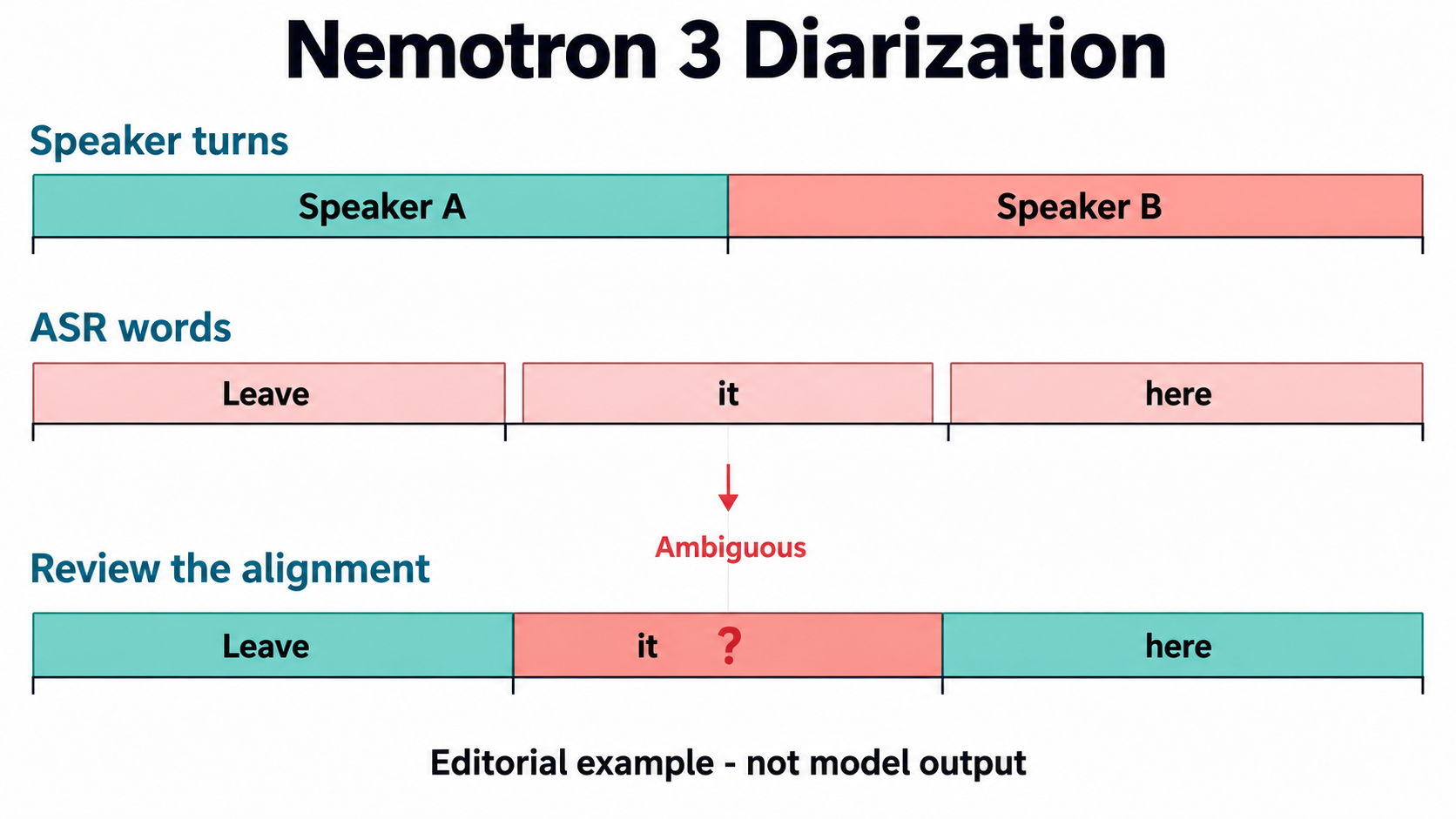
AI-generated editorial illustration, not a measured diarization timeline or product screenshot.
Sources checked October 14, 2026. NVIDIA's model card dates the release to September 23, 2026; this is a workflow guide, not a new-release claim. No audio was transcribed or diarized for this article. The downloadable example and checks use synthetic timestamps only.
What Nemotron 3 Diarization returns, and what it leaves open
The published model handles up to eight speakers and orders speaker channels by their arrival in the audio. At the model-output level, a [T,8] tensor holds activity probabilities for eight channels over time. Postprocessing can turn those values into labelled intervals. Neither representation establishes a person's name.
NVIDIA's integration article separates this task from automatic speech recognition, or ASR. Speech recognition supplies words; diarization supplies activity and timestamps. A missed word and a swapped speaker label are different errors and need different evidence.
| Evidence | A question it helps answer |
|---|---|
| Diarization intervals | Which anonymous speaker channels were active during this period? |
| ASR word timestamps | What words were recognised, and where were they placed in time? |
| Reviewed alignment | Is there enough timing evidence to attach a speaker label to this word? |
Begin with anonymous labels such as speaker_a. Do not treat the first voice in every file as the same person. A human-reviewed identity mapping, when genuinely needed and authorized, should remain separate from the model's anonymous channel assignment.
Select the exact model and audio path before recording a meeting
For the NeMo model path, the card specifies 16 kHz single-channel audio. Its input and output description is the reference for that boundary. If an application resamples or downmixes a file, keep the original recording and record the transformation. Do not silently compare timestamps from differently cropped inputs.
The native NeMo-Speech.cpp CLI documents its own file conversion and backend handling. Those conveniences belong to that runtime; they do not change the raw model's input contract. Inspect the runtime's effective configuration before relying on an automatic conversion.
Version selection also matters. The CLI documents four-speaker V2 and eight-speaker V3 paths. A generic diarization command or automatic default is not sufficient evidence that Nemotron 3 handled a file. Record the selected artifact, revision, runtime build, preset and processing mode with the resulting intervals.
A proposed CLI workflow can explicitly select a reviewed V3 artifact:
nemo-speech transcribe meeting.wav \
  --diar-model ./models/your-reviewed-v3.gguf --json
The filename is an illustrative placeholder, not a supplied checkpoint. This command was not executed here and may load additional ASR models. Check the current official installation and artifact instructions before running it; do not capture a live microphone merely to see whether the program starts.
Keep one recording and one time origin throughout the join
Use the same audio segment for ASR and diarization. A ten-second trim on one branch shifts every comparison even if each component's output is internally valid. Likewise, chunk-local timestamps need an explicit offset before they can be joined with whole-recording timestamps.
Record whether times are seconds, sample indices or frame indices. Preserve the sample rate and recording identifier. A value of 80 is not meaningful until the unit and origin are known; it could be milliseconds, a frame count or a point in a much longer recording.
NVIDIA's NeMo example describes diarized segments as start seconds, end seconds and a speaker label. The native CLI's ASR JSON uses 1-based word-speaker values. Treat these as runtime-specific representations, not interchangeable labels. Converting a number into speaker_0 by subtracting one is only appropriate after checking the format and mapping, not as an automatic normalization rule.
The companion synthetic example uses a small editorial schema with recording_id, turns and words. It is not the raw response format of either runtime. Populate such a record only after validating your actual output contract.
Review full word intervals instead of hiding boundary uncertainty
A word can cross a speaker boundary. Checking only its midpoint can choose one speaker while ignoring activity elsewhere inside the word. A second voice can also overlap part of that interval. For review-sensitive transcripts, it is useful to preserve both cases as unresolved.
The local alignment review helper applies a deliberately conservative editorial rule:
Download the offline check kit for the helper, tests and input records. The kit uses only Python standard-library checks; it does not run the reviewed model or contact a provider.
- Reject malformed, negative or non-finite times before assigning any labels.
- Require the ASR and diarization recording identifiers to match.
- Collect every speaker whose turn intersects the word's positive-duration interval.
- Keep multiple candidates as
AMBIGUOUS; do not pick the loudest voice without audio evidence. - Assign a label only when one candidate's intervals cover the whole word. Keep incomplete coverage as
PARTIAL_SPEECHand empty coverage asUNASSIGNED.
This is a review policy, not an industry accuracy threshold or a claim that every boundary-crossing word is wrong. It may leave more words unresolved than a permissive alignment rule. That is intentional: a reviewer can inspect the audio later, while a confident-looking wrong label is harder to notice.
Repeated overlapping intervals for the same speaker are merged for the coverage calculation rather than counted twice. Distinct speaker intervals are not flattened into a single continuous voice. The helper does not separate overlapping speech, inspect an audio waveform or correct recognition errors.
Run it against the supplied synthetic record with:
python3 turn_review.py alignment-example.json
The record includes a fully covered word, a word crossing two active speakers and a word outside detected speech. These are constructed cases, not a demonstration of NVIDIA's measured accuracy.
Measure transcript usability separately from input-buffer latency
The model card distinguishes input-buffer settings from complete application latency. Its lowest recommended buffer is 0.32 seconds, but that is not a promise that a final speaker-labelled transcript reaches a user in 0.32 seconds. Computation, ASR, networking and output stabilization remain separate parts of the path.
Choose a streaming or offline-style configuration for the actual use case, then evaluate it on approved representative audio. Record errors in the words, speaker assignments and turn boundaries separately. Include interruptions and uncertain outputs in that review instead of reporting only the easiest isolated utterance.
The unrun evaluation record leaves measurements and reviewer decisions null. Fill it only from a real authorized attempt. DataLLM Lab's methodology distinguishes executed evidence from an implementation plan.
Keep the usage review separate as well. The model's license information does not establish permission to process a particular recording, disclose its contents or attribute consequential statements to a named person.
FAQ
Does Nemotron 3 produce a meeting transcript by itself?
Standalone diarization produces speaker activity and time intervals. A speaker-attributed transcript combines that output with ASR words and timestamps. Evaluate the joined result, not just the two components independently.
Is speaker 0 a persistent identity across meetings?
No persistent identity is established by an arrival-order channel label. Keep mappings local to the recording and review any separate name association before using it.
Does passing the offline helper prove diarization accuracy?
No. The helper checks timestamp structure and applies a conservative join to supplied metadata. It never loads the model or listens to audio. Plausible timestamps can still describe incorrect model output.
Conclusion
Use Nemotron 3 Diarization as one component of a transcript pipeline, with a pinned runtime and shared audio time base. Preserve overlap, partial coverage and missing activity when joining words to turns. The next useful step is an authorized audio review against those unresolved intervals, not automatically replacing anonymous labels with names.