 DataLLM Lab
Claude Haiku 5.5 API Routing: Price the Task Before You Switch
Claude Haiku 5.5 API routing makes sense when an application has a narrow task, an inspectable answer and a reliable escalation path. A cheaper token does not tell you whether a classification, document extraction or support summary will cost less after retries and review. Start with one task whose mistakes you can detect.
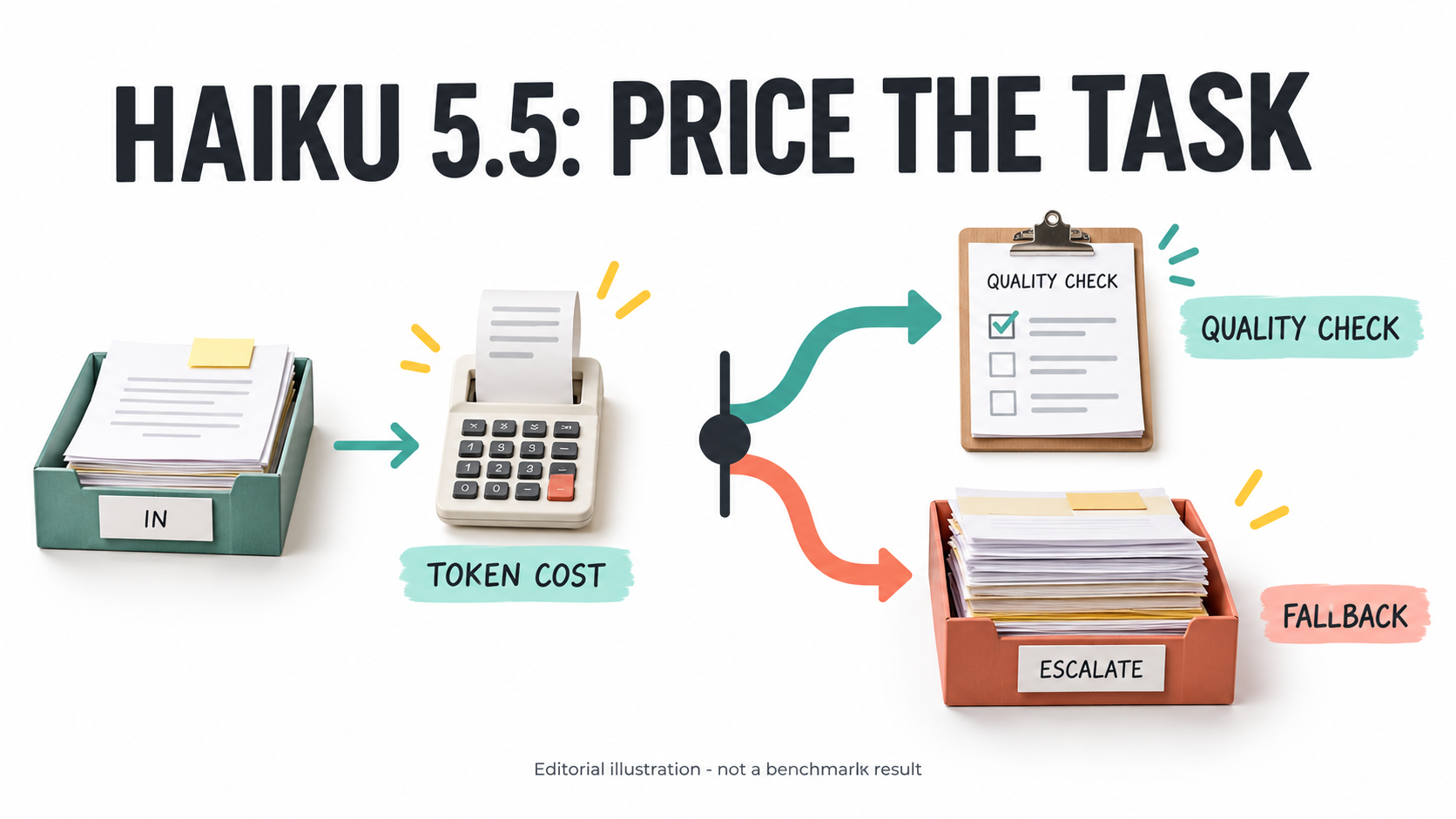
AI-generated editorial illustration, not a model output, price quote or benchmark result.
This guide uses public documentation checked on October 9, 2026. It contains proposed evaluation policies and hypothetical calculations, not model runs, measured latency or production savings.
Confirm the Claude Haiku 5.5 API routing boundary
Anthropic announced Haiku 5.5 on October 7. Its direct API identifier is claude-haiku-5-5; the announcement also names AWS, Google Cloud and Microsoft Azure availability. That is a product-level statement, not confirmation of access, capacity or pricing for your organization. Official announcement.
The model documentation lists text and image input, text output and a one-million-token context window. This guide's calculations cover text requests only. Image support does not establish image accuracy for your documents, and a large context window does not mean every prompt has the same price. Models overview.
Anthropic's approximately 75% lower operating-cost claim compares Haiku 5.5 with Haiku 4.5. Its footnote accounts for different price tiers, the previous model's prompt-length mix and changed tokenization. The announcement does not provide a request-level dataset that would let this guide reproduce that average for an application. Treat it as an attributed vendor estimate, not a universal discount or a measured DataLLM Lab result. Claim and footnote.
Read Haiku 5.5 pricing separately from subscriptions and credits
These are standard Claude Platform rates in USD per million tokens, checked for this guide. They are not quotes for cloud marketplaces or another gateway. Official pricing.
| Model and prompt tier | Uncached input | Output |
|---|---|---|
| Haiku 4.5, comparison baseline | $1.00 | $5.00 |
| Haiku 5.5, up to 100,000 input tokens | $0.10 | $0.50 |
| Haiku 5.5, over 100,000 input tokens | $0.50 | $2.50 |
| Sonnet 5.5, hypothetical fallback | $2.00 | $10.00 |
The Haiku threshold counts all input, including cache reads and writes. Crossing it changes the request's rates; it is not a surcharge only on tokens beyond 100,000. Prompt caching has separate rates and should be budgeted separately rather than treated as free input.
A Claude subscription is another product. Eligible Max and Team plans now include monthly API credits, but those require linking an eligible Console organization. The credits do not apply to Bedrock, Vertex AI or Microsoft Foundry, and do not change interactive Claude usage limits. Free, Pro and Enterprise plans are not eligible for this particular benefit. Credits can offset a bill; they do not change the token rate. API-credit rules.
Calculate the cost of a defined task
Use the new model's token counts. Anthropic's Haiku overview describes approximately 30% more tokens for the same text than Haiku 4.5, with content-dependent variation. Do not multiply an old production bill by the new price ratio. Haiku overview.
The following is a hypothetical planning table, not a benchmark. It assumes 30% growth in both input and output counts for the new model; that output assumption is illustrative, not a prediction of response length. Output counts represent all billable output, not just the displayed answer. Every row represents 1,000 identical-sized requests, with no cache, batch discount, retries, tools, taxes or credits.
Request cost = (input tokens x input rate + output tokens x output rate) / 1,000,000
| Proposed workload | Model | Input / output per request | Applicable tier | Cost per 1,000 requests |
|---|---|---|---|---|
| Short extraction baseline | Haiku 4.5 | 2,000 / 300 | Standard | $3.50 |
| Same-text planning assumption | Haiku 5.5 | 2,600 / 390 | Up to 100k | $0.455 |
| Long prompt baseline | Haiku 4.5 | 90,000 / 2,000 | Standard | $100.00 |
| Same-text planning assumption | Haiku 5.5 | 117,000 / 2,600 | Over 100k | $65.00 |
The short example saves 87% on these assumed token charges. The long example saves 35%, because the new count crosses the pricing threshold. Neither percentage predicts actual operating costs. Count each candidate request, select its tier, then include the full workflow.
Put fallback routing into the break-even calculation
An inexpensive first pass can become expensive if too many answers need another model. Assume the short example's Haiku pass costs $0.455 per 1,000 tasks. A full Sonnet 5.5 retry using the same hypothetical 2,600 input and 390 output tokens costs $9.10 per 1,000 escalations.
If q is the fraction escalated, the proposed route costs $0.455 + q x $9.10 per 1,000 original tasks. Compare that with the hypothetical $3.50 Haiku 4.5 baseline:
| Assumed escalation fraction | Routed token cost / 1,000 tasks | Below $3.50 baseline? |
|---|---|---|
| 0% | $0.455 | Yes |
| 20% | $2.275 | Yes |
| 35% | $3.640 | No |
The token-only break-even fraction is (3.50 - 0.455) / 9.10, approximately 33.5%. It assumes one fallback at most, unchanged fallback token counts and acceptable baseline quality. Added conversation history, human review and tool charges lower the margin. Passing a cost threshold alone cannot establish equivalent correctness.
Define acceptance before evaluating the cheaper route
For a proposed support-ticket classifier, allow only billing, technical, account and needs_review. Build a human-labeled collection containing ambiguous requests, missing details and instructions embedded inside tickets. Keep customer identifiers and secrets out of the evaluation material.
Write the gates before collecting outputs:
- Reject malformed responses or labels outside the fixed set.
- Route mixed or insufficient evidence to
needs_review; do not let a label authorize refunds or account changes. - Grade against held-out labels, not the model's confidence statement.
- Record each attempt, refusal, escalation and final reviewer decision.
- Compare cost per accepted task, while retaining unresolved tasks in the report.
This is an evaluation proposal, not evidence that Haiku passes these checks. DataLLM Lab's historical Haiku 4.5 review covers a different model and bounded coding workload. Its scores, token counts and timings cannot be transferred to Haiku 5.5.
Review migration assumptions before changing the model ID
The Haiku 4.5 migration guide requires more than an identifier swap. It calls for adaptive thinking instead of a fixed thinking budget, omitting sampling parameters, replacing assistant prefills and reading response blocks by type. It also flags refusal handling and model-specific platform differences. Migration checklist.
For the proposed classifier, freeze the prompt, output contract and effort setting for a comparison. Check truncated responses separately from wrong labels. Record model, route, settings, token usage, retry count and grader version together. Roll back when the acceptance policy fails, even if the token bill is lower.
Conclusion
Claude Haiku 5.5 API routing is a candidate for bounded work, not permission to replace every model in an application. Verify the actual route, recount tokens and price escalation before a controlled evaluation. Adopt it only where task quality and total workflow cost both meet a policy established in advance.
FAQ
Does Haiku 5.5 guarantee 75% savings?
No. That is Anthropic's average estimate against Haiku 4.5, not a guarantee for your workload. Prompt tiers, token counts, retries and review costs can change the result.
Can Claude subscription credits pay for any API route?
No. The documented Max and Team benefit applies to the linked Claude Platform organization, not the named cloud-provider routes. Check eligibility and the actual balance before budgeting a credit offset.
Can the Haiku 4.5 benchmark settle this routing decision?
No. It measures an older model on a particular harness. A Haiku 5.5 decision needs its own authorized evaluation with the intended prompt, route, settings and acceptance tests.