 DataLLM Lab
Best LLM for SQL (Text-to-SQL) in 2026: Accuracy & Cost
Text-to-SQL — turning a plain-English question into a correct query — is a reasoning task over your schema, not a memorization task. The best LLM for it understands table relationships, writes valid dialect-specific SQL, and gets the join logic right. Claude and GPT-5 lead on the hardest queries; DeepSeek and Qwen Coder are cheap and very capable for the common ones. This guide picks by need, models the cost, and shows how to make text-to-SQL accurate.
The short answer
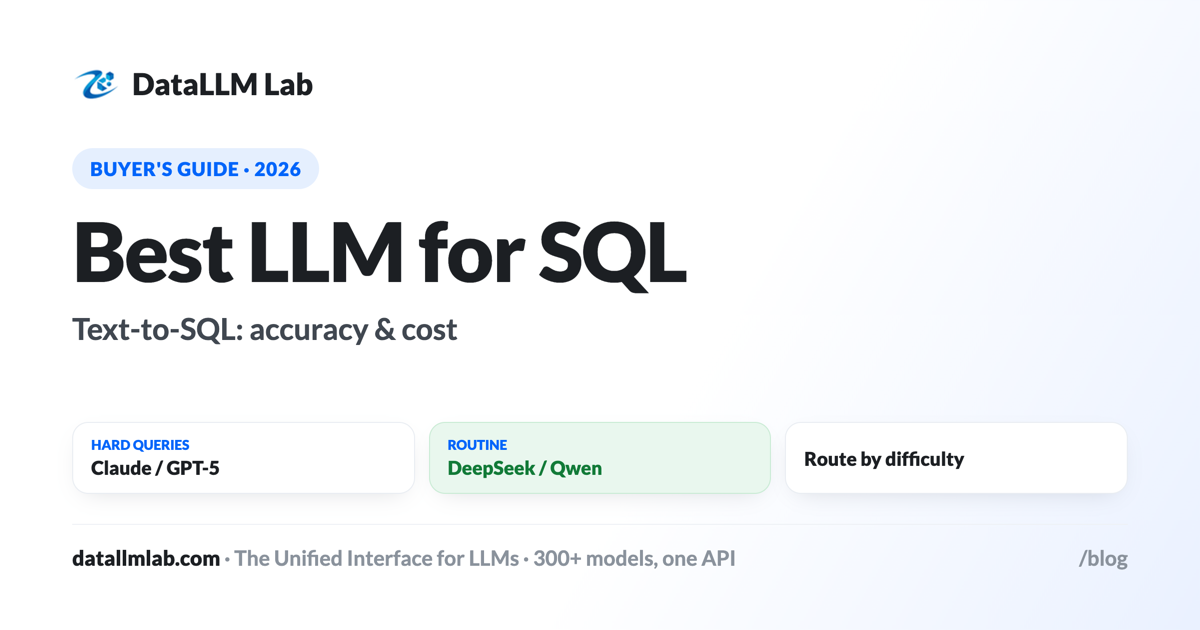
Claude and GPT-5 for the hardest queries; DeepSeek V4 and Qwen Coder for cheap, capable routine SQL. Text-to-SQL is schema reasoning — relationships, joins, dialect — so strong reasoning and coding ability win. Route routine queries to a cheap model and escalate complex ones to a frontier model.
What actually matters for SQL
- Schema reasoning — understanding tables, columns, and relationships to pick the right joins.
- Query accuracy — correct aggregation, filtering, and window logic, in your SQL dialect.
- Self-correction — fixing a query when it errors, given the error message.
- Cost — queries are short, so even frontier models are affordable per call; routing saves at volume.
What text-to-SQL costs
SQL queries are short, so the bill is low — and a cheap model handles the common ones:
| Monthly workload | DeepSeek V3.2 | Qwen3 Coder Next | GPT-5 mini | Claude Sonnet 4.6 | GPT-5.4 |
|---|---|---|---|---|---|
| Support chatbot | $13.3 | $14.0 | $34.0 | $300 | $280 |
| RAG / knowledge base | $52.8 | $38.0 | $90.0 | $900 | $800 |
| Coding / SQL agent | $26.9 | $28.8 | $70.0 | $615 | $575 |
| Batch extraction | $37.2 | $22.9 | $53.5 | $570 | $495 |
| Content generation | $18.2 | $34.2 | $85.0 | $660 | $650 |
Best model by need
Hardest queries Claude / GPT-5
- Complex joins, window functions, ambiguous intent.
Routine SQL DeepSeek / Qwen Coder
- Filters, simple joins, aggregations — cheap and accurate.
Balanced GPT-5 mini
- A capable mid-cheap default for mixed query difficulty.
Best move Route by difficulty
- Cheap model default, escalate hard queries to a frontier model.
Making it accurate
- Provide the schema — tables, columns, types, relationships in the prompt.
- Specify the dialect — Postgres, MySQL, etc., so syntax is correct.
- Few-shot examples — a couple of question→SQL pairs anchor the style.
- Self-correct — on an error, feed it back and let the model fix the query.
Running queries safely
The LLM generates SQL; your app runs it — and should do so carefully. Execute against a read-only connection, validate or dry-run the query before running, and never give the model direct write access. Generate → validate → execute is the safe loop; many text-to-SQL tools wire it up for you, with the model proposing and your system guarding.
Route SQL by difficulty from one key
DeepSeek, Qwen Coder, Claude, GPT-5 and 300+ more — one OpenAI-compatible key, cheap model for routine queries, escalate the hard ones.
FAQ
What is the best LLM for text-to-SQL?
Claude and GPT-5 for the hardest queries; DeepSeek V4 and Qwen Coder for cheap, capable routine SQL. Route by query difficulty.
What makes an LLM good at SQL?
Schema reasoning (relationships, joins), dialect knowledge, and correct aggregation/window logic. Strong reasoning and coding ability translate to better SQL.
How do I make text-to-SQL accurate?
Provide the schema and dialect, few-shot example pairs, validate before running, and add a self-correction step that fixes queries on error.
Is a cheap LLM good enough for SQL?
For common queries, yes — DeepSeek V4, Qwen Coder handle them well cheaply. Hard queries benefit from a frontier model; route by difficulty.
Coding model or general model for SQL?
Either — SQL benefits from both. Frontier general models excel on hard/ambiguous queries; cheap coders are great value on routine SQL. Test both.
What does text-to-SQL cost?
Cheap — queries are short. ~$27/mo on DeepSeek vs $575+ on a flagship for an agent-style load; routing the routine majority to a cheap model saves most.
Can an LLM connect to my database?
The LLM writes the SQL; your app runs it (read-only, validated). Don't give the model write access — generate, validate, execute.
Which is best for complex joins?
A frontier model — Claude or GPT-5 — handles multi-table joins and window functions most reliably. Reserve them for the hard queries.