 DataLLM Lab
DeepSeek V4-Flash-Vision: The Text Parity Claim Holds, at 3.9x the Price
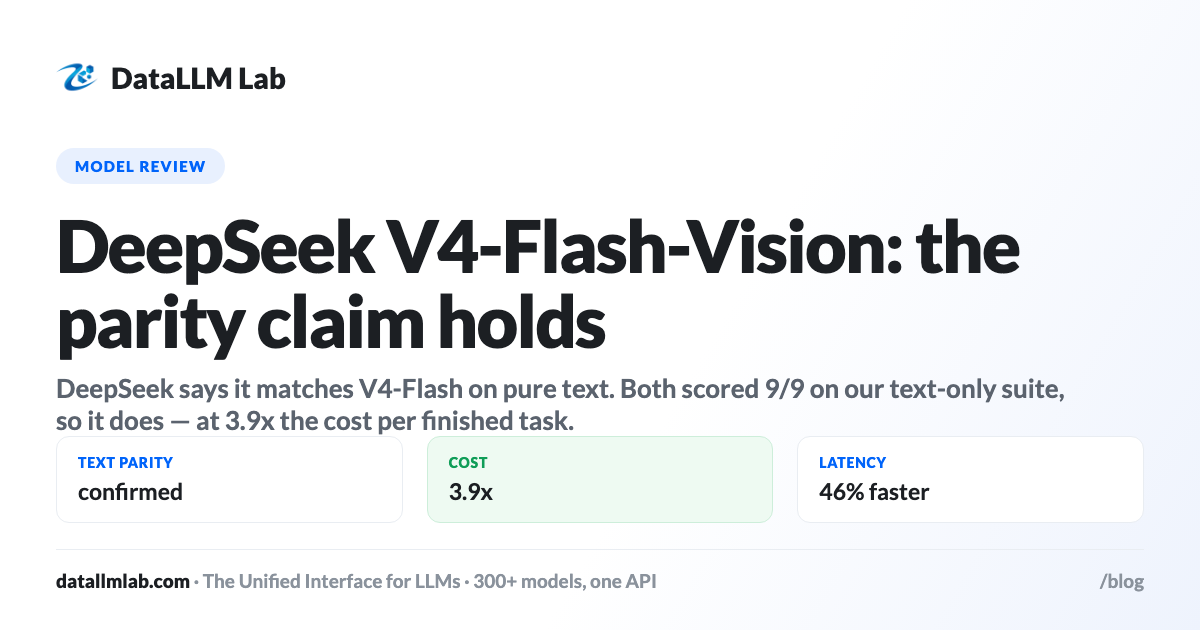
DeepSeek's claim for V4-Flash-Vision-Exp is specific enough to test: it matches the pure-text capabilities of DeepSeek-V4-Flash while adding visual understanding. We have run both models on the same nine executed Python tasks, which are pure text. Both scored 9 out of 9, so the parity claim holds. The part the announcement does not mention is the bill: on that identical text workload, Vision-Exp cost $0.51 per 1,000 tasks against V4-Flash's $0.13 — 3.9x, because it lists at $0.22 and $0.66 against $0.09 and $0.18. It was also 46% faster. If you were planning to consolidate onto one model because the vision variant matches on text, that is the number to see first.
Correction, October 3, 2026: single-model benchmark latency is a mean, not a median. Labels were corrected; measured values and the original run dates are unchanged. Measurement details.
Most vendor claims are too vague to check. This one names a baseline and a dimension, which makes it testable, so we tested it.
The claim, and how we tested it
DeepSeek's position on V4-Flash-Vision-Exp, as published: it is built on the V4-Flash architecture with visual modules added and continued training, it matches the pure-text capabilities of DeepSeek-V4-Flash, and it makes significant gains on visual-understanding agent performance, which DeepSeek describes as approaching the level of Opus 4.8.
Our benchmark is entirely text — nine Python function specs, no images — which makes it a clean instrument for exactly the first half of that claim and useless for the second. So this page checks the text-parity claim and says nothing about vision.
Both models, same nine tasks
| V4-Flash | V4-Flash-Vision-Exp | Difference | |
|---|---|---|---|
| Score | 9/9 | 9/9 | none — claim holds |
| List price in / out | $0.09 / $0.18 | $0.22 / $0.66 | 2.4x / 3.7x |
| Measured cost / 1k tasks | $0.13 | $0.51 | 3.9x |
| Mean latency | 14.5s | 7.8s | −46% |
| Reasoning tokens per call | 568 | 610 | +7% |
| Context window | 1,048,576 | 1,048,576 | none |
The parity claim is correct and worth crediting: adding a vision stack to a model often costs it something on text, and here it did not. Nine tasks is a narrow test, but it is the same narrow test both models took.
Parity on score is not parity on cost
The cost gap is almost entirely list price: Vision-Exp bills output at $0.66 per million against $0.18, and the two models emitted similar token volumes — 610 reasoning tokens against 568, a 7% difference. This is the straightforward case where price per token does the work, unlike GPT-5.1-Codex-Max, which lists below its sibling and still costs 3.09x more on volume alone.
The latency result is the genuinely surprising one. Vision-Exp finished in 7.8 seconds against 14.5 while emitting slightly more reasoning. We have no explanation for that from the model card, and it may simply reflect different serving capacity on the two endpoints rather than anything about the weights — a distinction we learned to take seriously after measuring one model under two names and getting completely different token profiles.
What the model is
- The first experimental multimodal model in the DeepSeek-V4 family, built on the V4-Flash architecture with visual modules added and continued training.
- 284B total parameters, 13B activated per token, mixture-of-experts.
- A 1,048,576-token context window, matching V4-Flash.
- Live on the DeepSeek API platform from 2026-08-21, reachable through both OpenAI ChatCompletions and Anthropic-shaped interfaces.
- Weights open-sourced on Hugging Face and ModelScope roughly ten days after the API launch, at
deepseek-ai/DeepSeek-V4-Flash-Vision-Exp. - DeepSeek's vision claim is that agent performance on visual understanding approaches Opus 4.8. We cannot test that; for cost context only, Claude Opus 4.8 measured $4.05 per 1,000 tasks on our text suite against Vision-Exp's $0.51.
Open weights changed who can serve it
A concrete, slightly unusual data point on what open-sourcing does. Nine days ago we could not run this model at all. Our benchmark returned No endpoints available matching your guardrail restrictions and data policy — the only endpoint serving it was DeepSeek's own first-party one, and a single excluded provider leaves zero routes.
After the weights were published, other providers began serving it, and the same account and the same harness now reach it without any configuration change on our side. Open weights did not make the model cheaper here; they made it reachable. That is a practical argument for open weights that rarely gets made, and it sits alongside the licensing one in open weights versus open source.
Which to run
- Text-only workloads: V4-Flash. Same 9/9, a quarter of the cost. There is no text reason to pay for the vision stack.
- Mixed text and image: Vision-Exp, and the parity result above means you are not giving up text quality to get vision in one model.
- Cheapest that clears the suite: neither. Ling 3.0 Flash VL scored 9/9 at $0.07 and DeepSeek V3.2 at $0.08, both with a fraction of the reasoning spend.
- If latency matters, the 7.8-second figure is real but measured once on one endpoint, so verify it on your own traffic before designing around it.
Our V4-Flash review covers the base model, DeepSeek API pricing tracks the family's rates, and the cheap coding roundup has the wider low end.
How these numbers were produced
Nine Python tasks, each a function signature plus a spec and no example tests. Generated code executes against hidden asserts in an isolated python3 -I subprocess with a 12-second timeout. Temperature 0, max_tokens 4000, one scored attempt per task. Cost is derived from measured token counts at the list price captured 2026-08-31, not a billing statement, and prices move. Runs go through OpenRouter. Full method on the methodology page.
What we did not measure, starting with vision
- Vision. At all. Our suite is text-only, so the entire reason this model exists is untested here. The parity claim we checked is the text half of DeepSeek's statement; the visual half is unverified by us.
- The Opus 4.8 comparison, which is DeepSeek's claim about visual agent performance. We have measured Opus 4.8 on text only.
- Whether the latency advantage is durable. One run, one endpoint, one day.
- Self-hosting, now that weights are public.
- Repeat runs. One scored attempt per task. Single-run figures, not averages.
FAQ
Does DeepSeek V4-Flash-Vision match V4-Flash on text? On our nine executed Python tasks, yes — both scored 9 out of 9.
How much does V4-Flash-Vision-Exp cost? $0.22 per million input tokens and $0.66 output as of 2026-08-31. On our suite that came to $0.51 per 1,000 tasks, against $0.13 for V4-Flash.
How big is it? 284B total parameters with 13B activated per token, on a 1,048,576-token context window.
Are the weights open? Yes, on Hugging Face and ModelScope, published about ten days after the API launch.
Should I use it for text-only work? No. V4-Flash scores the same and costs a quarter as much.