 DataLLM Lab
DeepSeek V4 vs GPT-5.5 vs Claude Opus 4.8
Three frontier models, three very different philosophies: Claude Opus 4.8 (the quality leader), GPT-5.5 (the agentic specialist), and DeepSeek V4 (the open-weights value king at a fraction of the price). Most comparison articles still pit you against the older Opus 4.7 and quote conflicting prices. This one uses the independent benchmark board, reconciled official pricing, and answers the question those posts skip: which can you actually call today?
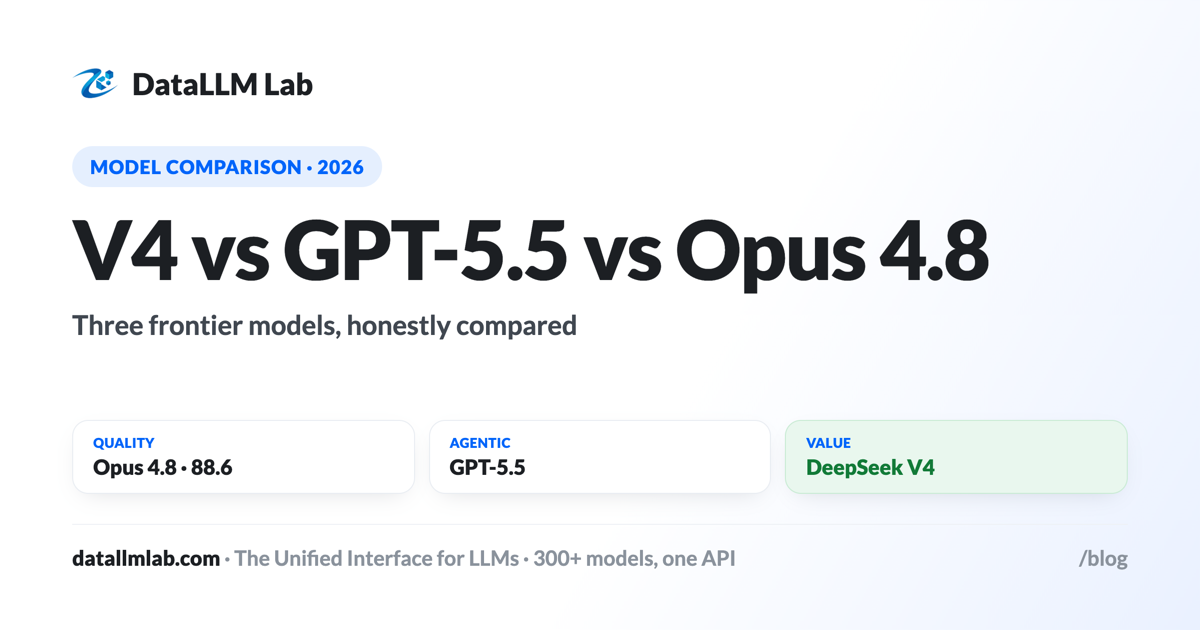
The verdict & master table
If you want the single best coder, it's Claude Opus 4.8. If you build terminal/agent workflows, GPT-5.5 edges ahead. If cost-per-task matters at all, DeepSeek V4 wins by a landslide — at a fraction of the price, within a few points on real-world coding, and with open weights you can self-host. Here's the whole picture in one table.
| DeepSeek V4-Pro | GPT-5.5 | Claude Opus 4.8 | |
|---|---|---|---|
| SWE-bench Verified | 80.6% (vendor) | 82.6% | 88.6% |
| Terminal-Bench (agentic) | — | ~82.7% | strong |
| Price (in / out) | $0.435 / $0.87 | $5 / $30 | $5 / $25 |
| Context | 1M | ~1M (eff. ~922K) | 1M |
| Open weights | Yes (MIT) | No | No |
| On DataLLM Lab | No (V3.2) | No (5.4) | No (4.7) |
What you can call today
Coding: who actually fixes bugs
On SWE-bench Verified — patching real GitHub issues, the benchmark that best predicts agentic coding — the independent order is clear: Opus 4.8 (88.6%) > GPT-5.5 (82.6%) > DeepSeek V4 (80.6%, vendor-reported). Opus is the bug-fixer.
But flip to competitive / algorithmic coding (LiveCodeBench, Codeforces) and DeepSeek V4 is at or near the top of any model — it's a phenomenal problem-solver. The distinction matters: if your work is "fix this failing test in a big repo," lean Opus; if it's "implement this tricky algorithm," DeepSeek holds its own at a tenth of the cost. For the full ranking, see our best coding LLM guide.
Agentic & terminal
GPT-5.5 is the agentic specialist — it leads Terminal-Bench (~82.7%), meaning more reliable multi-step command execution and tool use. Claude Opus 4.8 leads a different agentic axis: browser and computer use, at 84% on Online-Mind2Web. DeepSeek V4 doesn't top these boards but handles most agentic coding capably for a fraction of the price — the right call when you're running many agents and cost compounds. See best LLM for AI agents for the deeper agentic breakdown.
Long context: claimed vs real
All three advertise a 1M-token context. One honest caveat: independent testing (Artificial Analysis) suggests GPT-5.5's effective window is closer to ~922K, with retrieval quality degrading near the top. "1M context" is a ceiling, not a guarantee of perfect recall at 1M — verify retrieval at the length you actually use, on any of these models.
Pricing & cost per task
This is where DeepSeek rewrites the math. Same 200K-token job (180K in, 20K out) across all three:
| Model | Cost for the job | vs DeepSeek V4-Pro |
|---|---|---|
| DeepSeek V4-Pro | ~$0.10 | 1× |
| Claude Opus 4.8 | ~$1.40 | ~14× |
| GPT-5.5 | ~$1.39 | ~14× |
So the closed frontier costs roughly 14× more per task for a single-digit edge on real-world coding. That doesn't make Opus or GPT-5.5 wrong — for high-stakes work where a few points of accuracy save expensive mistakes, they earn it. But for the broad middle of tasks, DeepSeek V4's value is hard to argue with. (Cheaper still: route to the cheapest competent model first, escalate only on failure.)
Open vs closed
Only DeepSeek V4 is open-weights (MIT) — you can download, self-host, fine-tune, and keep data fully in-house. GPT-5.5 and Opus 4.8 are closed, API-only. For privacy-sensitive or air-gapped deployments, that alone can decide it. The trade-off: self-hosting a 1.6T-parameter model is non-trivial; most teams will still call V4 via a hosted API.
Which to pick
Opus 4.8 Best quality
- Top real-world coding and planning. Pick it when correctness on hard tasks beats cost, and you're fine on a closed API.
GPT-5.5 Best agentic
- Terminal and tool-use workflows, long-horizon autonomy. Pick it for agent execution reliability.
DeepSeek V4 Best value / open
- ~14× cheaper per task, open weights, top algorithmic coding. Pick it for scale, budgets, or self-hosting.
Smart move Don't pick one
- Route by difficulty: DeepSeek for the bulk, escalate to Opus/GPT on the hard cases — through one gateway key.
Route across all three vendors with one key
Claude Opus 4.7, GPT-5.4, DeepSeek V3.2 and 300+ more today — one OpenAI-compatible endpoint with live price comparison, so escalation is a config change, not a rewrite.
FAQ
Is DeepSeek V4 better than Claude Opus 4.8 for coding?
For real-world bug-fixing, Opus 4.8 leads (88.6% vs V4's reported 80.6% on SWE-bench Verified). For competitive/algorithmic coding, DeepSeek V4 is at or near the top. Price usually decides it — V4 is roughly a tenth the cost per token.
How much cheaper is DeepSeek V4 than GPT-5.5?
V4-Pro is $0.435/$0.87 vs GPT-5.5's $5/$30 — about 7× cheaper, and around 30× cheaper if you use V4-Flash ($0.14/$0.28).
Which is best for AI agents and terminal tasks?
GPT-5.5 leads terminal agents (Terminal-Bench ~82.7%). Opus 4.8 leads browser/computer-use (84% Online-Mind2Web) and planning. DeepSeek V4 is the budget choice for most agentic coding.
Does GPT-5.5 really have a 1M-token context?
It advertises ~1M, but independent testing suggests an effective window closer to ~922K with retrieval degrading near the top. All three offer 1M ceilings — test retrieval at your real length.
Is DeepSeek V4 open source?
Yes — Pro and Flash are open weights under MIT, so you can self-host and fine-tune commercially. GPT-5.5 and Opus 4.8 are closed, API-only.
Can I use these three through a gateway today?
Not directly yet on every gateway. DataLLM Lab carries the prior generation — Opus 4.7, GPT-5.4, DeepSeek V3.2 — callable now through one key while the newest models roll out.