 DataLLM Lab
GLM-5.3 Prime Review: The Premium Tier Scored Worst in Its Family (7 of 9)
GLM-5.3 Prime scored 7 out of 9 on our executed Python benchmark at $11.52 per 1,000 tasks (priced 2026-10-02). It is the premium tier of the GLM-5.3 family, and it is both the most expensive and the worst-scoring GLM we have measured as of 2026-10-02. The plain GLM-5.3 scored 9 out of 9 at $3.35 (priced 2026-08-22). GLM-5.3-FlashX scored 9 out of 9 at $1.36 (priced 2026-10-02). Prime is sold as the high-speed variant, yet its mean latency was 14.2 seconds — exactly the same as plain GLM-5.3. The extra speed went into extra thinking: 1,215 reasoning tokens per call against 631. You pay twice the per-token price for nearly twice the reasoning, and on our suite you got two wrong answers back.
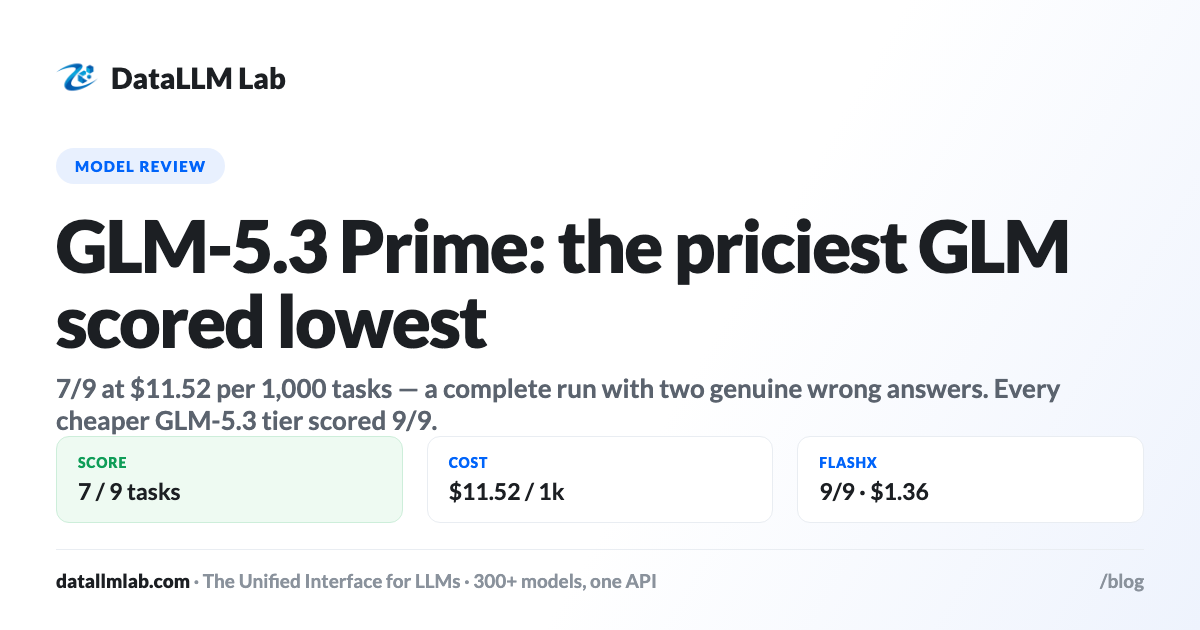
A premium tier usually promises one of two things: a better answer or a faster one. On our nine tasks GLM-5.3 Prime delivered neither, and charged the most of any GLM we have run for the privilege.
The result
| Metric | GLM-5.3 Prime |
|---|---|
| Score | 7/9 — a complete run, two wrong answers |
| Missed | token_bucket, parse_csv_line |
| Measured cost / 1,000 tasks | $11.52 (priced 2026-10-02) |
| Mean latency | 14.2s |
| Reasoning tokens per call | 1,215 |
| Tokens across the suite | 655 in / 11,575 out |
| Priced at | $2.8 in / $8.8 out per 1M (2026-10-02) |
| Context window | 1,000,000 |
| Measured | 2026-10-02 |
The important word in the first row is complete. Every one of the nine tasks came back with a response body and was scored. Neither miss was an API-layer failure or a truncated reply, so this is a real 7 out of 9, not an incomplete run we would exclude. Because it did not score 9 out of 9 it has no place in our cost or speed ranks, which only order models that solved the whole suite.
For contrast, from the same 2026-10-02 sweep: Cohere's Command A Plus returned an empty body on parse_csv_line with finish_reason=length. That is an API-layer outcome, not a wrong answer, so that model is marked excluded and carries no valid score at all. Prime is the opposite case: it answered, and the answer was wrong.
Against the rest of the GLM-5.3 family
We have now measured four GLM-5.3 endpoints on the identical nine prompts. Prime is the outlier on every column that matters:
| Model | Score | Measured cost / 1k | Priced at (per 1M) | Mean latency | Reasoning tokens / call | Output tokens, suite |
|---|---|---|---|---|---|---|
| GLM-5.3 Prime | 7/9 | $11.52 | $2.8 / $8.8 (2026-10-02) | 14.2s | 1,215 | 11,575 |
| GLM-5.3 | 9/9 | $3.35 | $1.4 / $4.4 (2026-08-22) | 14.2s | 631 | 6,640 |
| GLM-5.3-FlashX | 9/9 | $1.36 | $0.37 / $1.25 (2026-10-02) | 12.9s | 963 | 9,623 |
| GLM-5.3-Flash | 9/9 | $0.34 | $0.075 / $0.25 (2026-08-31) | 24.9s | 1,212 | 11,884 |
Three things stand out. Prime costs 3.4x plain GLM-5.3 ($11.52 ÷ $3.35), 8.5x FlashX ($11.52 ÷ $1.36) and 34x Flash ($11.52 ÷ $0.34). Every other GLM we have measured, across every generation we have run, scored 9 out of 9; Prime is the first to drop below it. And FlashX, the cheaper speed-oriented sibling, posted a lower mean latency than the tier actually marketed on speed.
One pricing note, because prices move: GLM-5.3-Flash was costed at $0.075 / $0.25 on 2026-08-31, and its list price has since moved. The $0.34 figure belongs to that date, not to today's rate card.
Where the speed went
Third-party context first. OpenRouter's model page for z-ai/glm-5.3-prime (read 2026-10-02) describes it as the high-speed variant of GLM-5.3, inheriting the base model's capabilities while raising output throughput through inference acceleration. The same page lists reasoning as mandatory, with low, high and max effort levels and max as the default. We did not verify the throughput claim independently, and we are not repeating its multiplier.
What we did measure: the identical 14.2-second mean as plain GLM-5.3, on runs weeks apart through the same router. If throughput really is higher, the obvious place for it to go is the token count, and that is exactly where the difference shows up. Prime spent 1,215 reasoning tokens per call against GLM-5.3's 631 — nearly double — and produced 11,575 output tokens across the suite against 6,640, which is 74% more. Generating more tokens in the same wall-clock time is consistent with faster decoding. It just did not reach you as a faster answer.
That also explains the bill. Prime's rate card is exactly twice GLM-5.3's on both sides ($2.8 ÷ $1.4, and $8.8 ÷ $4.4). Twice the price per token on 74% more output tokens comes to about 3.5x on output alone; with the doubled-price but identical-volume input folded in, the measured ratio is 3.4x. There is no hidden-prompt mechanism here of the kind we found in GPT-6 Astra Pro: Prime's 655 input tokens across the suite are identical to every other GLM-5.3 variant. The premium is all output.
Prime's reasoning volume is, curiously, almost identical to GLM-5.3-Flash: 1,215 tokens per call against 1,212, and 11,575 output tokens against 11,884. The two endpoints think about the same amount; one charges $0.25 per million output tokens (as of 2026-08-31) and the other $8.8 (as of 2026-10-02). For scale, GLM-5.1 holds the top of our reasoning column among 9/9 models as of 2026-10-02, at 1,327 tokens per call, and it cleared the suite. More thinking did not buy Prime more correctness. We have made the broader case that reasoning tokens decide the bill; Prime is a clean example of the bill rising without the score following.
The two misses
token_bucket asks for a rate limiter with stateful refill logic. parse_csv_line asks for a CSV-line parser with quoted fields and escaped quotes. Both came back as complete answers that failed our hidden asserts.
parse_csv_line is a familiar stumble. Among the scored entries from 2026-10-02, three others missed it: Codestral 2508, Qwen3 Coder Plus and Qwen3 Coder Flash, each at 8 out of 9. token_bucket is rarer — none of the other scored 2026-10-02 entries on our sheet missed it. Prime is the only model in that sweep to miss both.
Be careful how much weight that carries. Each task gets one scored attempt at temperature 0. Two misses on one run is a measured fact; whether Prime would miss them again on a re-run is something we have not tested. What we can say without hedging is that the cheaper siblings, on their own single runs, did not miss them.
Should you pay for Prime?
Not on the evidence we have. If you want GLM-5.3 behaviour, plain GLM-5.3 scored 9 out of 9 at $3.35 (priced 2026-08-22) with the same mean latency. If you want it cheaper and slightly quicker, GLM-5.3-FlashX scored 9 out of 9 at $1.36 and 12.9 seconds (priced 2026-10-02). If you can tolerate a slow 24.9-second mean, GLM-5.3-Flash did it for $0.34 (priced 2026-08-31).
And if you do not care about the GLM family specifically, the gap is larger still. Solar Mini 4 is the cheapest and fastest 9 out of 9 in our set as of 2026-10-02, at $0.03 and 2 seconds — 384x less than Prime ($11.52 ÷ $0.03) for two more correct answers. Our cheap coding roundup covers that end of the market.
Prime is not alone in being a pricey “Prime” tier this sweep: Qwen3.8 Max Prime cost $12.41 (priced 2026-10-02). The difference is that it scored 9 out of 9.
The honest limit on all of this: nine self-contained Python functions cannot separate a frontier model from a competent small one. A model that passes all nine is not proven strong, and Prime's 7 out of 9 does not prove it weak on long-horizon agentic work, which our suite does not test. What the suite does measure well is the price of getting simple, checkable code right — and on that measure Prime is the worst purchase in its own family.
How these numbers were produced
Nine Python tasks, each a function signature plus a spec and no example tests. Generated code executes against hidden asserts in an isolated python3 -I subprocess with a 12-second timeout. Temperature 0, max_tokens 4000, one scored attempt per task. An API-layer failure is recorded separately from a wrong answer, which is why Prime is scored 7 out of 9 while a model that returns an empty body is excluded. Cost is derived from measured token counts multiplied by the list price captured on the date shown beside each figure, not a billing statement. Runs go through OpenRouter, not through the DataLLM Lab gateway. Full method on the methodology page.
What we did not measure
- Repeat runs. One attempt per task. We cannot tell you whether the two misses are stable or a bad draw, and a single re-run could change the score.
- Lower reasoning efforts. OpenRouter lists low and high effort settings alongside the max default. We did not test them, and a lower setting is the most obvious way to cut Prime's bill.
- Throughput directly. We record mean end-to-end latency, not tokens per second, so we cannot confirm or refute the high-speed claim; we can only say it did not shorten our wall-clock time.
- Same-day comparison. GLM-5.3 was run on 2026-08-22 and Prime on 2026-10-02. Provider load on two different days could move a mean.
- Long context and agentic work. Our prompts are short and single-turn; the 1,000,000-token window and multi-turn behaviour are untested.
- Why the answers were wrong. We publish pass or fail against hidden asserts, not a diagnosis of each failing function.
Evidence: dated measurements and catalogue fields; method, latency statistics and limitations. Measurements describe these runs, not all providers or future versions.