 DataLLM Lab
Claude Code Weekly Limits: A 25% Rise That Is a 17% Cut
Anthropic's announcement is short and both halves are true: from 2026-09-14 standard weekly limits in Claude Code rise permanently by 25% for Pro, Max, Team and seat-based Enterprise plans, and until then the current 50% increase stays in place. Those two sentences describe a 25% increase over the old baseline and a 17% reduction against what you have this week. If your baseline was 100, you have 150 today and you will have 125. Both numbers are real; which one you feel depends on when you started. The part worth planning around is the second one, so the rest of this page is what a 17% smaller quota costs you and where the work can go instead — using measured numbers from 60 models rather than guesses.
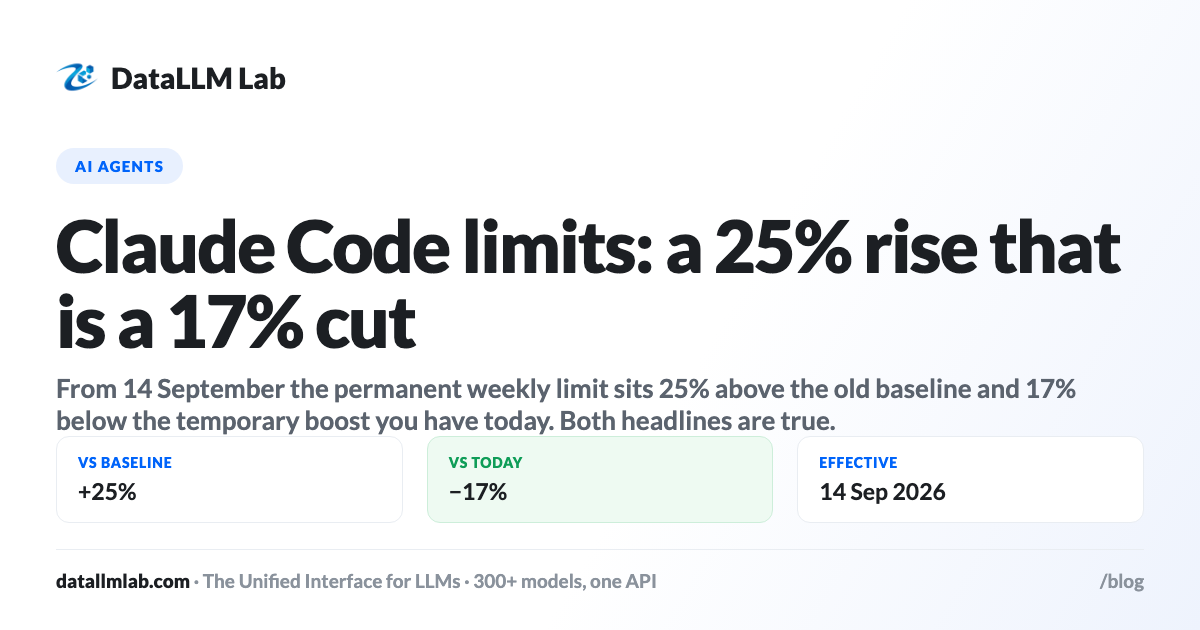
Two framings of this change are circulating and both cite the same announcement. Here is the announcement, the arithmetic, and then the part nobody covering it can do: what the alternatives actually score and cost.
What actually changes on 2026-09-14
From Anthropic's developer account, verbatim: starting September 14, standard weekly limits in Claude Code are permanently raised by 25% for Pro, Max, Team and seat-based Enterprise plans, and until then the current 50% increase remains in place.
So there are three levels, not two:
| Period | Weekly limit | Relative to baseline |
|---|---|---|
| Before the promotion | 100 units | baseline |
| Now, until 2026-09-13 | 150 units | +50% (temporary) |
| From 2026-09-14, permanently | 125 units | +25% |
The units are illustrative; the ratios are the announcement.
The arithmetic, both ways
125 divided by 150 is 0.833, so the new permanent ceiling sits 16.7% below the one you are using this week. If you started before the promotion, you gain 25%. If you have only ever known the boosted limit — which is most people who started Claude Code recently — you lose a sixth of your week.
Where to offload, measured
A smaller quota is a routing problem: which work has to run on Claude, and which can run somewhere cheaper without getting worse. That question needs numbers, so here are ours. Every model below scored 9 out of 9 on our executed Python benchmark — real generated code, run against hidden asserts, temperature 0.
| Model | Score | Measured cost / 1k tasks | Latency | Reasoning tokens |
|---|---|---|---|---|
| DeepSeek V3.2 | 9/9 | $0.08 | 7.1s | 0 |
| Qwen3 Coder Next | 9/9 | $0.10 | 7s | 0 |
| DeepSeek Chat | 9/9 | $0.10 | 3.8s | 0 |
| GLM-5.3-Flash | 9/9 | $0.34 | 24.9s | 1,212 |
| GPT-5.4 mini | 9/9 | $0.53 | 2.3s | 0 |
| Claude Haiku 4.5 | 9/9 | $0.94 | 3.7s | 0 |
| Claude Sonnet 5 | 9/9 | $1.67 | 7.2s | 0 |
Claude Sonnet 5 costs 21x what DeepSeek V3.2 costs on the same nine tasks, and both got every one right. That is not an argument that they are the same model — nine self-contained Python functions is a narrow test and says nothing about long agentic sessions, which is exactly what Claude Code is for. It is an argument that a meaningful share of what runs through a coding agent is routine enough that the expensive model is not buying you anything.
Note the reasoning-token column too. In an agent that fires many calls per task, per-call reasoning multiplies by every turn — the mechanism we worked through in our agent model comparison. GLM-5.3-Flash is cheap per task but emits 1,212 reasoning tokens a call and takes 24.9 seconds, which reads very differently inside a loop than in this table.
How offloading actually works
You do not have to leave Claude Code to stop spending its quota. The practical routes, in rough order of effort:
- Point Claude Code at another model. Claude Code Router covers the mechanics, and running Claude Code with GLM, DeepSeek and Qwen is the worked example.
- Cut tokens rather than switch models. Most agent bills are context, not intelligence — cutting token costs in coding agents covers the levers that work without changing anything else.
- Split by task type. Routine edits, test scaffolding, renames and boilerplate to a cheap 9/9 model; architecture, debugging and long multi-file sessions stay on Claude.
What to keep on Claude
Our benchmark measures single-turn code generation. It does not measure the things a coding agent is actually bought for: holding a large repository in context, planning across many files, recovering from its own mistakes over a long session, and using tools well. Nothing in the table above tells you a cheap model does those as well.
So the honest split is: use the measured numbers to decide what to move, not whether to move everything. A 17% smaller weekly quota is roughly a day a week. Moving the routine sixth of your work off Claude buys that back without touching the work you bought Claude for. Our Claude Code guide covers the workflow side.
How these numbers were produced
Nine Python tasks, each a function signature plus a spec and no example tests. Generated code executes against hidden asserts in an isolated python3 -I subprocess with a 12-second timeout. Temperature 0, max_tokens 4000, one scored attempt per task. Cost is derived from measured token counts at the list price on each model's measurement date, not a billing statement, and prices move. Runs go through OpenRouter, not through a Claude Code subscription. Full method on the methodology page.
What we did not measure
- Claude Code itself. We measured models through an API. We did not run the agent, and nothing here measures the harness, its tools or its context handling.
- What a “unit” of weekly limit is. Anthropic publishes ratios, not a token figure. Our 100/150/125 is illustrative arithmetic on those ratios.
- Long agentic sessions, which is the workload the quota actually constrains.
- Plan-specific effects. The change is stated for Pro, Max, Team and seat-based Enterprise. We have not verified behaviour on any individual plan.
FAQ
Is Claude Code raising or cutting weekly limits? Both, depending on the comparison. From 2026-09-14 the permanent limit is 25% above the pre-promotion baseline and about 17% below the temporary level in place until then.
When does the change take effect? 2026-09-14. The current 50% increase runs until then.
Which plans are affected? Pro, Max, Team and seat-based Enterprise.
How much cheaper is a non-Claude model? On our nine executed tasks, DeepSeek V3.2 scored 9 out of 9 at $0.08 per 1,000 tasks against Claude Sonnet 5's $1.67 — about 21x. That gap is for single-turn code generation, not for agentic work.
Can I use another model inside Claude Code? Yes. Claude Code Router is the usual route, and our GLM walkthrough covers a working setup.