 DataLLM Lab
Grok vs Groq: They Are Completely Different
"Grok" and "Groq" sound identical and are both AI companies, which is why they get confused constantly — but they do completely different things. Grok is the family of large language models built by xAI, Elon Musk's AI lab tied to X; you buy API access to xAI's own proprietary models. Groq (with a q) is a hardware company founded in 2016 that builds the LPU inference chip and runs GroqCloud, a platform that serves other people's open models — Llama, gpt-oss — at very high speed. This guide gives you the one-line answer, a side-by-side table, and a "which did you mean?" decision so you can stop second-guessing the spelling.
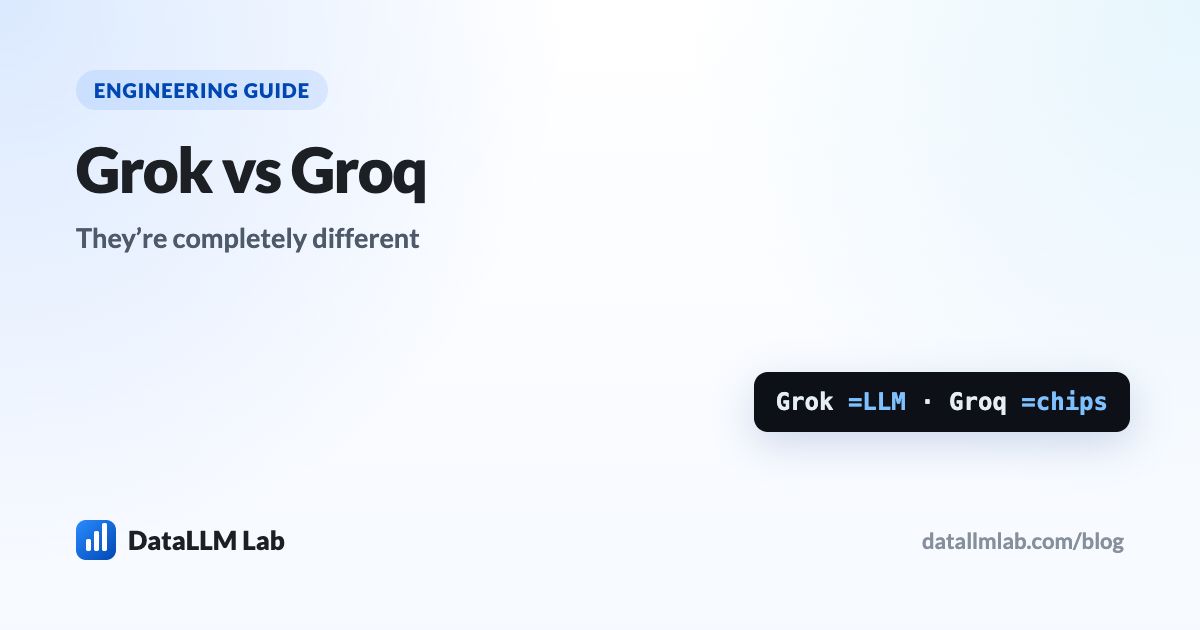
Grok vs Groq: the one-line answer
Grok is a model; Groq is the hardware that runs models — two different companies with near-identical names.
- Grok (with a k) is xAI's family of large language models, from Elon Musk's AI lab tied to X. You buy API access to xAI's own proprietary models.
- Groq (with a q) is an inference-hardware company founded in 2016. It builds the LPU chip and runs GroqCloud, which serves open third-party models (Llama, gpt-oss) very fast.
So they are not competitors in the usual sense: one makes a model, the other sells fast inference of open models it did not make. If you only remember one thing: proprietary model = Grok; fast hardware for open models = Groq.
Grok vs Groq, side by side
The fastest way to separate them is to line up what each one actually is. Everything below is from xAI's and Groq's own documentation (verified July 2026):
| Grok | Groq | |
|---|---|---|
| What it is | A family of proprietary LLMs | An inference-hardware company + cloud |
| Who makes it | xAI (Elon Musk / tied to X) | Groq, Inc. (founded 2016) |
| Core product | Grok models (current flagship Grok 4.3) | LPU chip + GroqCloud platform |
| What you buy | Tokens of xAI's own models | Fast, cheap inference of open models |
| Models served | xAI's closed Grok family only | Open weights: Llama 3.3 70B, gpt-oss, etc. |
| Website | x.ai / docs.x.ai | groq.com / console.groq.com |
| API base URL | https://api.x.ai/v1 | https://api.groq.com/openai/v1 |
| OpenAI-compatible? | Yes | Yes (some features unsupported) |
| Use it for | xAI's frontier model, X-flavoured chat | Very high tokens/sec on open models |
The two rows that cause all the confusion are the last few: both are AI, both expose an OpenAI-compatible API, and their names differ by a single letter. Everything above the fold is what actually distinguishes them.
What Grok is: xAI's model family
Grok is xAI's proprietary LLM family — you rent the model, and only xAI serves it. xAI describes Grok as intelligent, fast, and cost-effective models spanning code, text, voice, image, and video. As of July 2026 the current flagship is Grok 4.3, which xAI calls the most intelligent and fastest model it has built, with a 1M-token context window and both reasoning and non-reasoning modes. A note on version names people trip over:
- Grok 4 shipped in July 2025 and was the flagship at the time; it has since been superseded by Grok 4.3.
- In a May 15, 2026 retirement, several earlier Grok models were removed from the API and requests were auto-redirected to
grok-4.3. - xAI also offers Grok 4 Fast, a faster and cheaper variant available to all users including free users.
The key point for disambiguation: Grok is a model you consume, made and hosted by xAI. There is no LPU, no chip, no third-party open models here — just xAI's own frontier LLMs behind an OpenAI-compatible API.
What Groq is: LPU inference hardware
Groq is a hardware company — it sells speed, not a model. Founded in 2016, Groq positions itself around fast, low-cost inference. Its core technology is the LPU (Language Processing Unit), a custom chip Groq describes as the first purpose-built for inference, pioneered in 2016. On top of the hardware sits GroqCloud, Groq's inference platform: an API layer with free API keys, on-demand pricing, and enterprise options that runs models on Groq's LPUs.
Crucially, GroqCloud does not host a Groq-branded model — it hosts open-weight third-party models, including:
- Meta Llama 3.3 70B (
llama-3.3-70b-versatile) and Llama 3.1 8B (llama-3.1-8b-instant); - OpenAI's open models gpt-oss-120b and gpt-oss-20b.
Groq's pitch is throughput: it serves these models at high token-generation speeds (per Groq's model docs, in the range of hundreds to roughly 1,000 tokens per second). So when someone raves about "insanely fast inference" and mentions Llama, they almost certainly mean Groq — not Grok. If you want to run open weights yourself, our open-source LLM guide covers the model side of that story.
Why Grok and Groq get confused
Three overlaps stack up: near-identical names, both are AI, and both speak the OpenAI API. None of them mean the products are actually similar:
| Overlap | Why it confuses | The reality |
|---|---|---|
| The name | "Grok" and "Groq" are homophones, one letter apart | Unrelated companies; the spelling is the only tell |
| Both are AI | Both show up in LLM articles and demos | One is a model maker, one is a chip maker |
| OpenAI-compatible | Both are "drop-in" via base_url + key | xAI serves its own models; Groq serves others' |
The tidy way to hold it in your head: xAI sells its own model; Groq sells fast hardware-backed inference of other people's open models. Same syllable, opposite layer of the stack.
Which did you mean, Grok or Groq?
Match what you were reading about to the right company. The figure below turns the tell-tale signals into a quick decision:
Quick heuristics if you skipped the figure:
- Saw Elon Musk, X, or a version number like Grok 4? That is Grok.
- Saw "fastest inference," an LPU chip, or Llama being served cheaply? That is Groq.
How you access each one
Both are OpenAI-compatible, so in code the only differences are the base URL, the key, and which models you can call. Point the standard OpenAI client at the right host:
# Grok — xAI's own models
from openai import OpenAI
xai = OpenAI(base_url="https://api.x.ai/v1", api_key=os.environ["XAI_API_KEY"])
xai.chat.completions.create(model="grok-4.3", messages=msgs)

# Groq — open models on LPU hardware
groq = OpenAI(base_url="https://api.groq.com/openai/v1", api_key=os.environ["GROQ_API_KEY"])
groq.chat.completions.create(model="llama-3.3-70b-versatile", messages=msgs)
Per each vendor's docs: xAI works with the standard OpenAI libraries by setting base_url to https://api.x.ai/v1 with an XAI_API_KEY bearer token (xAI overview). GroqCloud migrates from OpenAI by changing base_url to https://api.groq.com/openai/v1 and supplying a Groq key, though some OpenAI features (e.g. logprobs, logit_bias) are unsupported. That shared shape is why one gateway can front both — see how the OpenAI-compatible API pattern works, and our picks for the best LLM API in 2026.
Call Grok — and open models — on one key
DataLLM Lab is an OpenAI-compatible gateway: point your client at https://www.datallmlab.com/v1 and reach xAI's Grok alongside 300+ models — no separate keys or base URLs to juggle.
FAQ
Is Grok the same as Groq?
No. Grok (with a k) is xAI's LLM family, tied to Elon Musk and X. Groq (with a q) is a separate 2016 hardware company that builds the LPU chip and runs GroqCloud, serving open models like Llama fast. Same sound, different products.
What is Grok?
xAI's family of AI models across code, text, voice, image and video. As of July 2026 the flagship is Grok 4.3, with a 1M-token context window and reasoning + non-reasoning modes, served via https://api.x.ai/v1.
What is Groq?
An inference company founded in 2016. Its LPU is a custom chip built for inference; GroqCloud (https://api.groq.com/openai/v1) serves open models like Llama 3.3 70B and gpt-oss at very high tokens/second. You buy fast inference, not a proprietary model.
Can you run Grok on Groq?
No. Grok is xAI's proprietary model and is only served by xAI. GroqCloud hosts open-weight models (Llama, gpt-oss), not xAI's closed Grok family. Want Grok? Go to xAI. Want fast Llama? Go to Groq.
Which did I mean, Grok or Groq?
Reading about a chatbot, Musk, X, or Grok 4 → Grok. Reading about very fast token generation, an LPU chip, or cheap Llama/gpt-oss inference → Groq. Rule of thumb: proprietary model = Grok; fast hardware for open models = Groq.
Do both have OpenAI-compatible APIs?
Yes — that is a big reason they get mixed up. xAI is OpenAI-compatible at https://api.x.ai/v1; GroqCloud at https://api.groq.com/openai/v1 (some features like logprobs and logit_bias unsupported). Swap the base URL and key on the standard OpenAI client.