 DataLLM Lab
Best LLM for Translation in 2026: By Language, Quality & Cost
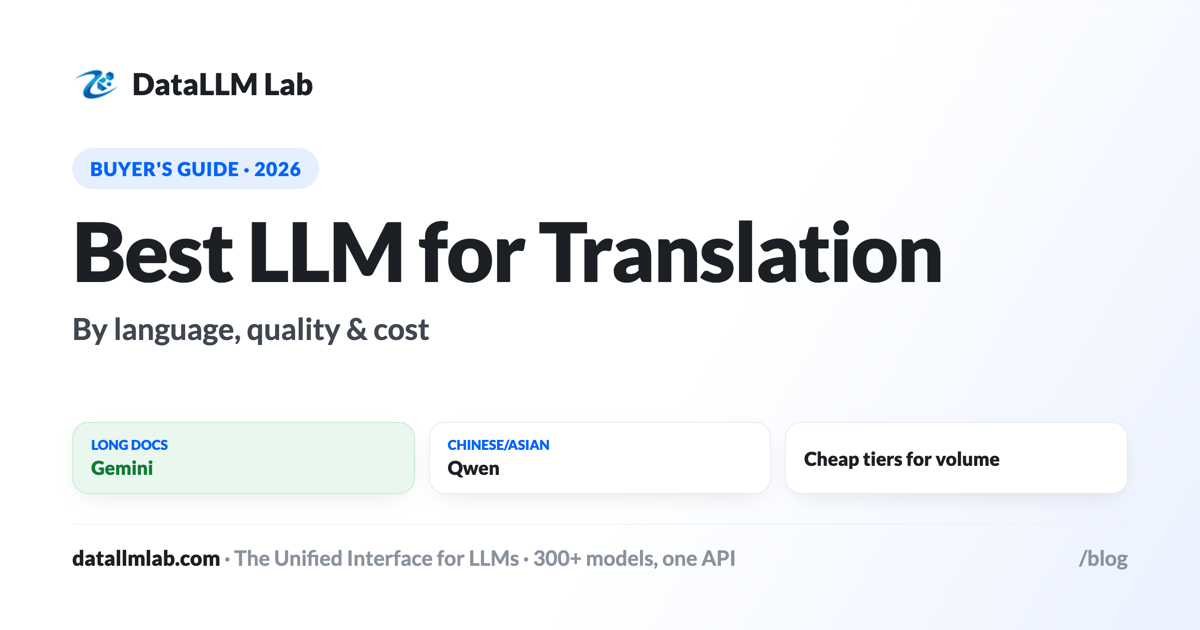
LLMs have quietly become excellent translators — fluent, context-aware, and able to preserve tone in ways classic machine translation can't. The best one depends on your languages and volume: Gemini for the broadest coverage and long-document translation, Claude and GPT-5 for top quality, the cheap tiers for high volume, and Qwen for strong Chinese and other Asian languages. This guide picks by need, models the cost, and shows where to save.
The short answer
Gemini for breadth and long documents, Claude/GPT-5 for top quality, cheap tiers for volume, Qwen for Chinese/Asian languages. LLMs translate with context and tone that classic machine translation can't match. The right pick depends on your language pairs and how much you translate — and for most content, a cheap tier is plenty.
What actually matters for translation
- Language coverage — strength on your specific pairs, not just "multilingual."
- Quality & tone — preserving register, idiom, and intent, not just literal meaning.
- Context window — for long documents, translating in one pass keeps terminology consistent.
- Cost — translation is output-heavy and often high-volume, so output price dominates.
Best model by need
Broad + long docs Gemini
- Wide coverage and the largest context for whole-document translation.
Top quality Claude / GPT-5
- Nuance and tone for high-stakes or literary content.
Chinese / Asian Qwen / DeepSeek
- Strong Asian-language training, very low cost.
High volume Cheap tiers
- GPT-5 mini / DeepSeek for bulk translation at a fraction of the cost.
What translation costs
Translation is output-heavy, so the output price drives the bill. The content-generation row below is the closest analog:
| Monthly workload | Claude Opus 4.7 | GPT-5.4 | Gemini 3.1 Pro | DeepSeek V3.2 | GPT-5 nano |
|---|---|---|---|---|---|
| Support chatbot | $500 | $280 | $224 | $13.3 | $6.80 |
| RAG / knowledge base | $1,500 | $800 | $640 | $52.8 | $18.0 |
| Coding agent | $1,025 | $575 | $460 | $26.9 | $14.0 |
| Batch extraction | $950 | $495 | $396 | $37.2 | $10.7 |
| Content generation | $1,100 | $650 | $520 | $18.2 | $17.0 |
Keeping cost low
- Cheap tier for the bulk — reserve a flagship only for high-stakes or nuanced content.
- Cache the glossary/instructions — reused terminology guidance shouldn't be re-billed each call.
- Batch large jobs — async translation runs at a discount.
- Mind the output rate — translation is output-heavy, so a low output price is the key lever.
Translate across every model from one key
Gemini, Qwen, GPT-5, DeepSeek and 300+ more — one OpenAI-compatible key, test your language pair and route the best fit.
FAQ
What is the best LLM for translation?
Depends on languages/volume — Gemini for breadth and long docs, Claude/GPT-5 for quality, cheap tiers for volume, Qwen for Chinese/Asian. Test your pair.
Are LLMs better than Google Translate?
For nuance, context, and tone, generally yes. For ultra-low-latency bulk short strings, dedicated MT can still win, but LLMs lead on quality for real content.
What is the cheapest LLM for translation?
Cheap tiers — GPT-5 mini, DeepSeek V3.2. A content (translation-like) workload is ~$85/mo on mini vs $650 on GPT-5.4.
Which is best for Chinese/Asian languages?
Qwen and DeepSeek — strong Asian-language training at low cost. Gemini and GPT-5 are also strong. For Chinese, Qwen is a frequent top pick.
Which is best for long documents?
Gemini — the largest context lets you translate a whole document in one pass, keeping terminology consistent. Claude's large context is also strong.
How do I keep cost low?
Cheap tier for bulk, flagship for high-stakes; cache glossary/instructions; batch big jobs; pick a low output rate (translation is output-heavy).
Can one LLM handle many languages?
Yes — modern models are broadly multilingual across dozens of pairs. Quality varies by pair, so test a couple for your languages.
Is DeepSeek good for translation?
Yes — cheap and capable, strong on Asian languages. A good high-volume choice; test against Qwen and Gemini for your pair.